The Bung Factory
Every barrel of Albany beer had a hole in it, and every hole needed a stopper. For about seventy years, a German woodworker named Stephen Kampf and his sons made those stoppers, and the shovels that turned Albany's malt, in the building where this website was made.
Who was S. Kampf?
The painted sign on the front says S. Kampf & Sons Bung Factory. Solid For years nobody on this project knew what the "S" stood for. The old Albany city directories answer it: Stephen Kampf, sometimes spelled Stephan, and sometimes misspelled "Kempf" by mapmakers. Solid1
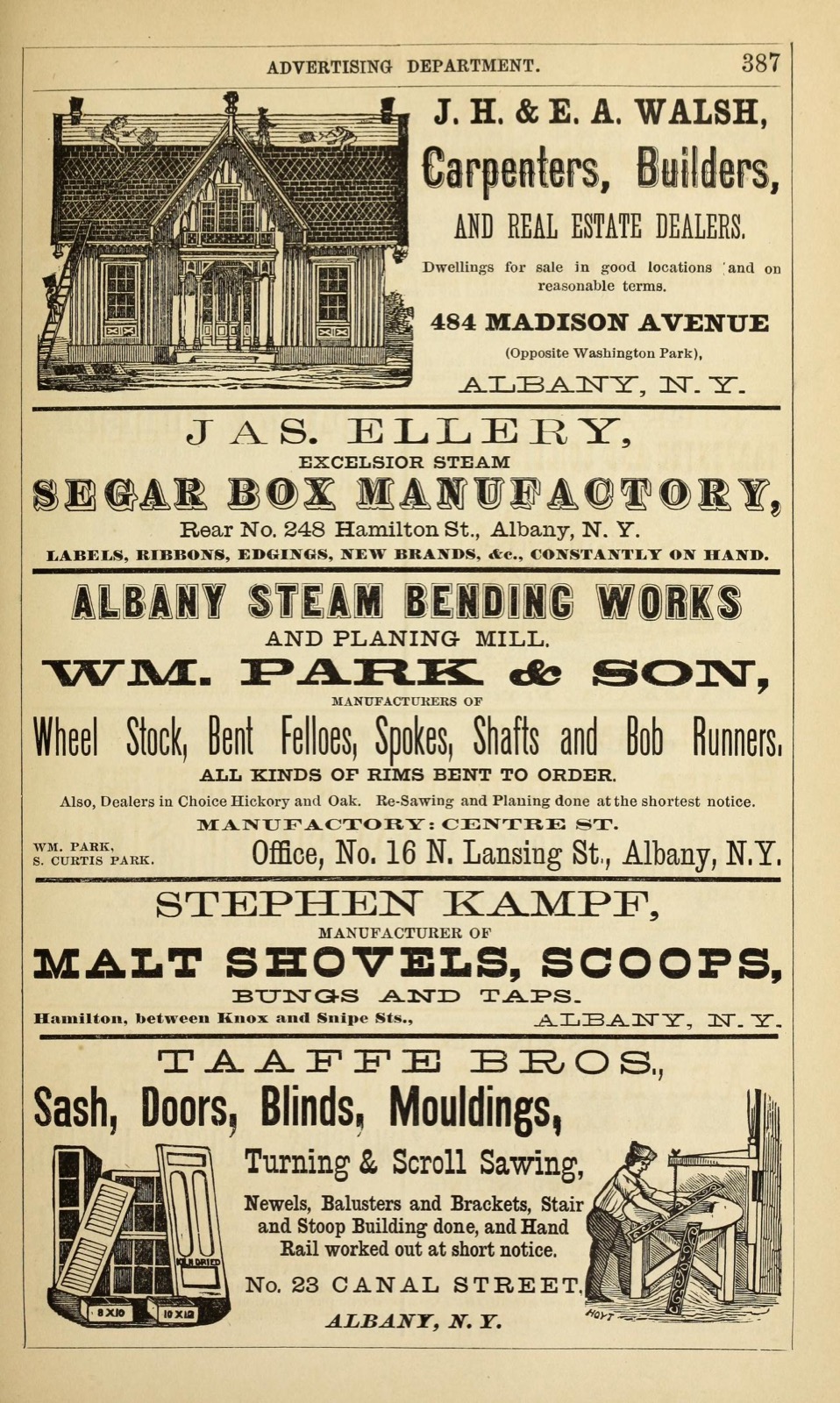
He first turns up in the 1876 directory, not on Jefferson Street but on Hamilton Street between Knox and Snipe, a few blocks north. His advertisement that year reads: "STEPHEN KAMPF, Manufacturer of MALT SHOVELS, SCOOPS, BUNGS AND TAPS." Solid2
That same year Kampf sent his work to the great Centennial Exhibition in Philadelphia. The judges' report lists award no. 1313: "Stephen Kampf, Albany, N.Y., U.S. MALT SHOVELS. Report.—Commended for good workmanship and adaptation to the purpose." Solid3
Shovels first, bungs later
A surprise in the records: Kampf started out as a malt-shovel maker. Malt shovels are the wide wooden shovels maltsters used to turn sprouting barley on the malting floor, and in the 1870s and 1880s Albany's malt houses were turning hundreds of thousands of bushels a year. Solid4 The directories call him a "shovelmaker" in 1876 and 1885 and only from 1900 a "bung and shovel manufacturer." The fire-insurance maps say "Shovels & Bungs" in 1892, "Shovel & Bung Fac'y" in 1909, and only from 1934 "Wood Bung Fact'y." Solid The name on the sign seems to belong to the later decades, after the malt-shovel trade had faded. Inference
He wasn't the first Albanian in this odd specialty. In 1854 Patrick Coyle of 80 Church Street was listed as a "bung turner & shovel maker," the very combination Kampf would build a business on. Solid5
What a bung is
A bung is the stopper that seals the bunghole in the belly of a wooden cask, through which it's filled and vented. A tap is the spigot driven into the cask head to draw the beer. Both wore out or were lost with every barrel that went out to a saloon, a canal boat or a ship. Solid In 1913 the State College of Forestry noted that in New York "spruce is used in the manufacture of bungs," and Kampf was the only bung maker it named in the state. Solid6 A 1901 brewing handbook describes the standard American brewer's bung as "made from choice poplar wood and compressed across the grain," usually a little under an inch thick and 1 15/16 inches across, "compressed at one end so as to enter the bushing easily." Solid7 An 1862 Albany ad for compressed bungs, made of oak or poplar, advised: "BREWERS, use the Poplar." Solid8 Brewers drilled the bung out when an empty cask came back, so every refill needed a new one, which meant steady business. Solid So Kampf's bungs were almost certainly wood, not cork, despite one modern blog's description. Inference
A question for Gwen
The box of bungs taken from the factory floor in the 1970s: were they wood? If they're compressed poplar, about two inches across and an inch thick, they match the trade standard exactly.
The building on the maps
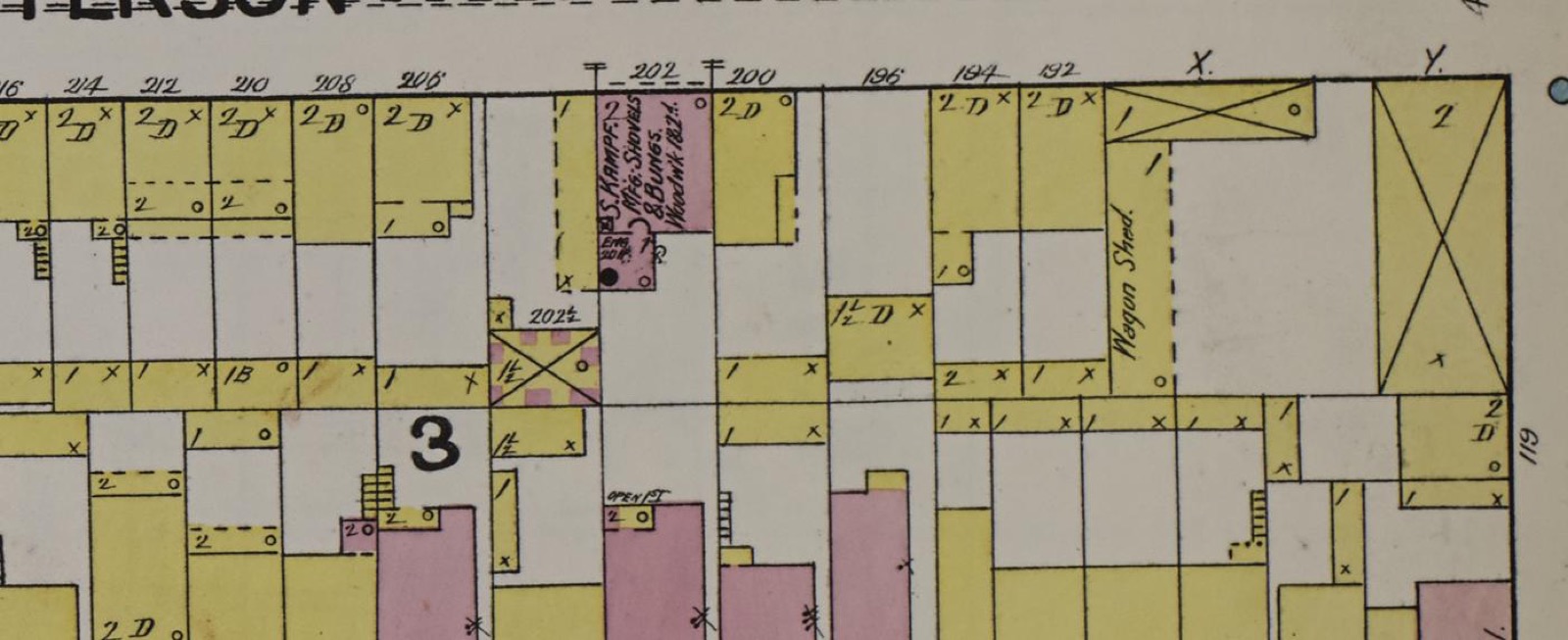
By 1885 Kampf was at 202 Jefferson Street, living at 247 (later 251) Elm. Solid9 The Sanborn fire-insurance map of 1892 shows exactly what was there: a two-story brick building labeled "S. KAMPF Mfg. Shovels & Bungs. Woodwk.," with a steam engine and a boiler stack. Solid10
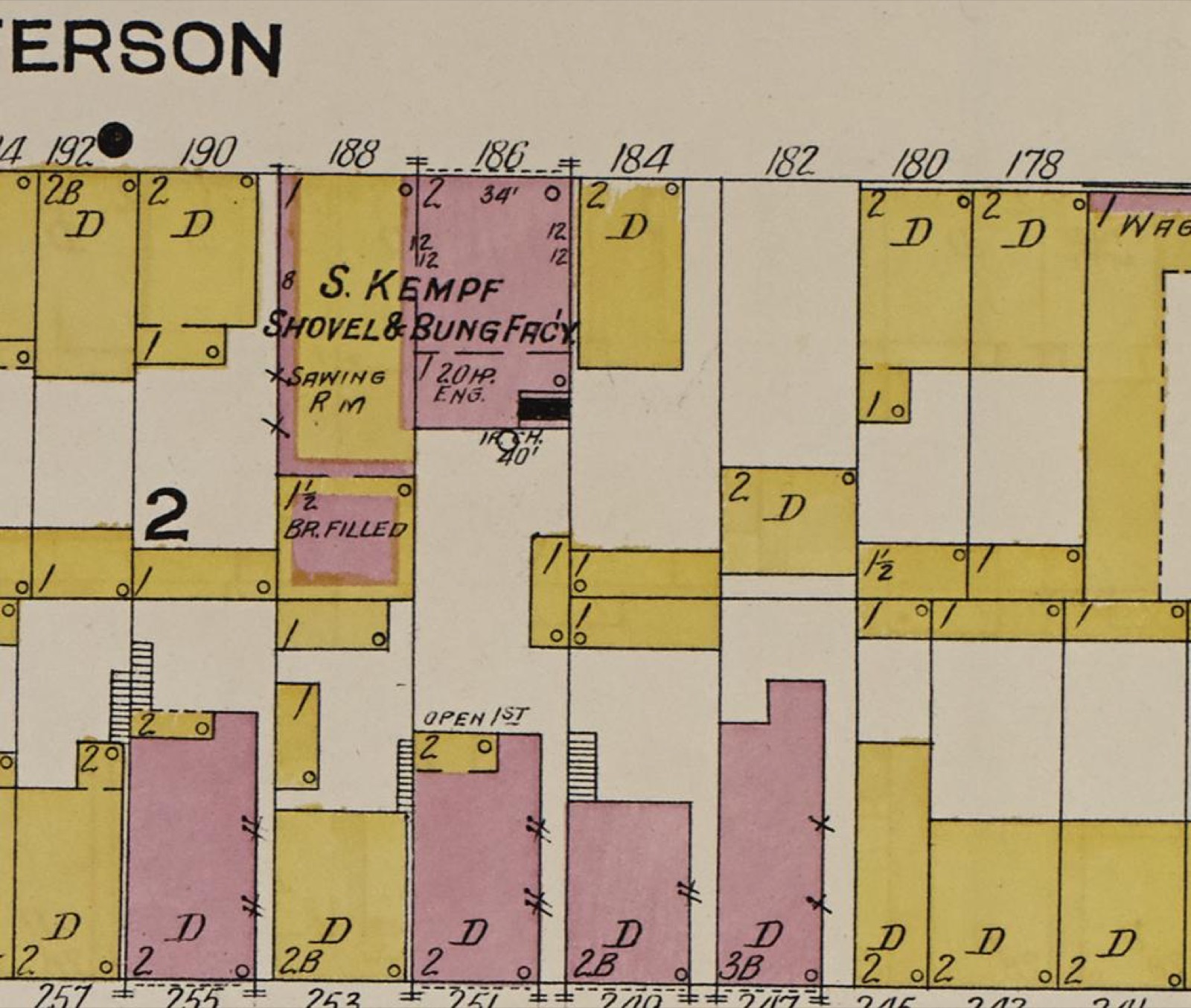
But Gwen's address is 186, not 202. The 1909 map solves that. It shows the same footprint, a two-story brick factory with an engine and the same brick house "Open 1st" behind it on Elm, now numbered 186. The neighbors' numbers shifted by about 16 too. That side of Jefferson Street was renumbered in the 1890s, and 202 and 186 are the same building. Inference It's a strong inference: identical footprint, identical neighbors, two dated maps. In 1909 the factory had a 20-horsepower engine, an iron chimney 40 feet tall, and a "Sawing Rm" next door at 188. Solid11
The bung man
What happened to all those bungs? One witness remembers the other end of the trade. John Oliver, whose father distributed Hedrick's beer, visited the Hedrick brewery on Central Avenue at about age five and met the "bung man," whose lifelong job was hammering wooden bungs into filled kegs. His right arm, Oliver recalls, had grown enormous; his left stayed normal. Oral history12 Whether Hedrick's bungs came from Jefferson Street isn't recorded, but Kampf was still making wooden bungs in Albany in the 1940s, and Hedrick was one of the brewers named alongside him in the state factory inspector's report. Inference
The family memories, checked
Gwen grew up hearing stories about this building. The records turn out to back most of them up.
| What the neighbors remember | What the records say | |
|---|---|---|
| The house behind the factory on Elm Street was the Kampf family's home. | Every directory from 1885 to 1923 puts Stephen Kampf's house on Elm, at 251 Elm from 1898 on, and the 1892 and 1909 maps show that house directly behind the factory. | Solid |
| 188 Jefferson, next door, was the stables for the delivery horses. | In 1892 the lot next door had a 1½-story frame building drawn with an "X," which in Sanborn's convention usually marks a stable. By 1909 it was Kampf's sawing room, and by 1934 part of the factory. | Inference |
| In the 1970s someone took a box of bungs off the factory floor. | The factory was still listed as "Stephen Kampf & Son" in a 1946 state survey, and the fire map corrected to December 1950 still labels "S. Kampf & Son Wood Bung Fact'y." Leftover stock decades later is entirely plausible. | Oral history |
| The building went up in 1849 or 1851. | Stephen Kampf isn't in any Albany directory checked from 1852 to 1869, and first appears in 1876. So the business dates from the 1870s. The building may well be older. Its owner dated it to about 1850 in 2009, and no record yet confirms or rules that out. Deeds would. | Disputed |
The stories, as told
- 188 Jefferson St. was the stables for the horses that pulled the bung delivery wagons.
- The house behind on Elm Street was the Kampf family residence.
- In the 1970s, before the building became apartments, a woman Gwen knows got inside and took a box of bungs off the factory floor.
The Kampfs
The directories also show the family around the works. Inference The links are inferred from shared addresses, since no census record has been read yet.
- Frank F. (or Frank J.) Kampf, foreman at 186 Jefferson around 1900–1905, and probably the "Son" of "S. Kampf & Son." Inference
- Andrew J. and Charles, shovelmakers, boarding at 251 Elm. Inference
- John S., who ran a meat market at 170 Jefferson. Inference
State factory inspectors counted four men working there in 1897 and five in 1899, on a 59-hour week. Solid13 The same report lists the brewers Kampf supplied, Hinckel and Hedrick among them.
A timeline of the works
- 1854 Patrick Coyle, "bung turner & shovel maker," at 80 Church St.: the trade exists in Albany before Kampf. Solid
- 1852–1869 No Stephen Kampf in any Albany directory checked. Solid
- 1876 First listing, on Hamilton St. between Knox and Snipe. Malt shovels, scoops, bungs and taps. Commended at the Centennial Exhibition. Solid
- 1885 "Kampf Stephan, shovelmaker, 202 Jefferson, h. 247 Elm." Solid
- 1891 Listed under BUNGS in a national manufacturers' directory. Solid
- 1892 Sanborn map: "S. Kampf Mfg. Shovels & Bungs," brick, with steam engine. Solid
- 1890s Jefferson St. renumbered: 202 becomes 186. Inference
- 1897–99 Four, then five, workers. Solid
- 1900 "Bung and shovel manufacturer, 186 Jefferson, h. 251 Elm." Frank Kampf is foreman. Solid
- 1909 "Shovel & Bung Fac'y," 20 h.p. engine, sawing room at 188. Solid
- 1913 Named by the State College of Forestry under "Bungs and Faucets." Solid
- 1923 Still listed at 186 Jefferson and 251 Elm. Single source
- 1934 "S. Kampf & Son Wood Bung Fact'y," now covering 184–188. Solid
- 1946 "Stephen Kampf & Son, 186 Jefferson St." in a state wood-industries census. Solid14
- 1950 Still labeled on the corrected fire map. Solid15
- 1970s A box of bungs is carried out of the empty factory. Oral history
- 2009 All Over Albany writes up "The bung factory." Solid
- 2026 This website is built inside it.
Still to find
- The exact year Kampf arrived and moved to Jefferson Street. The 1870–75 and 1877–84 directories weren't available online.
- Where he came from, and his family's names and dates: the 1880–1920 censuses.
- When the factory finally stopped: 1950s directories, or the Hall of Records.
- Who built 186 Jefferson, and when: the deeds at the Albany County Hall of Records.
Sources for this page
- Albany Directory 1900, p. 238 archive.org
- Albany Directory 1876, p. 387 (advertisement) archive.org
- Reports and Awards, Group III, International Exhibition 1876 (1878), p. 178 archive.org
- Howell & Tenney, Bi-centennial History of the County of Albany (1886) archive.org
- Albany Directory 1854, p. 76 archive.org
- Harris, Wood-Using Industries of New York (1913) archive.org
- Wahl & Henius, American Handy-Book of the Brewing, Malting and Auxiliary Trades (1901) archive.org
- Albany Directory 1862 archive.org
- Albany Directory 1885, p. 155 (archive.org item mislabeled "1898") archive.org
- Sanborn Map of Albany, 1892 (Library of Congress) www.loc.gov
- Sanborn Map of Albany, 1909, vol. 2 (Library of Congress) www.loc.gov
- John Oliver, "Beer Me, Dude!" (Substack, 2024) louchelife.substack.com
- NY Factory Inspector, 14th Annual Report (1900) archive.org
- Hoyle & Stillinger, Wood-Using Industries of New York: a 1946 census archive.org
- Sanborn Map of Albany, 1934–1950 (Library of Congress) www.loc.gov