Three centuries of Albany beer, from the inside: what went into the kettle, how hot or cold it was kept, how long it waited, what it was sealed in, and how it got to the drinker. Click through the process, compare the three great beers, convert old casks into modern pints, and see why nobody can quite agree how strong Albany Ale was.
498,000bushels of barley sold at Albany in the 1849 season
365white cedar "pontoons" in Taylor's fermenting room
88%of the nation's hops grown in New York State, 1860
31 galthe US beer barrel, fixed by a Civil War tax in 1862
Albany made three very different beers over its long brewing history. The Dutch made beer from wheat. The British-descended brewers of the 1800s made ale from barley, and sold it nationwide as "Albany Ale." The Germans who arrived after 1848 brought lager, a beer that could not be made without ice. Solid
Behind all three stood a whole city's worth of trades: maltsters, hop dealers, coopers, ice cutters, barge captains and the small workshops that made shovels and stoppers. One of those was Stephen Kampf's shovel and bung works at 186 Jefferson Street, the building where this site was made. Solid1 This page explains how the beer was made, one step at a time.
Three beers side by side
The quickest way into the subject is a comparison. The table below sets a Dutch wheat beer of the 1650s next to an Albany XX ale of the mid-1800s and a German lager of the 1880s. "XX" was a brewer's mark for a stronger grade of ale; Albany's brewers advertised "XX Pale," "Albany XX Ale" and "Amber XX" right through the 1860s. Solid2
Two things leap out. The ale and the lager used the same grain and nearly the same kettles; what separated them was yeast and temperature. And the Dutch column is full of blanks and inferences, because no Beverwijck brewer left a recipe. Inference
Compare the three beers
Every cell carries a confidence tag and a footnote. On a phone, pick one beer at a time.
Dutch wheat beer, Albany XX ale and German lager compared
Dutch wheat beer 1650s
Albany XX ale 1840s–1900s
German lager 1880s
Grain
Wheat malt. At Albany in 1749 Pehr Kalm found "Wheat is so plentiful that they make malt of it." Solid3 A 1909 history says New York's very first Dutch beer was made of oats. Single source4
Barley malt, both two-rowed and four-rowed; Albany sold 252,400 bushels of the first and 201,900 of the second in 1849. Solid5 By 1904 Amsdell's grists also held corn grits and sugar. Solid6
Barley malt; later American lagers added rice or corn. Single source7
Malting
Each Beverwijck brewery inventory lists its own malt kiln and a handmill or mill house. Solid8 So brewers probably malted their own wheat. Inference
Steeped, couched, sprouted on a floor and kiln-dried, "a four-fold treatment." Solid9 Done in giant specialist malt houses: John G. White's held 450,000 bushels a year. Solid10
The same four steps. Hinckel ran his own malt house on Central Avenue, a mile from the brewery. Solid11
Mash
In a wooden "work tub" (werck kuyp), with a liquor tub for hot water and a wort tub. Solid Temperatures unrecorded. Inference
For stock ale in 1901: start at 149–151°F, raise to 154°F, rest an hour, then sparge. Solid7
No lager mash schedule turns up in our sources. Inference Hinckel's mash tubs stood on the third floor, its kettles on the second. Solid11
Hops
Local and often wild. In 1665 Jeremias van Rensselaer thought wild "bush hops" better than cultivated "pole hops." Solid12
Heavy. Stock ale took 2–3 lb per barrel in 1901 Solid; Amsdell's everyday XX used 1.0–1.8 lb. Solid13
Arrived in 180-lb bales and went in late, "at the expiration of the third hour, or still later," of a four-hour boil. Solid9
Yeast & temp.
Top-fermenting yeast at cellar or room temperature. Inference
Top-fermenting. Pitched at 59°F and allowed to rise to 70°F (15–21°C), then the yeast skimmed off. Solid7
Bottom-fermenting at 42–51°F (6–11°C), in a cellar kept at 43–48°F. Solid7
Aging
Days to weeks, sold fresh by the half-barrel. Inference
"Present use" ale: days. Stock ale: "Store from three to four months." Solid7
Three to four months in casks, in a cellar "as near to freezing point as possible." Solid9
Strength
Graded, not measured: taxed "good" or "strong" beer, and cheap small beer. In 1658 a tun of strong beer cost 10 guilders in silver, small beer 3. Solid14
One 1843 test: 7.38% alcohol from the cask, 10.67% bottled Solid15, units disputed. Disputed Amsdell's XX in 1901: 4.6–4.9% ABV. Solid
No Albany lager strength figure has been found yet. Inference
Color
No description survives. Inference
"Their 'XX' is strong, though pale," says a Taylor company poem of 1866. Single source16 Amsdell's 1904 Burton was brown. Solid
Not recorded in our sources. Inference
Who drank it
Townspeople, by the can in taverns; "very small beer" with supper (Kalm, 1749). Solid Sold illegally to Mohawk and Mahican traders. Solid17
Albany and the nation: in 1849 it was "found not only in every city in the Union, but likewise in the West India islands, in South America, and in California." Solid18
German Albany first: 4,744 German-born residents in 1869. Single source19 By 1916 Albany made 213,544 barrels of lager to 120,273 of ale. Solid20
From barley to barrel, step by step
Whether a brewer made ale or lager, the job had the same eight stages. Grain was malted (sprouted and dried), milled, soaked in hot water in the mash to turn its starch to sugar, then boiled with hops. The hot wort was cooled, yeast was added for fermentation, the young beer was aged, and finally it was racked into casks and bunged shut. Solid9
The steps are the same; the temperatures are not. Click each step to see how an Albany ale brewer and a lager brewer handled it, and what survives about how it was done in Albany itself.
The brewing process
Malting
Barley is soaked, sprouted and dried so that its starch can later be turned into sugar.
Ale
Steep the barley, "couch" it in a heap, spread it on the malting floor to sprout for about a week, then dry it on a kiln. Solid9
The sprouting grain was turned by hand with wooden shovels and scoops. Inference
Lager
The same process. Lager brewers often kept their own malt houses: Hinckel's stood at 97–103 Central Avenue, three stories with kilns at the back. Solid11 Dobler's malt storehouse on State Street held 60,000 bushels in 1888. Single source21
In Albany
Malting was a trade as big as brewing. In 1886 the city's independent maltsters could make at least 1.175 million bushels of malt a year Approximate, and Taylor's own malt houses another 250,000 bushels of barley. Single source16
Stephen Kampf advertised "malt shovels, scoops, bungs and taps" in 1876. Solid22
Milling
The dried malt is cracked so that hot water can reach the starch inside. Inference
Ale
By 1866 Taylor's two 50-horsepower steam engines drove 700 feet of shafting that ran the mills, pumps and hoists. Single source16
Lager
Hinckel's 1892 brewhouse had its own "malt mill" beside the mash tubs. Solid11
In Dutch Albany
Beverwijck's brewers ground malt in a handmill "with four stones," or in a separate mill house next to the brewery. Solid8
Mashing
Crushed malt steeps in hot water; enzymes turn starch to sugar, giving a sweet liquid called wort.
Ale
Stock ale (1901): mash at 149–151°F, raise to 154°F, rest an hour, then rinse ("sparge") at 176, 170 and 165°F. Solid The lighter "cream" or present-use ale stepped through 122, 154 and 162°F. Solid7
Lager
Beverwyck's 1878 lager plant drew its water from an artesian well 230 feet deep, in the middle of a slate-floored engine room. Solid23
In Albany
Taylor's mash tuns could take 1,500 bushels of malt a day. Water came from the river into a 1,000-barrel iron tank on the sixth floor: "This water being taken from below the surface, is clear, cold, and free from all impurities." Single source16
A century earlier, Albanians brewed with Hudson water kept in cellars "in order that the slime may subside." Solid3
The boil
The wort is boiled with hops for bitterness, aroma and, crucially, preservation.
Ale
Stock ale took 2–3 lb of hops a barrel, added in thirds over about two hours. Solid7 Amsdell boiled most of its ales for just one hour, against about 1¾ hours at London's Whitbread. Solid13
Lager
Thomann's model brewery boiled for four hours, adding hops after the third. Solid9 Beverwyck's two copper kettles held 180 barrels each and cost $20,000. Solid23
In Albany
Taylor's coppers held 1,000 and 600 barrels. Single source On 10 September 1852, "A copper kettle, containing 200 barrels of beer, fell from its place in Messrs. Taylor & Son's brewery, doing great damage to the premises." Solid24
Two centuries earlier Pieter Bronck's kettle held "eleven half barrels." Solid
Cooling
Boiling wort must be cooled before yeast can live in it. Here ale and lager part ways.
Cool further, to 46–49°F (8–9°C). Solid7 Before machines that meant ice. Inference
In Albany
Taylor's coolers covered a whole floor, shaded with slatted blinds and fanned by powered fans. Single source16 Frans Pastoor's 1656 Beverwijck brewery was sold with "a cooler" too. Solid8
Fermentation
Yeast turns sugar into alcohol and carbon dioxide. Ale yeast works warm and rises to the top; lager yeast works cold and settles to the bottom.
Ale
Pitch 1.5 lb of yeast per barrel at 59°F and let it rise to 70°F. After 36 hours, rouse it and run it into "skimmers," where the yeast is skimmed off the top. Solid7
Lager
Ferment at 42–51°F. Solid Before refrigeration, brewers held the temperature down with "conical cans, called swimmers," filled with ice and floated in the beer. Solid9
In Albany
Taylor had four fermenting tuns of 1,000 barrels each, then the famous pontoon room: 365 white cedar vessels where the yeast poured itself off into troughs. Solid25 Hinckel's 1892 plant had a "Cold Storage & Fermenting" block and a "Refrigerating Mach." room. Solid11
Aging
Young beer rests to clear, mellow and build up its sparkle.
Ale
Cream or present-use ale: two days' settling, then into trade barrels with 10% fresh fermenting beer ("krausen"). Solid Stock ale: three to four months. Solid7
Lager
Three to four months in casks near freezing, then krausened with "one-fifth of a new beer to four-fifths of the old" and cleared on beech chips. Solid9 The chip cellar ran at 34–36°F. Solid
In Albany
Around 1900 Amsdell's ale brewery made "Polar," a pale ale cold-conditioned on chips at 42°F for ten to fourteen days: ale borrowing lager's methods. Single source26 Dobler kept both an ice house and a refrigerating machine in 1892. Solid
Racking & casking
The finished beer is drawn off into casks, sealed with a bung and sent out.
Ale
Fill trade barrels, add a quarter-pound of dry hops per barrel and prime with a pint of cane-sugar solution. Solid7
Lager
Casks were lined with pitch, and each filled barrel "is being closed up with a wooden bung tightly hammered into the bung hole." Solid9
In Albany
Taylor's racking tub held 1,000 barrels and its cellars had room for 10,000 casks. Single source16 Matthew Hawe's cooperage could turn out about 75 ale and beer casks and 150 barrels a week. Solid10 The bungs could come from Kampf's on Jefferson Street. Inference
A walk through Taylor's brewery
The best tour of an Albany ale brewery comes from a book the Taylor firm published about itself in 1866, Ale in Prose and Verse. It's a company puff, so its numbers deserve a raised eyebrow, but a second source from 1868 backs up most of the big features. Single source1625
John Taylor laid the cornerstone on 15 May 1851, on the riverbank block bounded by Broadway, Ferry Street, Arch Street and the Hudson. The site had once been under the river, and several hundred piles were driven to hold it up. Single source The main building was six stories tall and 80 by 200 feet. On the river stood a seven-story fireproof grain store holding 250,000 bushels, with elevators lifting grain straight out of boats "at the rate of one thousand bushels per hour." Solid
Before building, Taylor toured the London breweries and made drawings of their latest improvements. Single source25 The company's own book names the Lion Brewery as the model but dates the trip to 1860, after the brewery was finished, which can't be right. Disputed
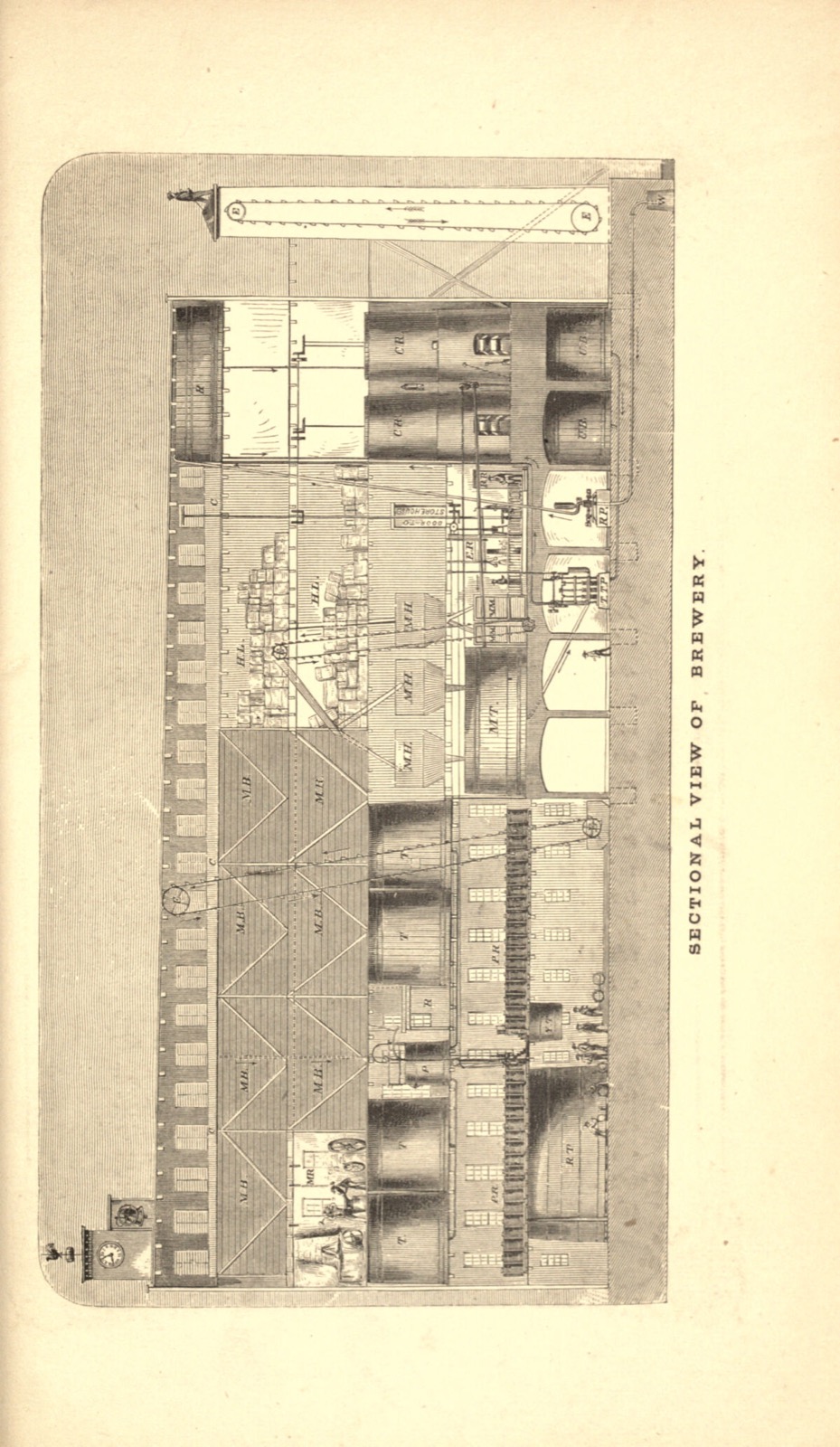
"Sectional View of Brewery," Taylor's plant at Broadway and Arch Street, 1866. Grain went up, beer came down: the brewery was stacked so gravity could move the liquid from floor to floor. Ale in Prose and Verse (1866), via Internet Archive. Public domain.
Inside, the book lists a machine age in miniature: two 50-horsepower steam engines, mash tuns for 1,500 bushels a day, coppers of 1,000 and 600 barrels, four fermenting tuns of 1,000 barrels each, thirteen drying kilns and "over two miles of pipe." Single source A "three-throw gun metal pump," built from Taylor's own drawings, moved 200 barrels an hour. Single source
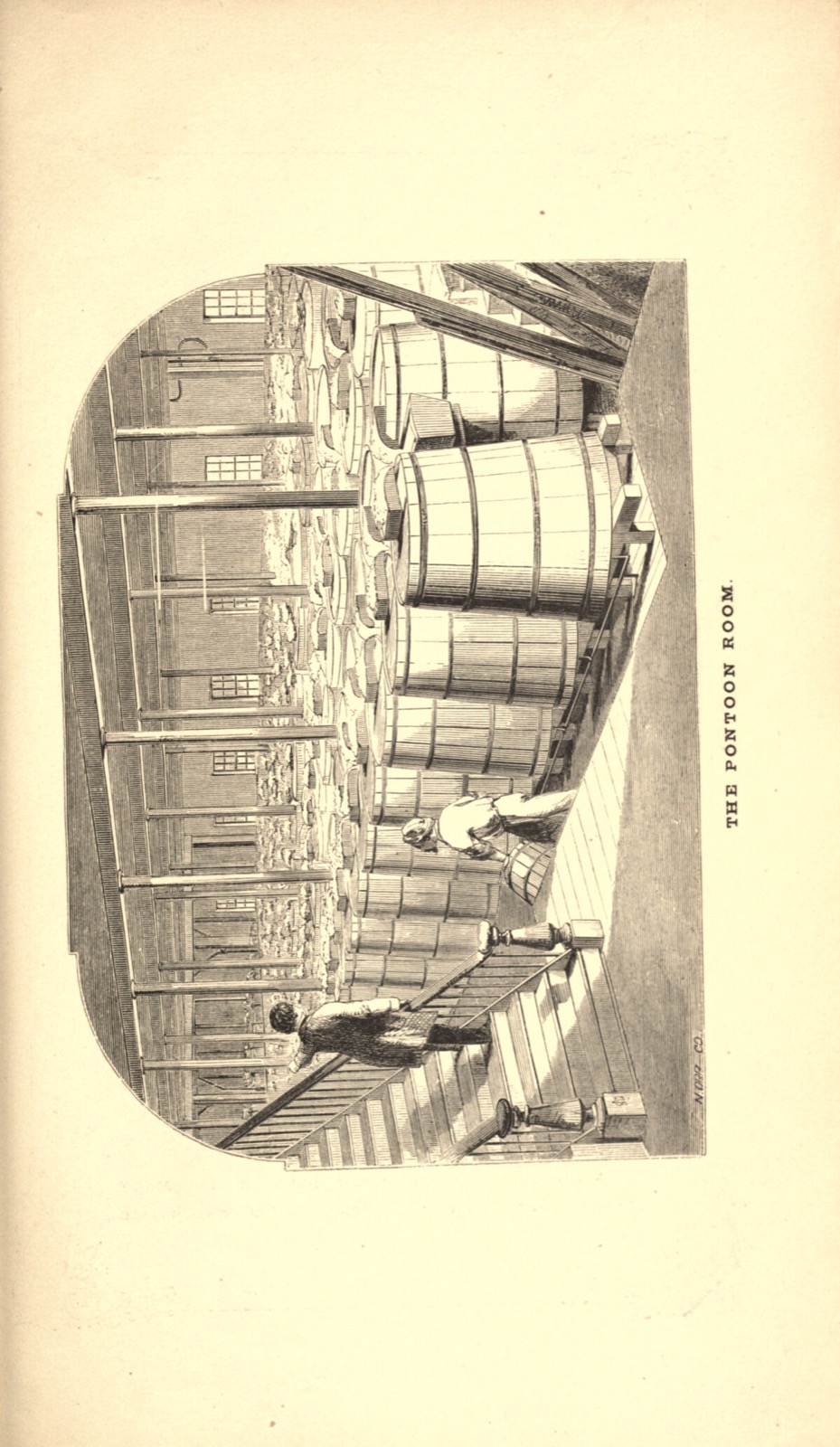
The showpiece was the pontoon room. Here stood "three hundred and sixty-five white cedar vessels or pontoons, capable of holding twenty-six hundred barrels," in five sets. As the ale fermented, the yeast rose and spilled over into troughs, so it cleaned itself instead of being skimmed by hand. Solid
"From each pontoon the creamy yeast, crowned with foam, reminding one of white capped billows, slowly pours itself into the receiving troughs."Ale in Prose and Verse, 1866
Taylor's book calls the old hand-skimming "a slovenly and dirty process," and Bishop called the pontoon system "as yet a novelty in American breweries." Solid25 It's the same idea as the "Burton union" system of English pale-ale brewers. Inference
"The Pontoon Room" at Taylor's brewery, 1866: 365 cedar vessels where the ale cleaned itself of yeast. Ale in Prose and Verse (1866), via Internet Archive. Public domain.
How big was it really? Bishop gave the plant "the capacity to produce over two hundred thousand barrels per annum." Solid That is capacity, not output. In the year ending 1 May 1877, Taylor & Son actually sold 53,453 barrels, behind the Albany Brewing Co.'s 72,723. Solid27
The brewery also had a clock tower. In 1858 the common council came to inspect its new clock and bell: dials six feet across, a 1,200-pound bell nearly 100 feet above the street, lit at night by gas. Solid28
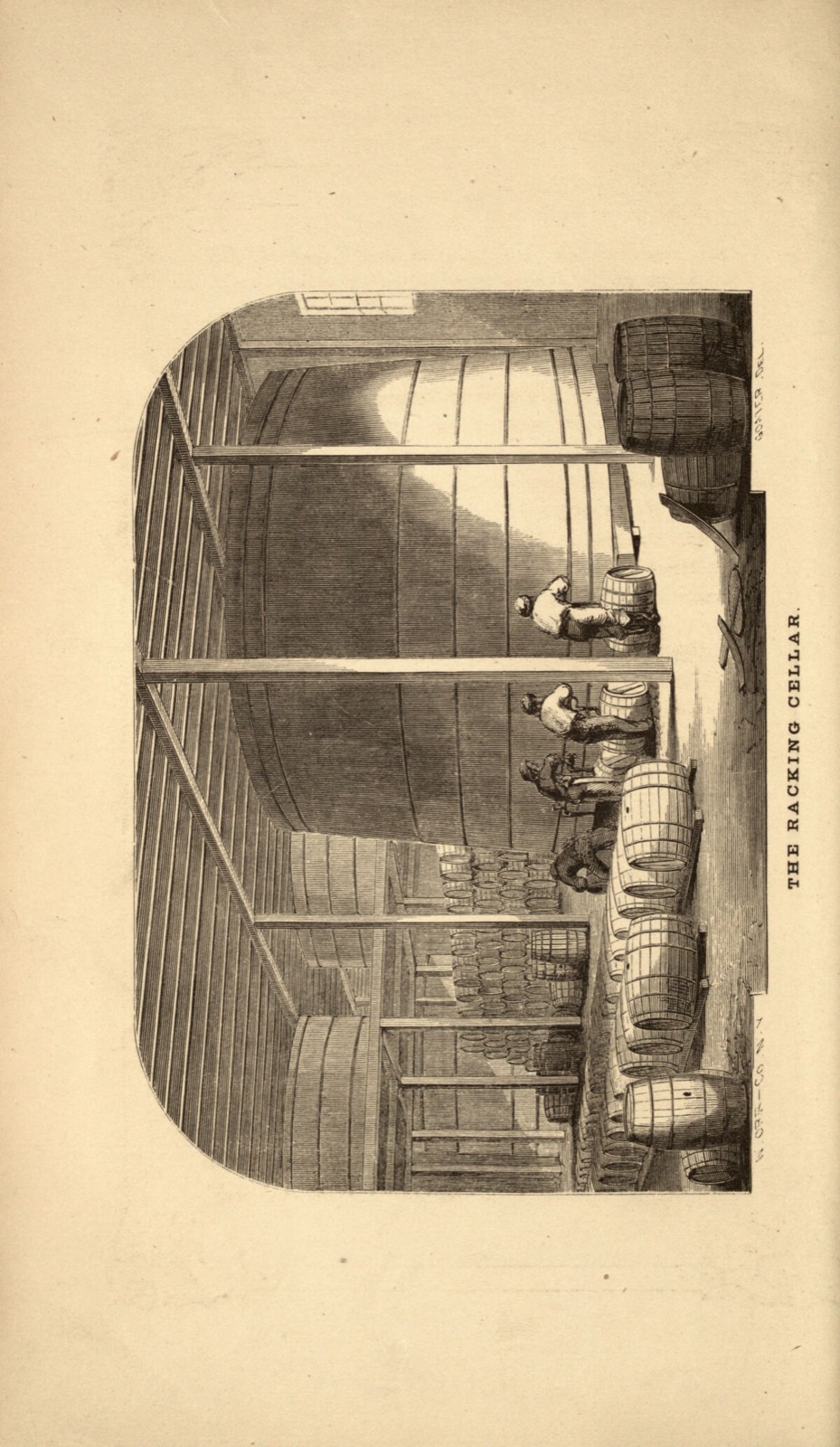
"The Racking Cellar," Taylor's brewery, 1866, where finished ale was drawn into casks. Ale in Prose and Verse (1866), via Internet Archive. Public domain.
How strong was Albany Ale?
This is the question everyone asks, and there is exactly one early answer. It comes from an appendix note in the 1843 New York edition of Pereira's Treatise on Food and Diet, edited by Charles A. Lee. Solid15
"According to Dr. L. C. Beck, Albany Ale in barrels contains 7·38 per cent. alcohol, or 14·76 per cent. proof spirit, while that in bottles has 10·67 per cent. alcohol, or 21·34 per cent. proof spirit."Pereira's Treatise on Food and Diet, New York, 1843
Many modern retellings, including earlier versions of this site, add "by weight" to that sentence and convert it to a hefty 9–13% ABV. The original doesn't say "by weight." Solid So which is it?
The clue is in Beck's own arithmetic. His "proof spirit" figure is exactly double his alcohol figure: 7.38 becomes 14.76, 10.67 becomes 21.34. That's the American proof convention, where proof is twice the alcohol by volume. Inference In the same note, a Scottish analysis of Edinburgh Ale gives "7·35 per cent. alcohol, or 16·15 per cent. by volume of proof spirit," which is not a doubling and so was probably by weight. Inference The most likely reading, then, is about 7.4% ABV from the cask and about 10.7% from the bottle. Disputed
The historians split on it. Craig Gravina reads Beck's figures as alcohol by volume. Alan McLeod has suggested Beck's sample may have been ale two years old, which would explain the strong bottled figure. Single source29
The gap between cask and bottle makes sense either way. Stock ale was aged three to six months and bottled "while moderately lively," and "The bottle stock beers are not pasteurized," so it kept fermenting in the glass. Solid7 Bottled Albany Ale was a different, older, stronger product than ale from the tap. Inference
Compare the sworn testimony brewers gave a New York Senate committee in 1835, as summarized by Gravina: table beer at about 1.5–2.5% and ordinary ale at about 5–8%. Single source29 And by 1901, Amsdell's XX was a 4.6–4.9% beer, about the strength of a London mild. Solid30 The name "XX" stayed while the beer got weaker, as happened in Britain. Inference
Albany Ale's strength, in context
0%5%10%15% ABV
Striped ends show a range, from the lowest to the highest figure. The thin pale line marks 5%, roughly an everyday modern American lager. Approximate Albany beers are gold, the rest grey.
Why the 9–13% figure won't go away
The common rule of thumb is that alcohol by volume is about 1.25 times alcohol by weight. Inference Apply that to Beck and you get 9.2% and 13.3%. The arithmetic is fine; the assumption that Beck measured by weight is what's in doubt. Beck's original publication, probably in an Albany or state medical or temperance report of the late 1830s, would settle it, and hasn't been found. Inference
One more clue sits in the same 1843 appendix. The editor boiled down a sample of "North River Ale" and got about 816 grains of solids per pint, or "nine ounces of solid matter to the gallon." Solid15 The North River is the Hudson, so this was very likely an Albany-area ale: a full-bodied beer, with plenty of unfermented sugar left in it. Inference
Four Albany Ales you can (almost) taste
No Albany brewer's book from the ale's heyday is known to survive. The oldest Albany recipes we have are two Amsdell brewing logs from 1900–01 and 1904–05, held by the Albany Institute, transcribed by Craig Gravina and analyzed by the beer historian Ron Pattinson. Solid30 Since 2013, brewers have used them and other clues to bring "Albany Ale" back. There are really two different modern Albany Ales: a 1901-style XX of about 5%, and a strong 1835-style pale of 8.7–9.5%. Inference
Recipe cards
Amsdell XX
Geo. I. Amsdell, Jay St., Albany · brewing logs 1900–05 · Solid
Not given in the published log table. Amsdell's 1904 Burton used 72.6% six-row pale malt, 19.1% corn grits, 7.1% sugar and 1.2% black malt Solid6; XX was probably similar. Inference
Hops
Cluster in Pattinson's Burton recipe Solid; American Cluster-type hops for XX too. Inference
Verdict
"Quite like a London Mild Ale," says Pattinson, but less fully fermented: about 65% attenuation against about 75% for Whitbread's X. Solid13
Date
Beer
OG
FG
ABV
Hops lb/bbl
24 Jan 1901
XX
1052.6
1016.4
4.80
1.80
1 Apr 1901
XX
1054.6
1019.6
4.63
1.61
27 May 1901
XX
1059.7
1022.4
4.94
1.23
22 Oct 1901
Pale XX
1054.2
1017.2
4.89
1.02
14 Nov 1904
XX Winter
1058
1019.2
5.13
1.12
"1901 Albany Ale" cask
C. H. Evans Brewing Co. & the Albany Ale Project · tapped 2 Nov 2013
~1053–1060OG (reconstructed)
~4.6–4.9%ABV (reconstructed)
150tickets, at $15
The event
The Albany Institute hosted the "1901 Albany Ale Cask Tap" on 2 November 2013, billed as the first cask of Albany Ale made in more than a century. Solid31
Recipe
Reportedly brewed from the Amsdell 1901 XX log. Single source The exact cask specs have not been found; the figures above are reconstructed from Amsdell's 1901 XX brews. Inference
Background
That spring, at Hudson Valley Hops, Gravina spoke on "a historic beer recipe book" and on adapting an old ale recipe for modern brewing. Solid32
"1835 Albany Ale" homebrew
Credited to Craig Gravina · posted to Brewer's Friend, 24 Nov 2018 · Solid as posted
17 lb American six-row pale malt (98.2%) and 5 oz honey. Solid
Hops
Cluster (8.1% alpha): 1.5 oz at 90 minutes, 1 oz at 60, 1 oz at 30. Galena, 1 oz, dry-hopped for 3 days. Solid
Extras
1.5 teaspoons of table salt in the boil, echoing the "little fine salt" some brewers admitted to in 1835. Solid34
Yeast
Escarpment Labs Scottish Ale. Solid
Albany Ale at the Pump Station
C. H. Evans / Albany Pump Station · brewed 31 May 2018 · Single source
9.5%ABV (reported)
6-rowAmerican barley
Honeywildflower, in the boil
Brewers
Head brewer Sam Pagano with Craig Gravina; released at the Pump Station at the end of July 2018. Single source35
Hops
Aged, low-alpha hops; no variety named. Single source
Caution
These specs survive only in search-engine extracts of a Discover Albany article that now redirects. Treat 9.5% as reported, not verified. Single source The recipe matches the 1835-style homebrew more closely than the 1901 mild. Inference
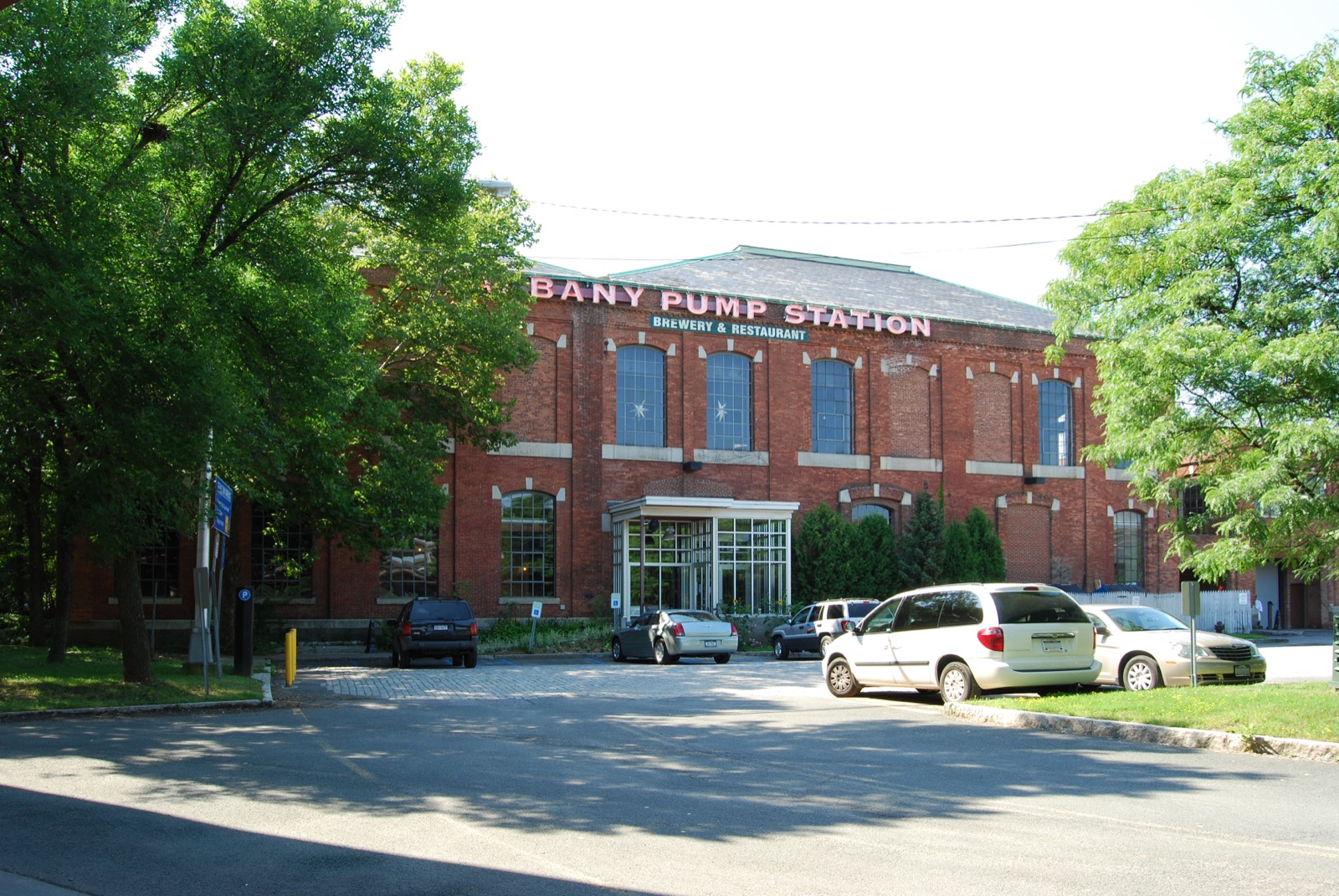
The Albany Pump Station, home of C. H. Evans Brewing, where Albany Ale was brewed again in 2018. Photo: UpstateNYer, 2009, CC BY-SA 3.0, via Wikimedia Commons.
Cream ale is older than lager
"Cream ale" is often explained as an American ale invented to compete with lager. Albany's newspapers say otherwise. John Taylor advertised "Albany Cream Ale" in May 1836 and "Taylor's Imperial Cream Ale" in April 1839, before lager was first brewed in America. Single source36 By 1901 "cream, lively, or present use ale" was the American everyday ale, taking "the place of the English mild ales." Solid7
Barley: the canal's harvest
Albany's ale was built on a geographic accident. The Erie Canal ended at Albany, and the grain counties of central and western New York lay along it. Solid In March 1832 the New-York Farmer's Albany correspondent wrote that "Near 600,000 bushels of barley are brought to this market." It came from fourteen counties, from Albany and Schoharie west to Ontario, Seneca, Cayuga and Tompkins. Solid37
The same writer explained why Albany ale beat New York's: "the quality of the water, and … the facilities afforded in Albany for purchasing the best of hops and barley." One big brewer told him he "should have established his business in N. York had the water been good." Solid
By 1849 an Albany paper could boast that "The city of Albany is known far and wide as the barley market of the Union," where five-sixths of the barley reaching tidewater "from the barley growing counties of the west is bought and sold. The trade lasts about two months." That autumn's sales came to 498,000 bushels. Solid5 Barley sold for 80–87 cents a bushel late in 1846 and 60–70 cents in spring 1851. Solid
Barley arriving at tidewater by canal, in bushels (Howell & Tenney 1886, "from official documents")
Almost all of it was sold in Albany, and buyers came "for points as far South as Charleston." Solid By the 1880s Albany's own brewers used 600,000–700,000 bushels a year. Solid10 From about 1860 to 1890, New York brewers also prized barley from Ontario's Bay of Quinte, shipped across Lake Ontario to Oswego, until a tariff of 1890 choked the trade. Single source38
Barley became malt in buildings that dwarfed most breweries. Here are the city's big malt houses in 1886, with their yearly capacity in bushels:
Maltster
Since
Where
Capacity (bu/yr)
John G. White & Sons
1823
125 Hudson Ave; seven stories, 150 × 70 ft
450,000
J. W. Tillinghast (founded by John Tweddle)
1850
105 Montgomery St; State & Lark
~300,000
Thomas McCredie
1847
Canal, Orange & Hawk Sts and three more plants
250,000
Story Brothers
1868
Broadway at Cherry and at Plum Sts
175,000
All from Howell & Tenney (1886). Solid10 The four add up to at least 1.175 million bushels a year, before counting the brewers' own malt houses. Approximate
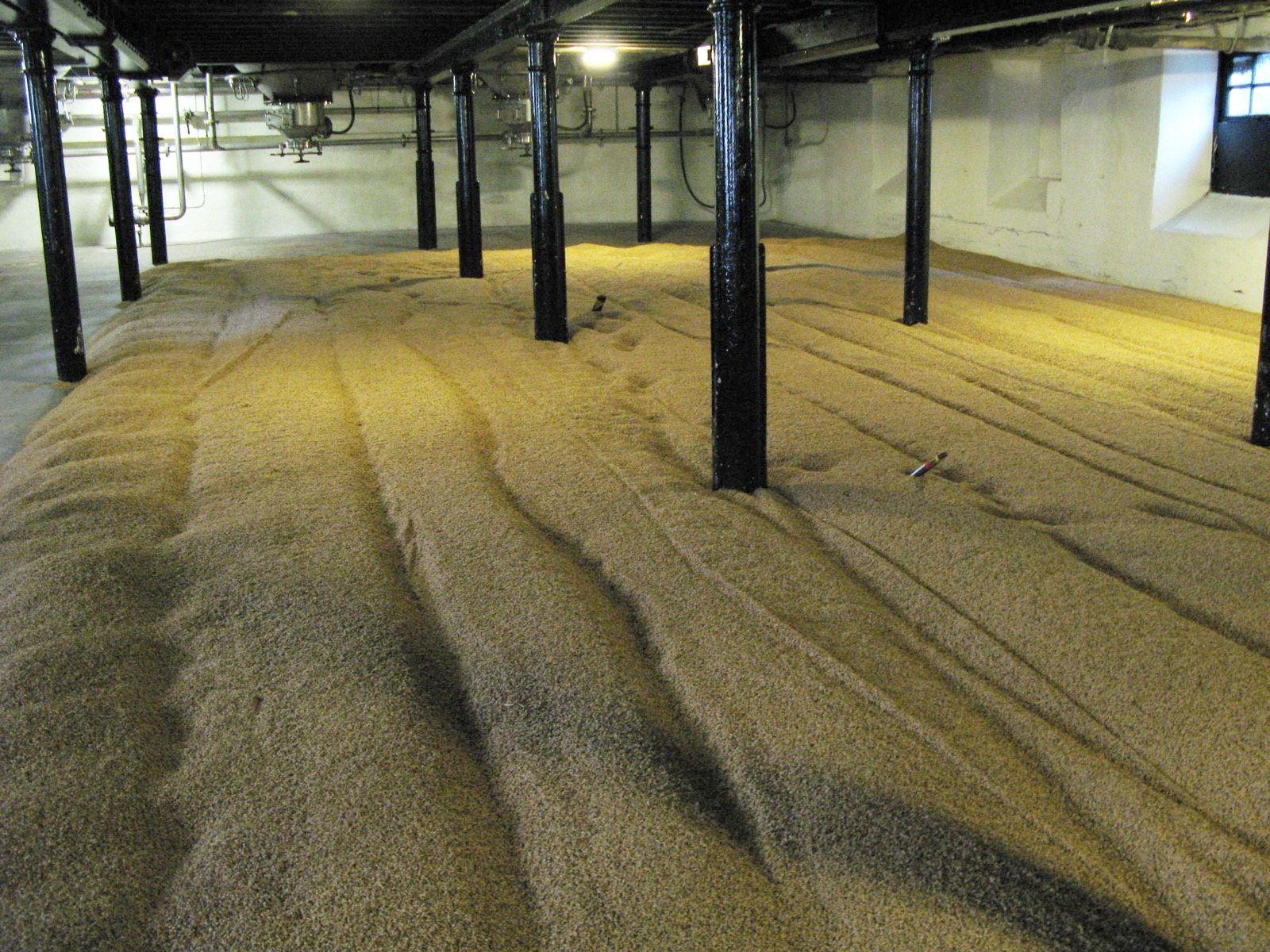
A traditional floor maltings (modern photograph). Sprouting barley was spread on floors like this and turned by hand with wooden malt shovels, the kind Stephen Kampf made in Albany. Photo: Lakeworther, CC BY-SA 3.0, via Wikimedia Commons.
Malting needed water too, and that's where Albany's most famous beer scandal began. In 1835 the temperance crusader Edward Delavan printed a witness's claim that Fidler & Taylor's malt house "on the hill" drew its steeping water from stagnant ponds with dead animals in them. Solid The claim included a precise detail about the work: "seven hogsheads of water are usually placed in a steep-tub at a time, and it is then filled with barley." Solid39 Taylor sued for libel and lost in April 1840. Solid The full story is in the Albany Ale chapter.
Hops: the central New York hop belt
If Albany was the barley market of the Union, the country just west of it was the hop garden. The 1860 census counted 10,991,996 pounds of hops grown in the United States. New York grew 9,671,931 of them, about 88%. Solid40
The census itself remarked that six New York counties produced "over eight and a half millions of pounds of hops, out of a total crop of eleven millions." Solid Otsego County alone grew 3,507,069 pounds, more than every state except New York put together. Solid Toggle the chart to see it.
Hops grown in 1860, in pounds
Source: 1860 census of agriculture. Solid "Rest of New York" and "all other states" are worked out by subtraction. Inference
Albany sat at the hop belt's eastern end and traded its crop. In 1832 about a million pounds of hops came to the Albany market, and 300,000–400,000 pounds a year were shipped on to Europe. Single source37 By 1880 New York grew about 21 million pounds, roughly 80% of the national crop. Single source41
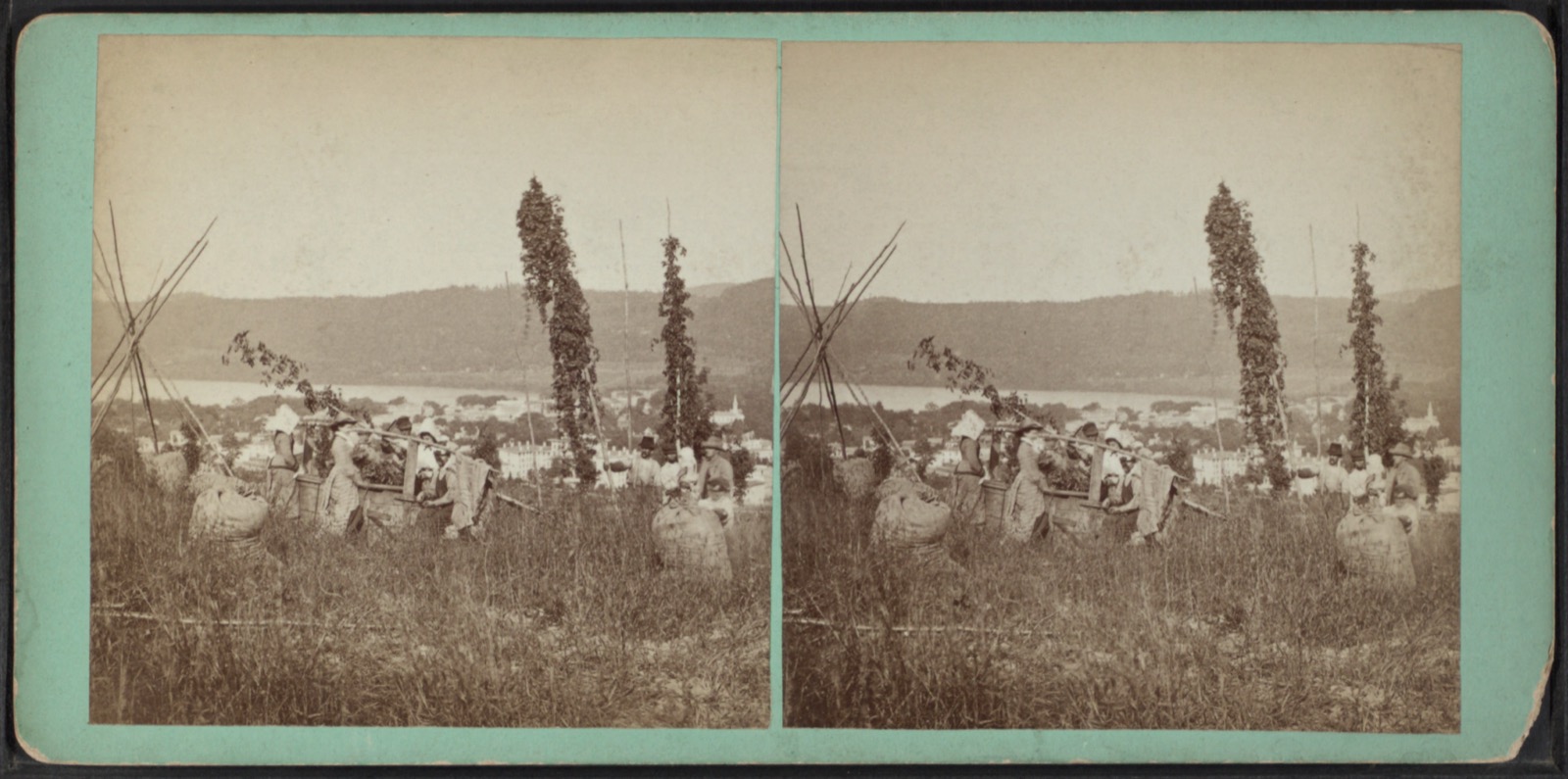
"Ostego [sic] Hop Yard," stereograph, Otsego County, New York, c. 1860–1915. Robert N. Dennis collection, New York Public Library. Public domain, via Wikimedia Commons.
Every September the hop yards needed thousands of hands at once. The brewing historian G. Thomann described the belt in 1909 as running "between Albany and Rochester, a belt two hundred miles long and fifty miles wide." Solid42 "On or about the first day of September, they come with a rush": city mechanics, factory girls and whole families, by wagon, chartered train and on foot. "Bread is baked by the barrel; 'doughnuts' are fried by the bushel." Solid
The working day ran from six in the morning to six at night, with half an hour for lunch. Solid Pickers were paid fifty cents a box, and it took fifteen boxes to fill a 180-pound bale. A fifteen-year-old could pick two or three boxes and "earn a dollar a day." Solid Thomann's picture is a rosy one, and the pickers' own accounts may read differently. Inference
A day in the hop yard, c. 1908
Rates from Thomann (1909): 50¢ a box, 15 boxes to a 180-lb bale. Solid Pounds per box (about 12) is worked out from those figures. Inference
New York's hop empire didn't last. "Up to 1899 New York produced the largest quantity of hops; thereafter Oregon took and maintained first place," and California passed New York soon after. Solid42 Powdery and downy mildew, aphids and finally Prohibition finished the job, and hop growing moved to the dry Pacific Northwest. Solid43
Ice, then machines
Ale could be brewed in an ordinary cellar. Lager could not. It ferments at 42–51°F and is stored "as near to freezing point as possible" for months. Solid7 Before refrigeration, wrote Thomann, "the successful brewer of lager beer depended very much upon the climate, the supply of ice and the chances of securing... 'Felsenkeller,' rock cellars." Solid9
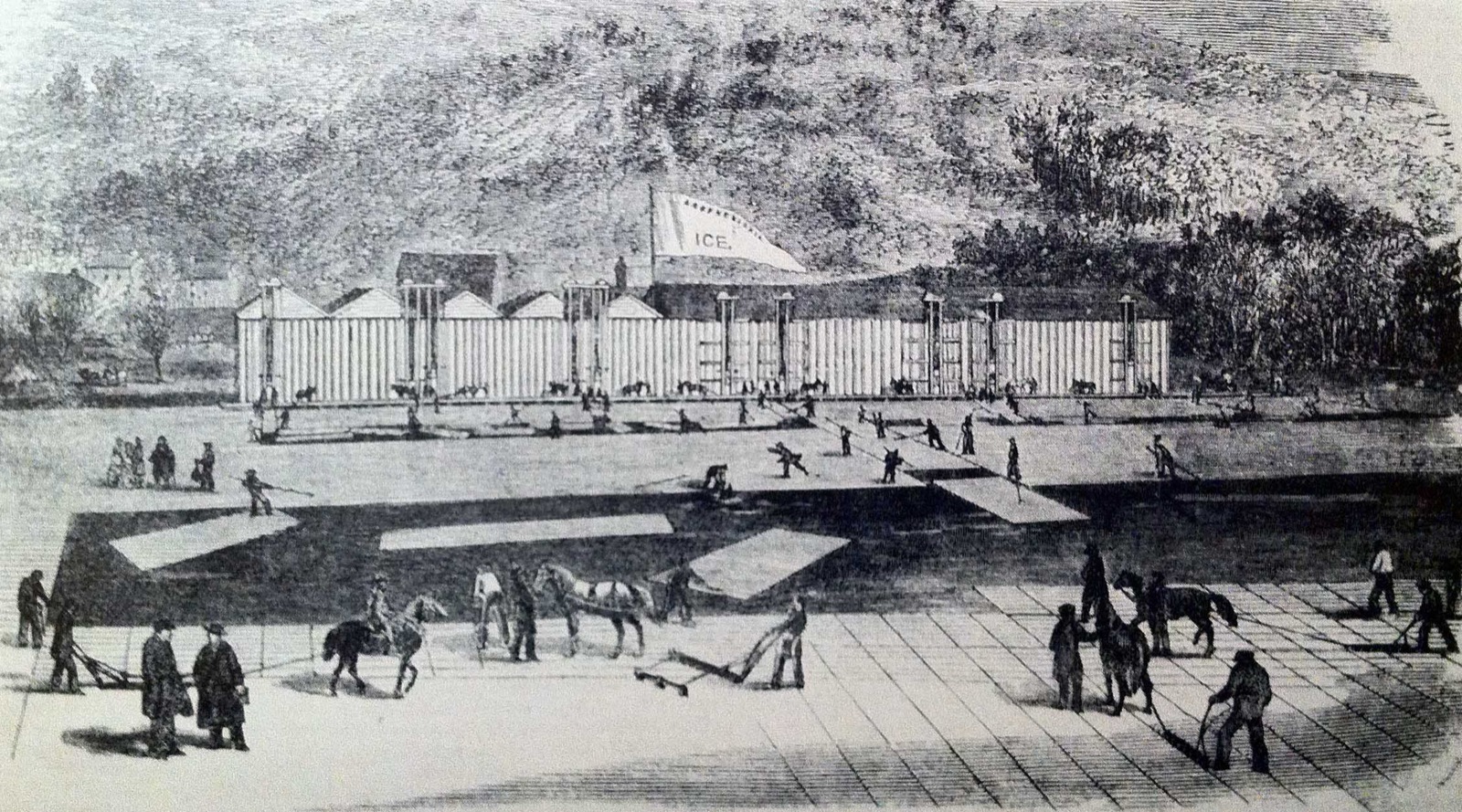
The Hudson supplied the ice. At its 1880s peak, the river's ice industry employed about 20,000 workers, with about 135 ice houses between Poughkeepsie and Albany. Single source44 Albany's lager brewers probably stored Hudson ice, but no ledger yet ties a particular brewery to a particular ice harvester. Inference
"Cutting ice," New York, 1852, from Gleason's Drawing Room Companion. Not Albany specifically, but the same work went on all along the frozen Hudson. Public domain, via Wikimedia Commons.
Even a German community didn't guarantee German beer. Craig Gravina has argued that little lager was actually brewed in Albany before 1860. An 1857 furniture ad offered refrigerators for "Lager Beer purposes," a sign of lager being sold, while Rochester lager was being shipped in by the mid-1860s. Single source45 A trade history of 1903 disagrees, crediting Hinckel with 500 barrels of lager in his first year. Disputed46
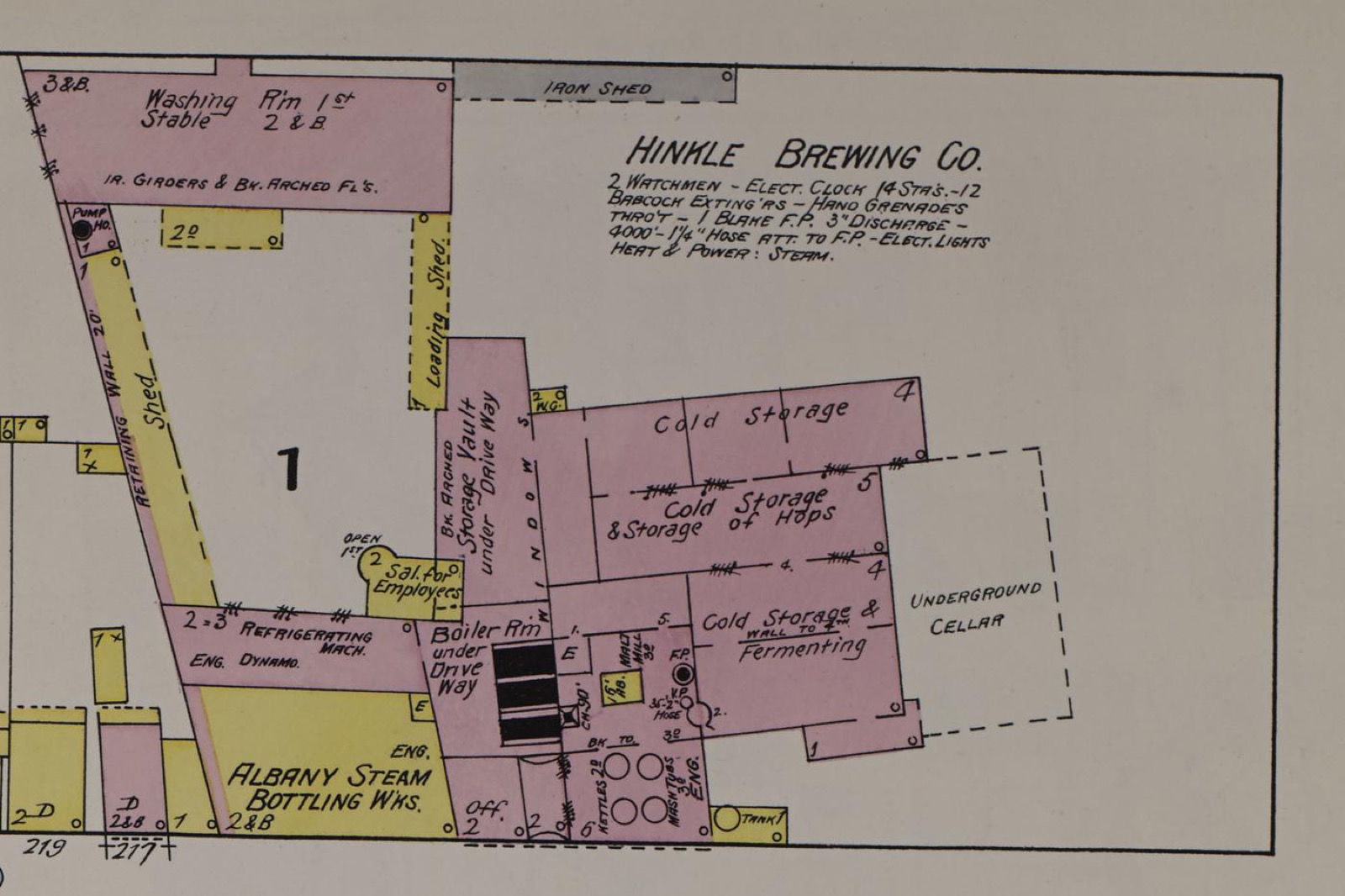
The big change came with Beverwyck's 1878 brewery on North Ferry Street, which Phelps called "the model lager beer brewery of the United States." Its nickel-plated pumps moved "beer, air, ice-water." Solid23 By 1892 the fire-insurance maps show a room labeled "Refrigerating Mach." at both Hinckel's and Dobler's, and Dobler still kept an ice house as well. Solid11 No source names the makers of Albany's machines. Inference
The "Hinkle Brewing Co." on the 1892 Sanborn fire-insurance map, sheet 43: cold storage, fermenting and the refrigerating machine room. Sanborn-Perris Map Co., Library of Congress. Public domain.
For scale, Thomann's model New York City brewery ran "four De La Vergne machines, each of an ice melting capacity of 310 tons," cooling about forty cellars. Solid47 The machines spread to ale, too: by 1901 American ale brewers were using refrigeration to make "brilliant or sparkling ale... that combines the properties of lager beer and ale." Solid7 Hinckel later sold a "Sparkling Ale." Single source
The story ends in a neat circle. By 1934, after Prohibition, Hinckel's old brewhouse on Park Avenue had become an ice factory for the City Ice & Fuel Co. Solid48
Barrels, bungs and coopers
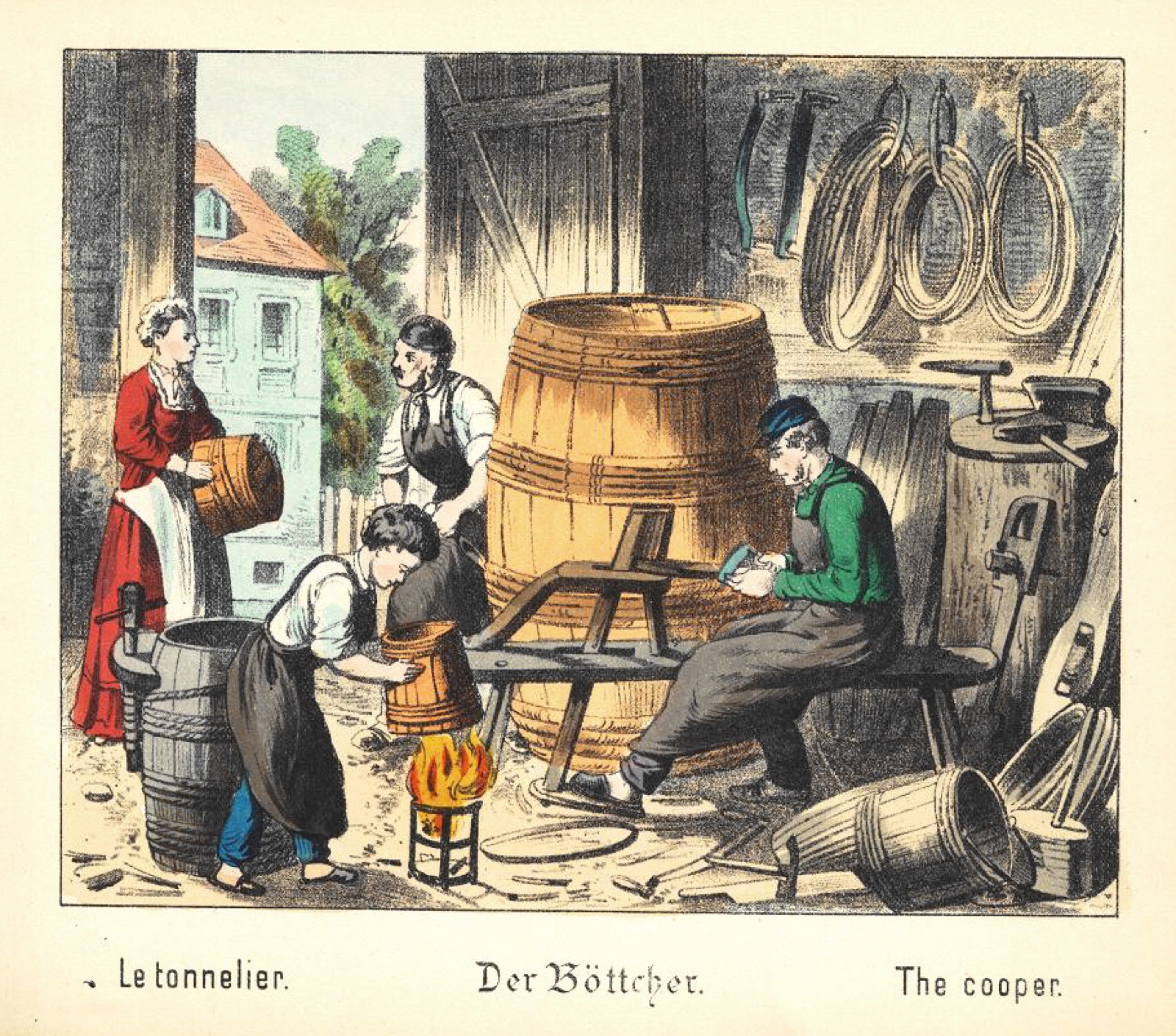
Every barrel of Albany beer travelled in a wooden cask, and Albany made a lot of casks. In 1886 the county history claimed that "at one time most of the coopers in the United States were located here, and most of the ale barrels used in this country were manufactured here." Solid10 It's a booster's boast, not a statistic. Inference But the trade was real and big.
Coopers had organized early. On 31 January 1792 Albany's coopers met at Denniston's tavern and fixed their prices: four shillings for a half barrel, three and six for a ten-gallon keg. A year later the "society of coopers" put everything up a shilling a barrel. Solid49
The biggest name of the ale era was Matthew Hawe. Born in Charleville, Ireland, in 1814, he came to America as a toddler and started his own cooperage in 1836. Solid He made "beer barrels, half-barrels and hogsheads," and devised improvements so that the heads of ale casks were as strong at the joint as anywhere else. Solid By 1886 the firm, run by his widow and their son Daniel, had shops at 63 Liberty and 58 Union Streets, about 20 skilled men, and capacity for some 75 ale and beer casks and 150 barrels a week. Solid10
Other shops filled the old South End. John Pennie Jr., stave dealer and cooper since 1843, worked at 39 Arch Street Solid, a block from Taylor's brewery. InferenceJohn Le Gallez began in 1849; by 1886 A. & W. Le Gallez employed 20 men at 51–61 Liberty Street, much of the work "remodeling barrels of all kinds." Solid In 1876 the cooper Jacob Happ worked at 199 Jefferson Street, across the street from Kampf's future shop if the old numbers match today's. SolidApproximate22
People listed as coopers in Albany directories
Rough counts of directory entries giving the trade "cooper," read from scanned text. They're lower bounds; the 1877–1899 directories weren't counted; and 1905 (hollow) used a different format, so it's less comparable. Approximate5051
Show the numbers
1858: about 100 · 1862: about 109 · 1869: about 126 · 1876: about 130 · 1900: about 63 · 1905: about 39
Cooper numbers peaked around 1870–1880 and then fell by more than half by 1900. Inference Thomann explained why in 1909: "Cooperage is no longer a handicraft in America." Machinery had "virtually wiped out the cooper's handicraft," leaving "a half dozen enormous manufacturing establishments, in which nearly all the barrels required by brewers and distillers are made by machine." Solid47
"The cooper," c. 1880. Anonymous, public domain, via Wikimedia Commons.
Lager casks had one more step: pitch. Coopers coated the inside with hot brewer's pitch, which made the barrel easier to clean and kept the beer from tasting of wood. Big breweries had a pitch oven and rolled the casks on moving rollers to spread it. Solid47 Brewers resisted cheaper petroleum substitutes, because they lacked "that peculiar, although exceedingly faint, flavor for which the ordinary pitch is so highly prized by both the brewer and the drinker." Solid English-style ale casks were usually left unlined, though that isn't confirmed for Albany. Inference
The bung
Every cask had a hole in its belly for filling, and every hole needed a stopper: the bung. A 1901 brewers' handbook describes the standard American kind. They "are made from choice poplar wood and compressed across the grain. The thickness is usually somewhat less than an inch, and the size commonly used in the United States is 1 15-16 inch diameter." Solid7
Anatomy of a beer barrel
Schematic, not to scale. Inference Bung description from Wahl & Henius (1901). Solid
The trick was the compression. An 1862 ad in the Albany directory for Kirby's Patent Compressed Bungs explained that they were "formed by being placed in a compressing die, and subjected to a pressure of several tons," so that they would "expand and fill out into all the irregularities of the bung hole." They came "either of OAK OR POPLAR WOOD... BREWERS, use the Poplar." Solid52 As the 1901 handbook put it, "The bung becoming moist by contact with the beer, expands, and fits more tightly than at first." Solid
Bungs were used once. They were knocked in with "a blow of considerable force," and when the empty cask came back, a revolving auger called a bung extractor drilled the old one out. Solid7 So every filling of every cask needed a new bung, which is why a city of breweries could support a local bung maker. Inference Some brewers branded the racking date on each bung, to settle arguments with saloonkeepers about stale beer. Solid
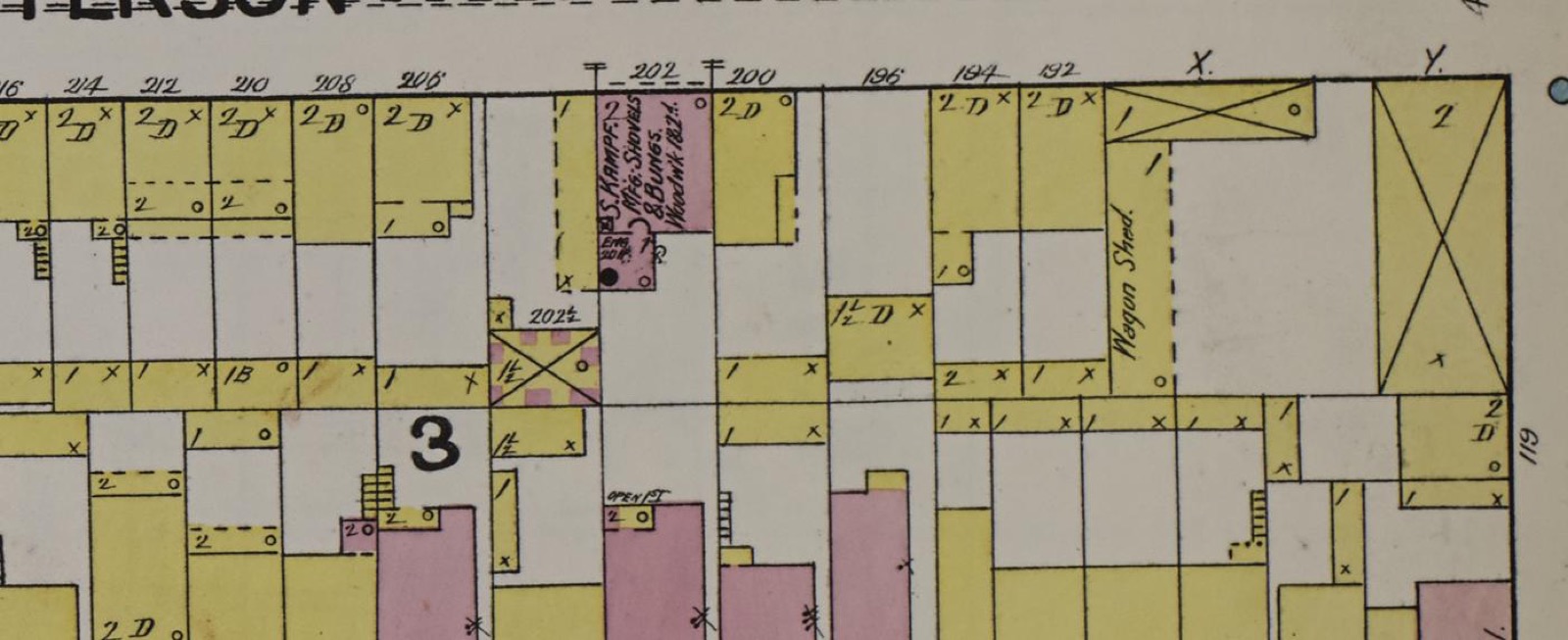
That bung maker was Stephen Kampf. He first appears in the 1876 directory on Hamilton Street, making malt shovels, scoops, bungs and taps. By 1885 he was at 186 Jefferson Street, living at 251 Elm, the lot directly behind. Solid53 The 1892 fire map labels his two-story brick shop "S. KAMPF. Mfg. SHOVELS & BUNGS." Solid54
"S. Kampf. Mfg. Shovels & Bungs," Jefferson Street, on the 1892 Sanborn fire-insurance map, sheet 45. The building is today's 186 Jefferson Street, where this site is made. Sanborn-Perris Map Co., Library of Congress. Public domain.
Cork or wood?
One online account says the Kampf factory made cork stoppers. The directories call Kampf a "bung and shovel" maker, and the brewers' standard was compressed poplar, so wood is much more likely. Disputed Albany did have a cork maker: in 1885 the Albany Cork Works on Clinton Avenue sold "Bungs and Taps" and Hutchinson's spring stoppers. Solid53 A box of bungs saved from the Kampf factory floor would settle it. Oral history
The whole story of the shop, the family and the building is on the Bung Factory page.
What's a hogshead? A cask converter
Old brewing records are full of units nobody uses now: tuns, butts, hogsheads, kilderkins and firkins from England; tons, half-vats and schepels from the Dutch. Even "barrel" meant different things at different times. The English ale barrel was 32 ale gallons in 1454 and 34 by 1688, and Britain settled on a 36-gallon beer barrel in 1803. Solid55
The American 31-gallon barrel is a tax unit. Section 50 of the federal Internal Revenue Act of 1 July 1862 levied "a duty of one dollar for each and every barrel containing not more than thirty-one gallons" on beer, lager, ale and porter. Solid56 Federal regulations still define a barrel as 31 US gallons. Solid57 The tax itself was $2.00 a barrel until 30 June 1901, then $1.60. Solid7
Pick a unit and a quantity, or try one of the historical examples.
Cask and unit converter
About the Dutch units
Dutch barrels varied by city: the "grofton" held about 155 liters and the "smalton" about 124. Single source58 Which one Fort Orange's brewers used is unknown, so the converter offers both. Inference The half-barrel (half vat) was the standard retail cask in Beverwijck. Solid59 The schepel, the Dutch grain measure, was about three-quarters of an English bushel, roughly 60 pounds of wheat. Solid6061
Getting it to market
Albany ale was a shipping beer from early on. In August 1806 a Newport, Rhode Island merchant was already offering "Albany Ale by the dozen." Single source62 By 1849 it was found "in every city in the Union," the West Indies, South America and California. Solid18
The raw materials came in by water, and the ale went out the same way. Barley and hops arrived by the Erie Canal. Solid Canal toll tables of 1830 and 1832 list "beer" as its own class of freight. Single source29 The Taylor house wrote that Albany was "the great central mart for the barley and hops raised in the West, and which, by way of the Erie Canal, are brought to a market at a cheaper rate than they could be by any other conveyance." Single source16
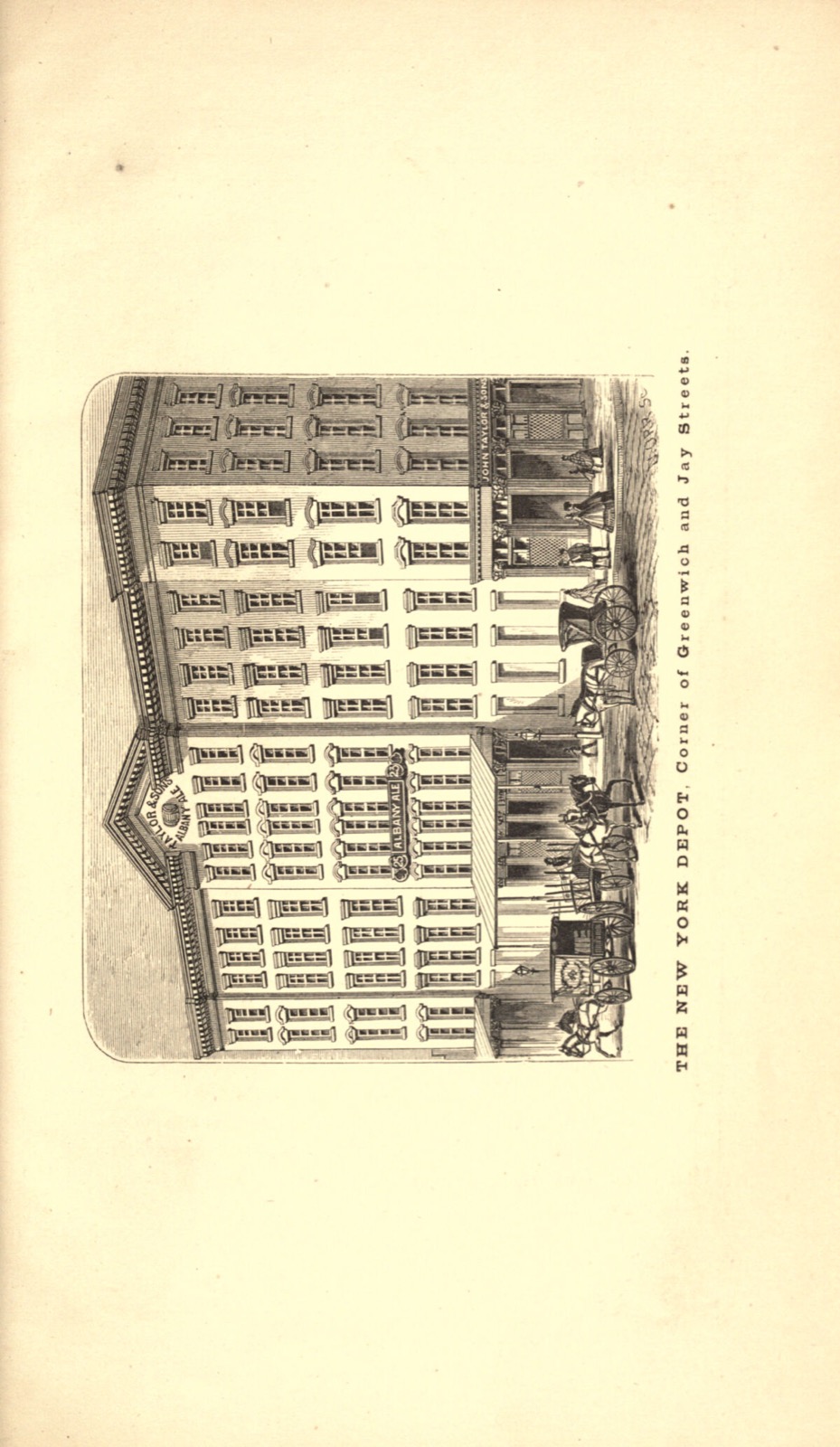
Downriver, the big firms ran their own depots. Taylor opened a New York depot on Warren Street in 1822 and later built a six-story iron and stone depot on Jay Street, begun in 1862 over granite-roofed ale vaults; empty casks went back to Albany "by barges belonging to the firm." Single source A Boston depot followed in 1851. "The Boston depot supplies the entire eastern, the New York one the southern, and the Albany one the western markets." Single source16 The maltster William Appleton ran "a line of barges plying on the Hudson between Albany and New York." Solid10
"The New York Depot, corner of Greenwich and Jay Streets," John Taylor's Sons, 1866. Ale in Prose and Verse (1866), via Internet Archive. Public domain.
Open each destination below for the evidence that Albany ale got there.
Where Albany ale went
New York Cityfrom 1822
Taylor's depot on Warren Street (1822), then Greenwich Street and the 1862 Jay Street building. Single source In 1864 Amsdell had depots at 122 Liberty and 125 Cedar Streets, and Dunlop at 85 Liberty. Solid2 McKnight even ran a branch brewery on Carmine Street. Solid
Bostonfrom 1851
Taylor's Boston depot, later in a six-story granite block at Commercial and Richmond Streets, run by Edmund B. Taylor until 1863. Solid16 Burt also had a Boston depot. Solid
New England towns1864
Amsdell's agents in Springfield, South Adams, Pittsfield, Hartford, Rutland, Ballston Spa, Poughkeepsie and more. Solid2
Newport, Rhode Island1806
A merchant's ad offering "Albany Ale by the dozen" beside brown stout. Single source62
The Southantebellum
Gravina's newspaper search found Albany ale mentioned most often outside New York in Louisiana, with seven of the top ten states southern. Single source63 In 1865, just after the war, New Berne, North Carolina grocers advertised "BURTS CELEBRATED ALBANY ALE." Single source64
San Francisco1850
A Gold Rush cargo list including "100 casks Albany ale," beside champagne and cider. Single source65
West Indies & South America1849
Named in the 1849 trade report. Solid18 No specific shipment has been found. Inference
Hawaii, Surinam, Newfoundlandclaimed
The Albany Institute lists these among Albany Ale's markets. Single source66 Our research hasn't found the underlying evidence for Hawaii. Disputed There's no evidence it reached England. Inference
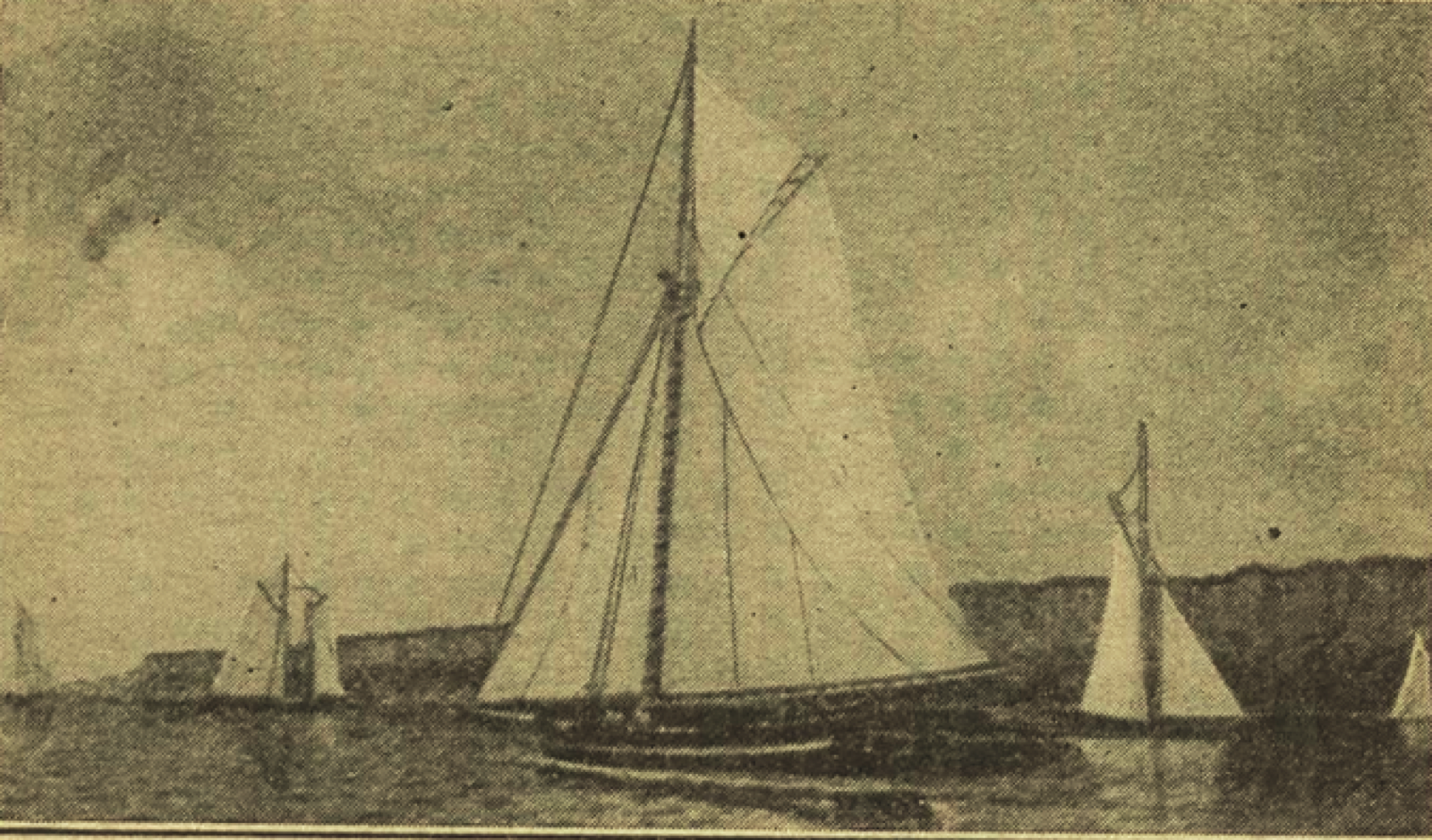
Passenger sloops on the Hudson. Henry Collins Brown, published by 1922. Public domain, via Wikimedia Commons.
How did ale survive the voyage?
A cask of ale bound for San Francisco or New Orleans spent weeks or months at sea in the heat. Nothing in Albany's records spells out how brewers made it survive, but the period methods suggest four reasons. Inference
Strength. Bottled Albany Ale tested at about 10.7% alcohol in 1843, enough to resist spoilage. Inference
Hops. Strong stock ales took 2–3 pounds a barrel Solid, and hops, as Thomann put it, "produce the preservative qualities of the liquid." Solid9
Age. Stock ale was stored three or four months before shipping or bottling, so most of the sugar had already fermented out. Inference
Tight wood. Strong-headed hogsheads like Hawe's, sealed with bungs that swelled when wet. Inference
It didn't always work. In 1844 the Brooklyn Daily Eagle reported that "a barrel of Albany Ale exploded." Single source29 Live, still-fermenting ale under pressure was part of the product. Inference
Bottles, corks and crowns
Albany's brewers sold in bottles as well as casks. In 1864 A. A. Dunlop offered "INDIA PALE ALE, XX PALE AND PORTER, in bottle or cask." Solid2 A Taylor stoneware bottle of about 1880, marked "Bottled at the Brewery, Albany, NY," was made by a pottery in Glasgow. Single source29
Closures changed fast. Charles Hutchinson patented his wire-spring rubber stopper in 1879, mainly for soda Solid67, and the Albany Cork Works was selling them by 1885. Solid William Painter of Baltimore patented the crown cap on 2 February 1892, a cap cheap enough to throw away after one use. Solid68 In 1892 the Albany Steam Bottling Works stood right next door to Hinckel's brewery on Park Avenue. Solid11
Pasteurization, the heat treatment Louis Pasteur devised in the 1860s partly to stop beer souring Solid69, was used on export bottled lager by 1901, but "The bottle stock beers are not pasteurized." Solid7 No source yet dates the first pasteurizer in an Albany brewery. Inference
The can came last. The first canned beer went on sale in 1935, and from 1942 to 1947 canned beer for the home market was barred to save tin. Solid70 During the Second World War, most of Beverwyck's beer went in green cans to soldiers in the Pacific. Single source71 The green was probably military camouflage paint, not a brand color. Inference
The Hutchinson spring stopper, patented in 1879, sold in Albany by the Albany Cork Works in 1885. Public domain, via Wikimedia Commons.
Still to find
Some of the most basic questions about how Albany beer was made are still open. What did a glass of Albany Ale cost in the 1840s? Where did Taylor's yeast come from? Which ice houses served the lager brewers? Did Beck test his ale by weight or by volume? The answers are probably sitting in 19th-century newspaper price columns, brewery ledgers and state reports. Inference If you know of one, the About page says how to get in touch.
Sources for the converter: 557273745875. Strength chart: 151333. Hop picking: 42. Bung diagram: 7.