The Albany Ale Empire
Scots on Arch Street, barley by canal, a candle-maker who built the biggest brewery in America, a libel trial about dead cats in the malting pond, and a city whose ale was drunk from New Orleans to Gold Rush San Francisco.
Two Scotsmen at harvest time
The Dutch chapter of Albany's beer ended in an old wheat brewery on Brewer's Street. The next one began on a farm. In 1868 the historian J. Leander Bishop told the story he had heard from the Boyd family. In 1796 a farmer named Boyd, "then living on an island below Albany," hired two Scotsmen to help bring in his grain. One was a brewer and the other a maltster. They had emigrated "to Canada to establish a Brewery," and they talked Boyd into building one instead. Single source1
It wasn't big. The brewery went up at the corner of Arch and Green Streets and began brewing in 1797. It "was but 24 by 30 feet, comprising a brewery and malt house." The two Scots did the malting and brewing and were bound to teach the Boyd son the trade, while his father "furnished the capital." Single source1
James or Robert?
Bishop calls the founder "Mr. Robert Boyd, the father of Robert." Every other source names James Boyd: the 1886 county history says the brewery was "founded in 1797 by James Boyd," and an 1885 trade review agrees. Disputed23 The likeliest reading is that James put up the money and his son Robert ran the brewery, and that Bishop slipped. Inference The State Museum's biography dates the founding to 1796, a year earlier than the brewing. Single source4
James Boyd was born in Scotland in 1742. He was a deacon, elder and trustee of the Presbyterian church, built brick houses on South Ferry Street across from his brewery, and died in August 1832 at the age of 90. Single source4 The 1800 census lists four enslaved people in his household. Single source His son Robert "gave up the business in a few years and removed to the country, but returned in 1808" as senior partner of Boyd & McCulloch. Single source1 In 1835 Robert swore he had been brewing ale in Albany "for thirty-one years last past," which puts his own start at about 1804. Solid5
The Boyds' little brewery had remarkable staying power. In September 1826 Boyd & McCulloch, boring for water at the brewery, reached 294 feet without finding enough. At 250 feet they had struck a vein of gas "which emitted a brilliant flame on being ignited." Solid6 A fire in September 1846 destroyed the brewery and malt house of R. Boyd & Co., along with the Mineral Spring Garden next door, the biggest blaze in the city since 1838. Solid7 It came back as Boyd & Bro., then Boyd, Brother & Co., then Coolidge, Pratt & Co. in 1863, and finally the Albany Brewing Company, incorporated around 1872 or 1873. Approximate3 By the 1880s its brick buildings, two to eight stories high, covered the whole block of Arch, Green, South Ferry and Franklin Streets. A grandson of the founder was president. Solid2
Dunlop, Le Breton, and a Mr. Gill
The other founding Scot was Robert Dunlop, who started brewing in 1806 according to Bishop. Single source The 1886 county history calls him "the first brewer in this city known to persons now living," and "another Scotchman, who, with all his peculiarities, was in his business far ahead of his day and generation." He began in "a little brewery at the corner of Broadway and Quackenbush street." Single source2 The Albany Institute holds his c.1840 lithograph advertisement for "R. Dunlop & Son's Albany Ale and Porter," printed by Joel Munsell. Solid8 He died around 1850–51, and his son Archibald A. Dunlop carried on as a maltster and brewer on Quay Street. Approximate
It's often said that Scots and Britons such as Boyd, Dunlop and Abraham Nash brought strong barley ale to the city in the 1790s. Single source9 Nash belongs to a later chapter and a different city. He swore in 1835 that he had brewed for eleven years in Troy, so from about 1824. Solid5
"Fine Albany Ale"
The brand came early. Edward A. Le Breton, who according to Bishop took over a brewery from "one Lloyd" in 1805, was advertising by 1803. Single source10 In March 1805 he offered "Fine Albany Ale" in the New York Morning Chronicle, the earliest known use of the name. Single source9 Le Breton later left; he died in Detroit in September 1830, aged 55, "formerly of Albany, where he had a brewery." Solid11
The name traveled fast. It turned up in the Hartford Courant on 30 April 1806, and four months later a Newport, Rhode Island merchant was selling "Albany Ale by the dozen" alongside brown stout. Single source1213 The first southern mention found is in the Louisiana Gazette in 1819. Single source In April 1820 the Albany Gazette could say that Albany ale had "a great and high character," and in 1822 the Argus wrote that "the reputation of the Albany brewers has long been established in New York." Single source10
That reputation rested on a small industry. A manufactures survey of 1820 found just four breweries making 8,500 barrels a year: Boyd & McCulloch and Robert Dunlop at 3,000 each, Fidler & Co. at 1,500, and Henry Birrel at 1,000. Solid2
Barley by canal
Then the Erie Canal opened in 1825 and Albany became the place where the grain of the West met the river to the sea. The Taylor company put it plainly in 1866: no city in the state was "better located for brewing purposes than Albany, it being the great central mart for the barley and hops raised in the West, and which, by way of the Erie Canal, are brought to a market at a cheaper rate than they could be by any other conveyance." Solid14
The best snapshot of that trade comes from an Albany correspondent of The New-York Farmer, writing in March 1832. He named seven breweries: "R. Dunlop, R. Boyd, Fidler & Taylor, Sinclair, Walsh & Hall, W. White & Co., J. White & Co. and A. Kirk." Solid15 And he gave the numbers:
"Near 600,000 bushels of barley are brought to this market, of which 200,000 bushels are used by the above brewers, and 200,000 by those in N. Y. and in other places on the Hudson. … During the last year 38,000 barrels of beer were brewed in this city. The Albany beer is esteemed superior to that manufactured in any section of the country, not excepting that of Philadelphia."
The barley came from a belt of counties running from Albany and Schoharie west through Montgomery, Oneida and Onondaga to Cayuga, Seneca, Ontario and Tompkins. Solid About a million pounds of hops came to the Albany market, mostly from Madison, Otsego and Saratoga counties, and 300,000 to 400,000 pounds of them were shipped on to Europe. Solid15 The writer credited Albany's edge over New York City to "the quality of the water" and the easy supply of good hops and barley, adding that one of the biggest firms had told him "he should have established his business in N. York had the water been good." Solid
His 38,000 barrels for 1831 agrees well with a later estimate of about 42,000 for 1829. Solid16 In just over a decade, the city's output had more than quadrupled. Inference
John Taylor, candle-maker
The man who would build Albany's grandest brewery came to beer late. John Taylor was born in Durham, England, in March 1790, carried to Brooklyn as an infant, and brought to Albany in 1793. At 17 he went into tallow-chandlering, making candles, with his father. He was "burned out four times" before he was 23, then made money as an army contractor from about 1813. Solid214
"The Taylor Brewery was started October 12, 1822," says the county history, in partnership with Lancelot Fidler as Fidler & Taylor. Solid21 Taylor himself swore in 1835 that he had been brewing in Albany "the last twelve years," which agrees. Solid5 A later bottle label's "c.1824" isn't a founding date. Solid That same year Taylor opened a New York depot at 113 Warren Street. Single source14
The firm grew quickly. In October 1825 Albany had "five extensive breweries," and Fidler & Taylor's was "supposed to be the largest in the United States," able to make 250 barrels of beer a day. Single source6 That was a capacity boast. Run all year, it would have exceeded the whole city's output. Inference Their malt house stood "on the hill," at the corner of State and Lark Streets, beside a pond that would soon become the most notorious body of water in Albany. Solid2 Fidler left around 1832 to form Fidler & Ryckman, and Taylor carried on alone. Solid17
Taylor took his sons into the business. John Richmond Taylor ran the New York depot from 1841, and in 1844 he and Joseph B. Taylor became partners in John Taylor & Sons. Single source14
Mayor, reader, and not the lieutenant governor
Taylor was mayor of Albany once, in 1848–49. Solid218 His 1863 obituary in the Home Journal claimed he was "several times elected" mayor, and that's probably where a collector's website got "three times." The official list shows one term. Inference14
Two John Taylors
Taylor the brewer was never lieutenant governor. That was John Tayler (1742–1829), an Albany merchant who served as lieutenant governor from 1813 to 1822 and briefly as acting governor in 1817. He was not a brewer. The near-identical names have confused writers ever since. Solid19
He was a reader. By 1858 his library held "about 10,000 volumes," kept in "a fire-proof apartment, fifty feet square" above the counting-house, and some of them had been bought at the sale of De Witt Clinton's library. Solid714
When did John Taylor die?
The company's own 1866 book reprints a contemporary obituary that says "on Saturday, August the fifteenth, JOHN TAYLOR passed away," and heads its memorial poem "OBIIT, AUG. 15, MDCCCLXIII." 15 August 1863 was indeed a Saturday. Solid14 Modern sources give 13 September 1863, and the 1886 county history prints the impossible "September 31." Disputed2021 We lean to August 15, the date printed closest to the event. A September 1863 Albany newspaper or the cemetery record would settle it. Inference
The great brewery at Broadway and Arch
On 15 May 1851 Taylor laid the corner-stone of a new brewery, sealing US coins and printed reports on Albany inside it. "During the following year the first barrel of ale was turned out." Single source14 It filled "the square bounded by Broadway, Ferry and Arch Streets, and the Hudson River," on made land: the site "was formerly covered by the waters of the Hudson," and several hundred piles were driven to hold it up. Single source It covered about two acres, at 133 Broadway. Solid122
Taylor had been to look at London's breweries first. The 1866 company book says he and his son Joseph went to Europe "in 1860" and chose "the Lion Brewery, of London" as their model, which is impossible for a plant built in 1851. Bishop, two years later, puts the trip where it must belong: "Previous to its erection in 1850, the senior of this firm visited Europe and made drawings." Disputed1 The beer historian Martyn Cornell had already argued for about 1850. Solid23
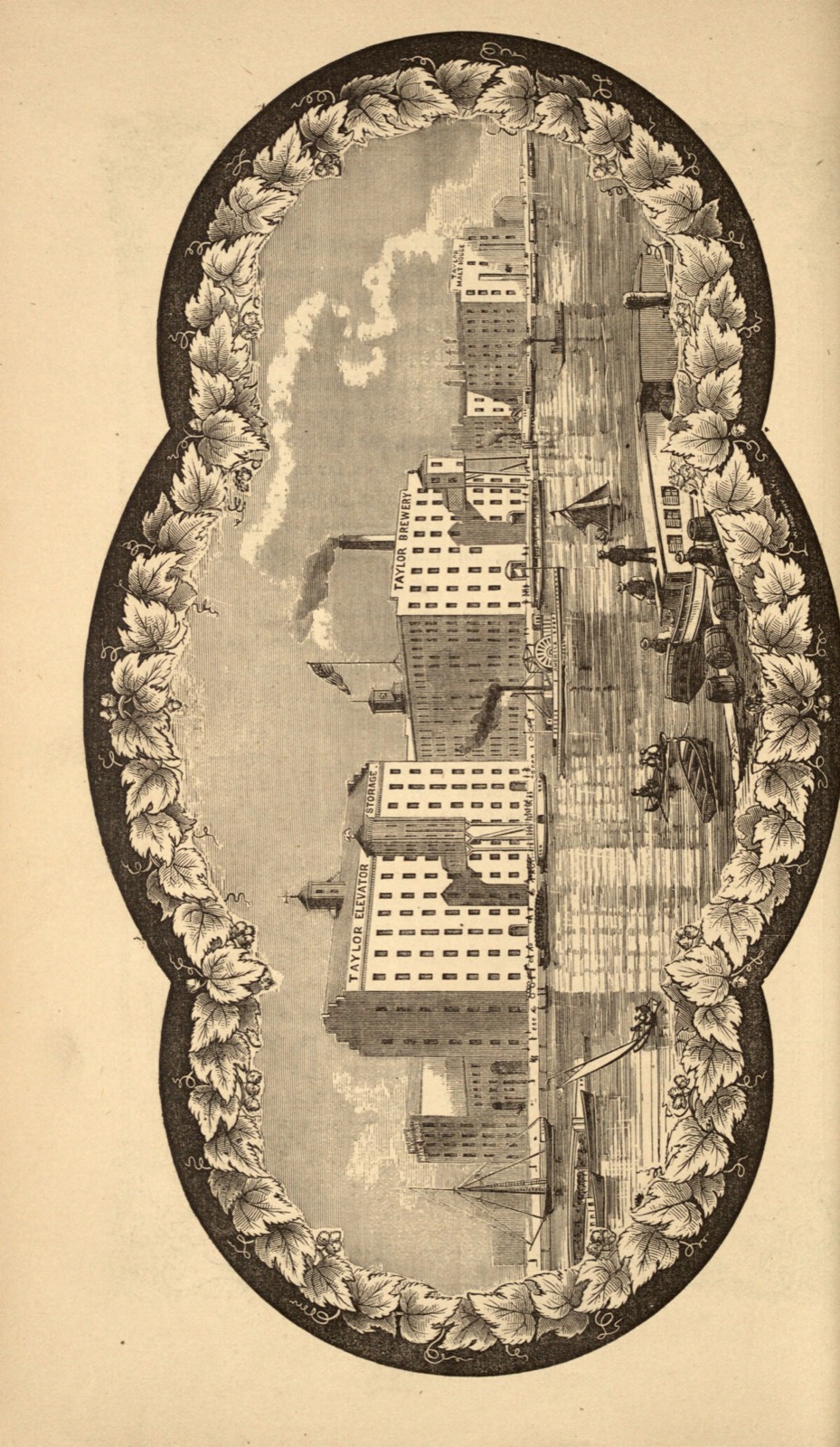
A tour in 1866
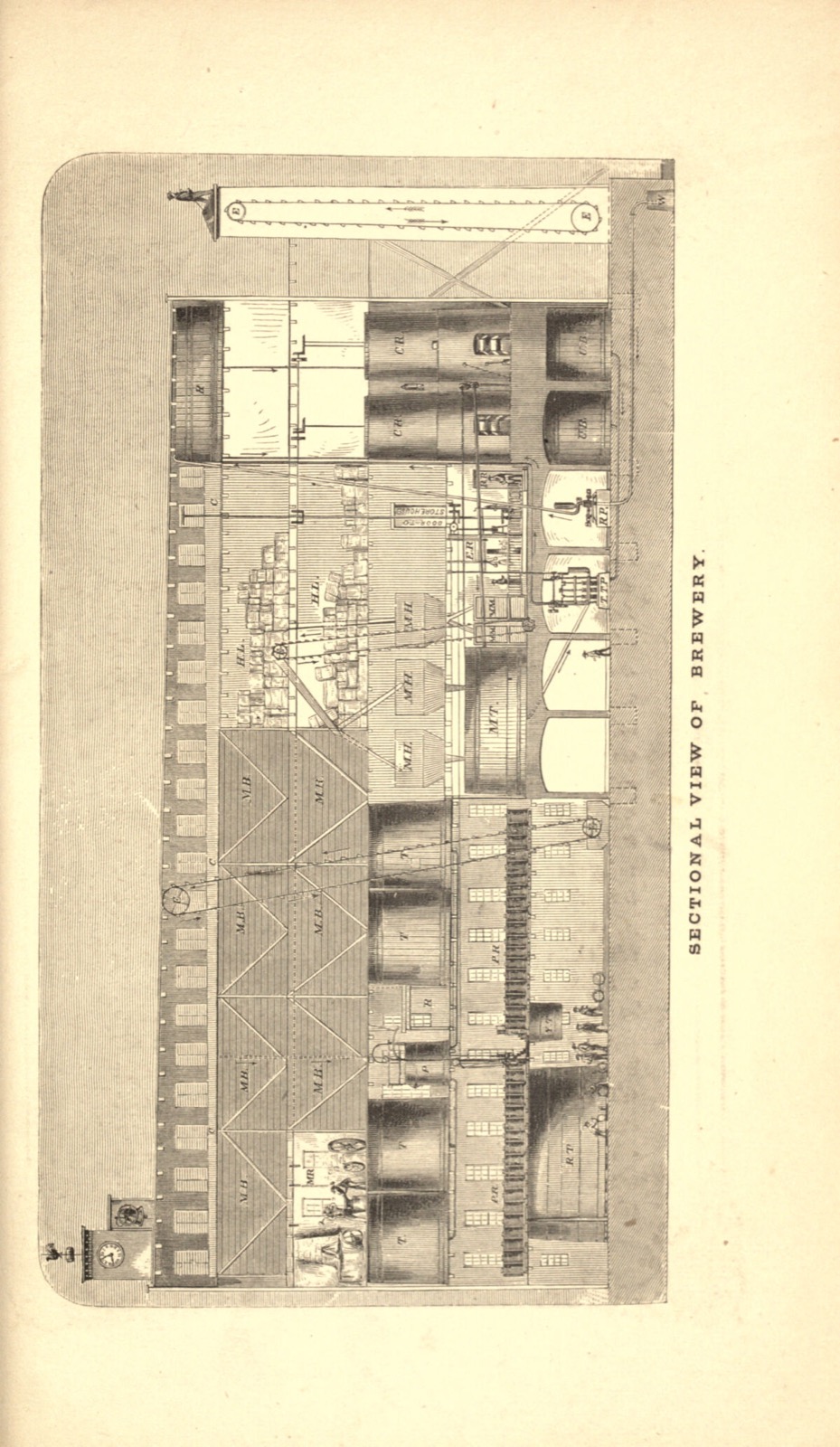
In 1866 the firm published Ale in Prose and Verse, a handsome book of poems, history and engravings that walks the reader through the plant. Solid14 The figures it gives are the company's own, but Bishop confirms the main ones. Single source
- The buildings. A main brewery six stories high, 80 by 200 feet, and a seven-story fireproof grain store on the river holding 250,000 bushels. Elevators lifted grain from the boats "at the rate of one thousand bushels per hour." Solid
- The brewhouse. Two 50-horsepower steam engines driving 700 feet of shafting, mash tuns that could take 1,500 bushels of malt a day, coppers of 1,000 and 600 barrels, and four fermenting tuns of 1,000 barrels each. Single source
- The water. A 1,000-barrel iron tank on the sixth floor, pumped from the river. "This water being taken from below the surface, is clear, cold, and free from all impurities," the book insists, perhaps with the 1840 trial in mind. Single sourceInference
- The rest. Coolers covering a whole floor, a 1,000-barrel racking tub, cellar room for 10,000 casks, 13 kilns and "over two miles of pipe." The malt houses could malt 250,000 bushels a year. Single source The book counts three malt houses and Bishop five. Disputed
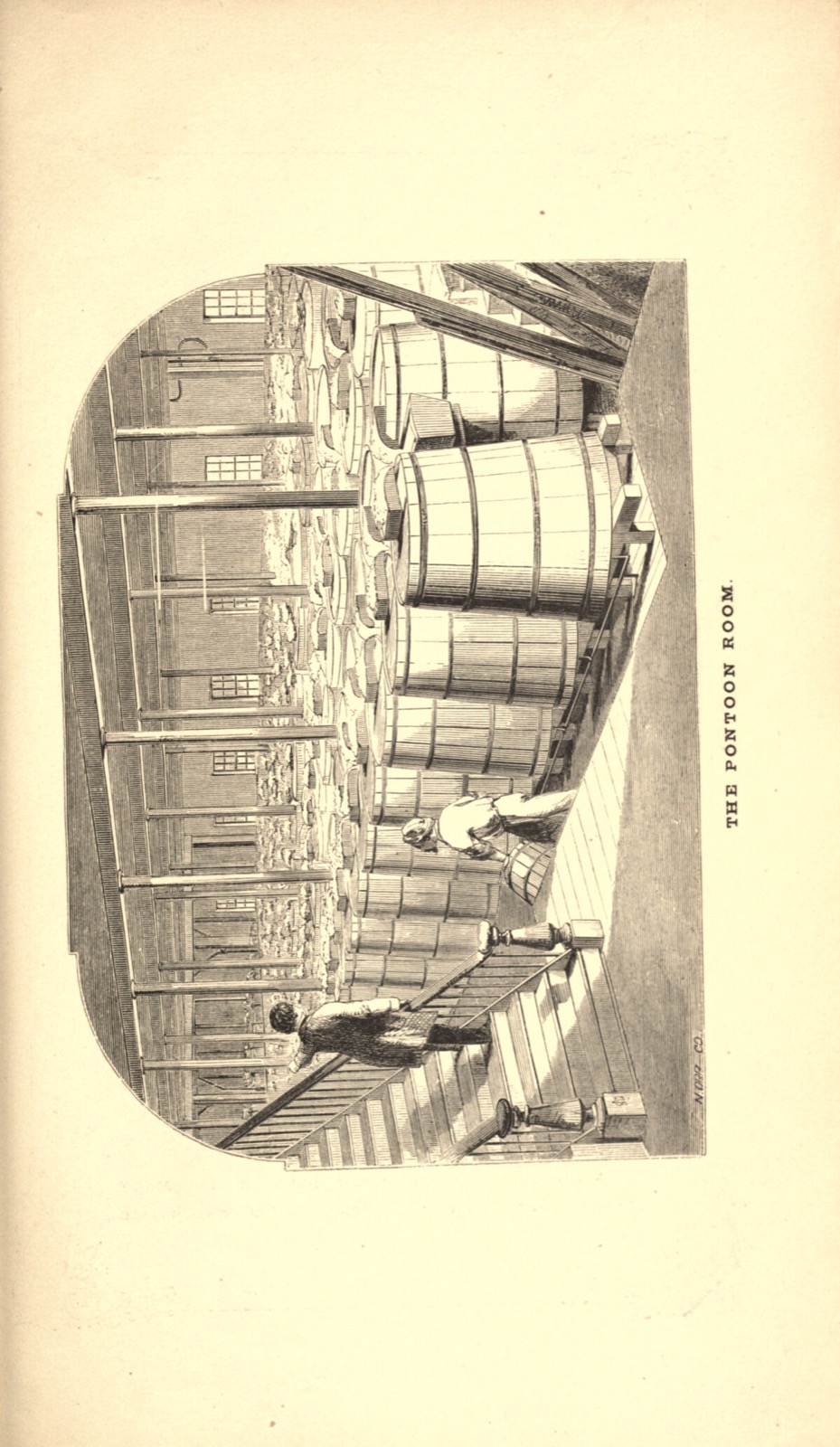
The pontoon room
The showpiece was the cleansing room, where the fermenting ale threw off its yeast. It held "three hundred and sixty-five white cedar vessels or pontoons, capable of holding twenty-six hundred barrels," one for every day of the year, set out in five rows. Solid141 The company's writer got lyrical about it:
"From each pontoon the creamy yeast, crowned with foam, reminding one of white capped billows, slowly pours itself into the receiving troughs. Heretofore this refining process was effected solely by hand — a slovenly and dirty process — which, until this pontoon apparatus was introduced by Mr. Taylor, in his present brewery, was the only one employed in this country."
Bishop called it "as yet a novelty in American breweries." Solid
The clock
The brewery told the South End the time. One evening in 1858 the common council came to inspect "the new clock and bell." The dials were six feet across, the bell weighed 1,200 pounds, and both sat nearly 100 feet above the street. They cost $4,000, and the clock was lit at night by gas burners and reflectors. Solid7 The company said the clock had won the top prize at New York's Crystal Palace fair. Single source
Capacity is not output
Bishop wrote in 1868 that the brewery had "the capacity to produce over two hundred thousand barrels per annum," and called it the largest in the United States. Solid1 That figure is often repeated as if Taylor actually brewed 200,000 barrels a year. He didn't, so far as anyone knows. The company claimed "more than two millions of barrels" brewed between 1852 and 1866, which would average roughly 140,000 a year. Single sourceInference
Not everything went smoothly. In 1852 "a copper kettle, containing 200 barrels of beer, fell from its place," doing great damage. Single source24 In June 1863, during a strike of dock and railroad laborers, the strikers "visited Taylor's Brewery, where they burst open the doors, ransacked the brewing and malt-houses, and drove the men from their work." Single source2
Taylor died that summer, and so did his son Edmund, who ran the Boston depot. Joseph B. Taylor took over New York and Boston, and William H. Taylor the Albany brewery. Solid1 By 1886, the county history noted, "the Messrs. Taylor who now conduct the business are not relatives of the founder." Single source2
Burt, Kirk, McKnight and company
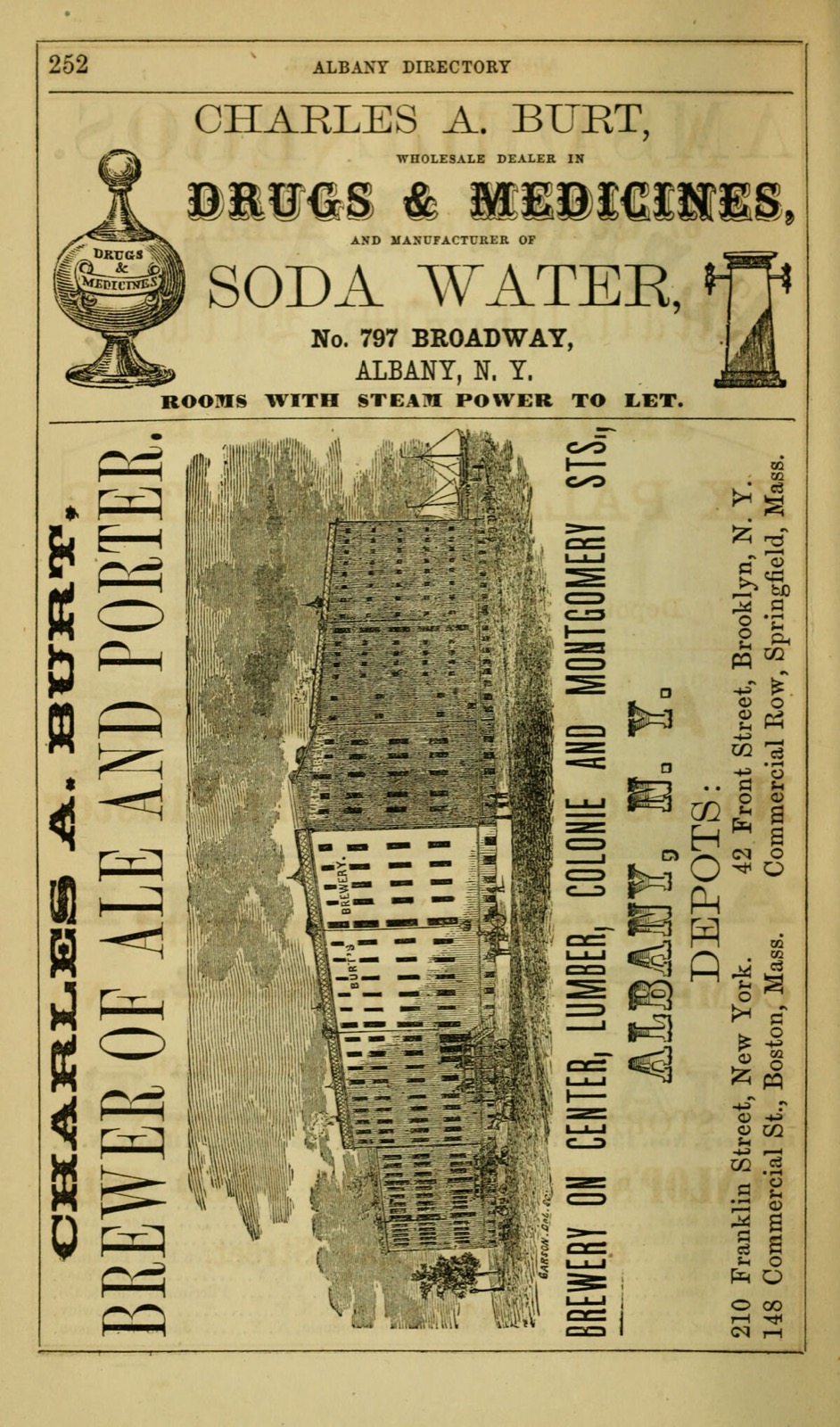
Taylor's was the giant, but not the only big house. Before 1851, Bishop wrote, "the largest in Albany was that of U. Burt & Co." Single source1 Uri Burt had brewed since 1819, including a spell in Troy as a partner in Nash, Burt & Co., and opened his Albany house with his son Charles A. Burt in 1836. Solid15 It started small, in a dwelling house at Colonie and Montgomery Streets with a capacity of about twenty barrels. Single source2 In 1841 Burt put up a brewery filling the block of Centre, Colonie, Montgomery and Lumber Streets, 325 by 209 feet, and in 1851 a malt house good for 100,000 bushels. By the 1860s it brewed "over 50,000 barrels" a year, and "in one year 1,860,825 gallons," or about 60,000 barrels. Single sourceInference1
Burt's was also, Bishop believed, "the first we believe to test the question whether malt liquors could be sold for cash only." Every cask shipped out of the city carried a deposit, refunded when it came back. Single source In a trade that ran on long credit to saloon keepers, that was a bold rule. Inference The firm made its own casks, too: it's listed under Coopers as well as Brewers. Solid25
Andrew Kirk, one of the seven brewers of 1832, swore in 1835 that he'd been brewing in Albany for three years, from "malt, hops and water, with a little salt." Solid5 His brewery on upper Broadway later became the Fort Orange Brewing Company; the county history dates it to 1838 in one place and 1839 in another. Disputed2
John McKnight brewed at Hawk and Canal Streets from at least 1852, and his son's firm ran a branch brewery in New York City on Carmine Street. Solid22 McKnight's specialty was "Malt Wine." Its ads printed an 1859 certificate from Charles H. Porter, chemistry professor at Albany Medical College, saying it held "nothing but the fermented extract of malt and hops" and more alcohol "than is generally found in American Ales." Solid25
Peter Ballantine's Albany years
One young Scot who learned the trade in Albany became more famous than any of them. Peter Ballantine moved to Newark around 1840, and his firm, P. Ballantine & Sons, became one of America's great ale brands. Solid261
The usual story comes from Bishop in 1868: born in Ayrshire in 1791, Ballantine came to America in 1820 and "entered into the employ of Robert Dunlop." Later he was offered a partnership in Fidler, Ryckman & Co., "which partnership lasted about six years." Single source1 Modern accounts turned that into an apprenticeship with Dunlop. Single source9
Ballantine, in his own words
In April 1835 Ballantine answered the State Senate under oath. Asked whether he'd been a brewer, he wrote: "Aye — in Schenectady and Albany for seven years; in Schenectady, two years for J. M. Schermerhorn; in Albany, two years for Robert Boyd; one year for Andrew Kirk; and two years for myself." Solid5
Dunlop isn't on the list. Ballantine's own account starts around 1828, with Schermerhorn, Boyd and Kirk. If he did work for Dunlop, it must have been between 1820 and 1828, and perhaps as a maltster rather than a brewer. Inference The Dunlop apprenticeship is now disputed. Disputed
By 1835 Ballantine had his own Albany brewery with eleven men, including two maltsters, a drayman, coopers and a clerk named William Fidler. He brewed with "malt, hops, and a very small quantity of common salt," except once when he "tried the experiment with thirty pounds of sugar, and at another time, with half a barrel of honey." Solid5 In October 1838 he was still in Albany, "the famous maltster and brewer" who found a job for a newly arrived Glasgow man, Thomas McCredie, who became one of the city's biggest maltsters. Single source2
What Albany Ale tasted like
Nobody alive has tasted the real thing, so its character has to be pieced together from what its brewers said they put in it. The best evidence is a set of sworn statements made to the State Senate in 1835. Solid
- Robert Boyd: "barley malt, hops, salt, and when the extract from the malt is pale, burnt sugar is added for coloring." Solid
- Lancelot Fidler: "Ales are of three colors, pale, amber and brown; these colors are made by drying or roasting the malt on the kiln … scarcely any two are the same … Clean vessels, pure air and water, are indispensable to obtain fine flavored ales." Solid
- White, Barker & Co.: malt "dried by a slow fire, it makes 'pale ale,'" and "when higher dried, it makes 'brown ale.'" Solid
- Abram Nash of Troy: three to three and a half bushels of malt to the barrel, dried "on a tile kiln at a slow but suitable heat, with hard coal" to "a light amber," and four quarts of fine table salt to every fifty barrels in the boil. Solid5
Some brewer told the senators they used "the palest malt and the palest bales of hops." Single source9 Put together, the picture is a strong, pale or amber barley ale, salted, sometimes sweetened a little with sugar or honey, and often sold as "XX." Inference Its exact character changed over the century and is still argued over by the people who rediscovered it. Inference
What "XX" meant
X marks were an old British way of grading beer by strength, in use at least since 1695, when a Southwark brewery shipped "15 Tunns of XX beer" to Barbados. Nobody has proved where the X came from. Solid27 WAMC's description of Albany's version is a "double-strength XX ale." Single source28 By the 1880s in Britain the standard gravities were 1055 for X and 1061 for XX mild, so XX meant stronger, not double. Solid27 Taylor's "Imperial" was a brand name, not a strength grade. Single source29
Taylor's own poets named three of his beers in 1866: "Their 'amber' brand is light and cheery, / Their 'XX' is strong, though pale, / But give to me, when dull and weary, / Their cream, imperial 'Astor' ale." Solid14 The "cream ale" was not today's cold-conditioned style, and whether it began as an answer to lager is argued over. Disputed29
How strong was it?
One chemical analysis survives from the 1840s. Dr. L. C. Beck found 7.38% alcohol by weight in Albany ale from the cask and 10.67% in bottled ale, roughly 9 to 13% alcohol by volume. Single source929 That's one sample, and bottled ale may have kept fermenting. Inference A Poughkeepsie log of 1834, from Matthew Vassar's brewery, works out to about 8% by readers' estimates, which are disputed. Disputed30 Try the comparison below.
How strong was Albany Ale?
Pick a beer. Bars show alcohol by volume. Alcohol by weight is converted at roughly ×1.25.
Three schools of thought
The two men who led the modern Albany Ale Project disagree. Alan McLeod sees a strong, heavily hopped pale ale with roots before 1800. Craig Gravina sees a lightly hopped XX mild, brewed stronger for export, with no link to Dutch wheat beer or to Scotch ale. The historian Maureen Ogle treats "Albany Ale" as a regional label, like "Milwaukee lager," rather than one fixed style. Disputed29 Ron Pattinson's study of Amsdell's brewing logs from 1900–05 found their XX resembled a London X ale, an ordinary mild, in gravity and hopping, though by then the beer had had seventy more years to change. Single sourceInference31
Drugs in the beer? The Senate asks
Albany's brewers were rich, respectable, and about to be dragged through the mud by the most famous temperance man in America. Edward C. Delavan had made a "handsome fortune in trade," much of it importing wine, before turning to the temperance cause. Solid11 Early in 1835 he made two separate charges. One was that brewers drugged their beer. The other, which led to the lawsuits, was about the water in their malt. Solid
The drug charge went to the State Senate first. A memorial "of sundry inhabitants of the city of Albany, in regard to the manufacture of beer" was sent to a select committee under Senator John W. Edmonds. Solid5 On 16 April 1835 Delavan declined to testify. "I disclaim any personal information on this subject," he wrote, but "I have no doubt that deleterious drugs are to some extent used in the manufacture of strong beer," and only a committee that could compel "unwilling as well as willing witnesses" would get at the truth. Solid The Senate refused to give the committee that power. Solid
So the committee sent six sworn questions to every brewer "between and including Lansingburgh and Brooklyn." Question three asked about a sinister list: "coculus indicus, nux vomica, opium, laurel leaves, copperas, alum, sulphuric acid, salt of steel, aloes, capsicum, sulphate of iron." Solid Albany's brewers answered, and their workmen too, sometimes signing with a mark: Fidler & Ryckman, Andrew Kirk, Peter Ballantine, White, Barker & Co., Robert Boyd, and John Taylor and his head brewer. So did the Troy brewers, Matthew Vassar in Poughkeepsie and about a dozen in New York City. Solid5
Taylor swore that "barley malt, hops, water and yeast, (with the exception of small quantities of white sugar and fresh honey,) are the only articles ever used by me." Solid Fidler added an argument of his own: "In America, the drunkard is no patron of the brewer; he is not willing to distend his stomach, lose his time, pay five times as much to get intoxicated, as he must, if he uses beer instead of ardent spirits." Solid
The committee cleared them. "Malt, hops and water are the only ingredients used in the manufacture of beer," it reported, apart from a little salt, some honey, molasses or sugar, and burnt sugar for color. "Every answer denies, unequivocally, the use of any noxious or unwholesome drug." English brewers had a motive to cheat because of heavy duties; "the absence of such duties here, removes the inducement." A few brewers admitted trying drugs years before, "but it is averred in every instance, that the experiment failed." Solid5
Dead cats in the malting water: Taylor v. Delavan
The second charge was the one that stuck. Delavan ran it first in his American Temperance Intelligencer, "a copy of which was placed in every family in the city of Albany, and sixty thousand circulated throughout the Union." Solid17 On 12 February 1835 it appeared in the Albany Evening Journal under the heading "TO THE PUBLIC." Citing an unnamed informant, it said that six or seven years earlier, Fidler & Taylor's and Robert Dunlop's malt houses "on the hill" had drawn their steeping water:
"…from stagnant pools, gutters and ditches, often in such a state as to be green on the surface … the water was often taken from puddles in which were dead animals. When the water was low in the pools, holes were sometimes made, in which the pail was sunk; and he had seen the sides of it come in contact with dead animals in a state of putridity; has seen water carried to the malt houses nearly as thick as cream with filth."
Delavan also explained why a maltster might do it: filthy water "could be procured for about sixpence a hogshead, while it would cost about fifty cents to procure pure." Solid17
Taylor moved fast. On 18 February he swore that Delavan meant to take his family to Europe for four years and had advertised his mansion for sale, and Delavan was held to bail in $5,000. Solid Eight maltsters and brewers sued, "with damages laid at $300,000," and Delavan was held to bail of $40,000. Taylor's own suit claimed $74,000. Solid17 One related case, Ryckman v. Delevan, went up to the Court of Errors in 1839. Single source32
Six days in court
John Taylor vs. Edward C. Delavan opened at the Albany Circuit on Tuesday 21 April 1840 before Judge Cushman. (The county history calls him Cushing; the trial report says Cushman.) Solid17 "This trial occupied six days. Seventy witnesses were examined pro and con." Solid2
The printed report includes a map of the neighbourhood of the malt houses. Its key reads like an inventory of everything a city wanted out of sight: the malt house and the pond, a glue factory and its drain, slaughterhouses, a "Dead hog," "Remains of dead horse," the Orphan Asylum and its drain, a privy on the creek, and the burying grounds of nearly every denomination, along with Potter's Field and a burial ground for Black Albanians. Solid17
The star witness was Charles W. Harvey, a surgeon-dentist who as a young man had helped his brother-in-law, a carter named John Quinlan, haul water to Taylor's malt house. Asked about the pond, he said it was "bad, from the fact that it was receiving almost all the offal from the hill; dead hogs and dogs and cats; horses all drawn very near the pond." How did they get water in winter, when the pond froze? "Cut a hole through the ice." And then:
"I have drowned cats in these holes myself."Charles W. Harvey, testifying in Taylor v. Delavan, April 1840
"Was it the ordinary way to drown cats in these holes?" "It was." Solid17
The brewers' side did its best. William Amsdell, Taylor's brewer, said he had drunk the malting water himself and that it was "sweet, pure water." The maltster John G. White "always considered the pond water good, in the fall, winter and spring." Solid Taylor's counsel tried patriotism on one witness, the English-born brewer Launcelot Howard: hadn't the great Thames breweries been reputed to make the best beer in the world, "until you beat them here in Albany?" Howard gave a brewer's answer: "They are reputed to make the best porter, but not the best ale." Solid17
The verdict
"The jury retired at 9 o'clock P. M.; and after a consultation of about an hour agreed upon a verdict," which was sealed and handed in on Monday: "FOR THE DEFENDANT, WITH COSTS." Solid17 This was a civil libel suit, so Delavan wasn't "acquitted," as some accounts put it: the brewers simply lost, and recovered nothing. Solid The Albany City Temperance Society called it "a righteous triumph of truth and patriotism over a combination of wealth and influence." Solid
Delavan was gracious in victory, after a fashion. "I esteem Mr. Taylor as one of our most worthy and estimable citizens," he wrote on 1 May 1840. "Were I a beer drinker, even now, I would as soon drink Mr. Taylor's beer as that of any other maker." Then he argued that beer was worse than spirits anyway, because the hop was "a deadly narcotic." Solid17
The story clung to Albany ale. An 1841 temperance tract has a reformed Baltimore drunkard calling it "cat soup," and an 1841 temperance paper glossed "O.K." as "Oil of Karrion," meaning Albany ale. Single source12 The pond outlived the case. In 1852 a grand jury declared the pond at Lark and Lancaster Streets a public nuisance, noting that it had once been the head of the Ruttenkill, that "the water had long been used for malting," and that it had led to "a libel suit between Mr. E. C. Delavan and the brewers." Solid24 The ravine had been filled in between 1845 and 1848 by Charles Stanford, the brother of Leland Stanford. Solid2
The Lament of the Albany Brewers
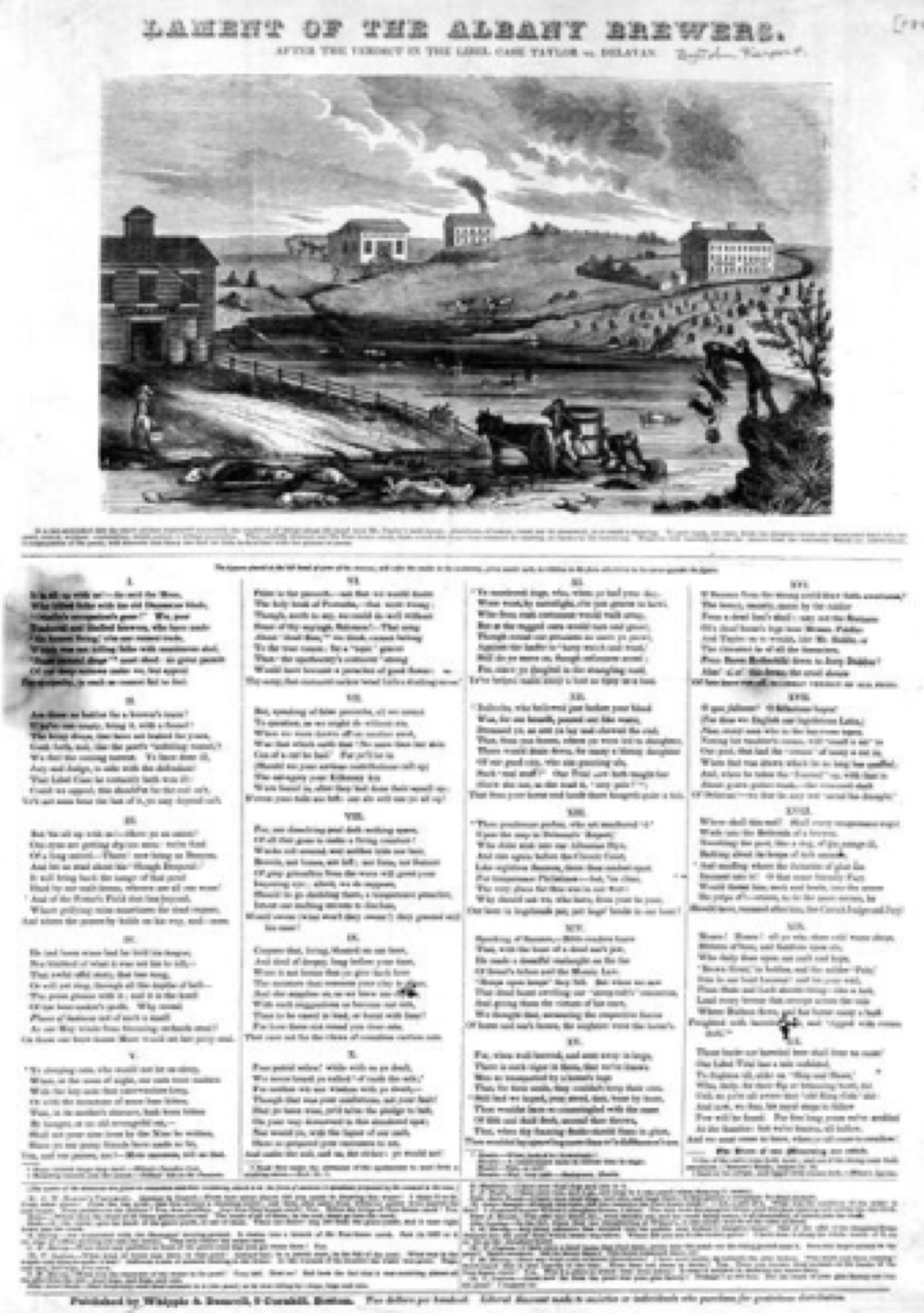
Within months a Boston printer had turned the verdict into a broadside: twenty mock-tragic stanzas in the voice of the beaten brewers, each footnoted to trial testimony, under an engraving of the malt house, the pond full of carcasses, a carter dipping water, and a man drowning cats. It sold at "two dollars per hundred," with discounts for anyone buying "for gratuitous distribution." Solid33 The caption admits the picture isn't literally accurate, but says anyone who reads the testimony "will discover that fancy has had but little to do either with the picture or poem." Solid Stanza XVII has the drinker in the tap-room who will now "'smell a rat' in / Our pool, that had the 'cream' of many a cat in." Solid And the last stanza ends: "And we must cease to brew, when ye all cease to swallow!" Solid
Who wrote it?
The surviving copy carries the words "By John Pierpont," the Boston minister and temperance poet. But they're handwritten on the sheet, not printed, and the poem isn't in Pierpont's collected poems published that same year. Disputed3432 Treat Pierpont as a librarian's attribution, not a fact.
Depots and distant markets
In July 1849 the Merchants' Magazine took stock. "Six breweries and malt-houses of the largest dimensions were erected in this city the past year, and the whole number of such establishments is about twenty," it reported, and "Albany ale and beer are found not only in every city in the Union, but likewise in the West India islands, in South America, and in California." It estimated output at 80,000 barrels, with $500,000 of capital and 500,000 bushels of barley bought a year. Solid35 About five years later another writer put it at "upward of 100,000." Solid36 A temperance survey of 1851 claimed 167,000 barrels from just seven breweries, which is out of line with both. Disputed37
The trail of advertisements bears out the boast. On 28 December 1850 a San Francisco cargo list included "100 casks Albany ale" beside the champagne and cider. Single source38 A dealer's ad of about 1859 listed "Boyd Bro. & Co.'s Albany Ale" next to Philadelphia, Portsmouth and Boston ales. Single source39 Weeks after the Civil War ended, grocers in New Berne, North Carolina, were advertising "BURTS CELEBRATED ALBANY ALE." Single source40
The South was a bigger market than anyone expected. Craig Gravina searched about 3,500 newspaper mentions of Albany ale from 1800 to 1900, leaving out New York papers. Seven of the top ten states were southern, and Louisiana led with 94 hits, ahead of Pennsylvania, the first northern state, in fourth. Single source12 Albany ale was, in his words, fairly common in the antebellum South. Single source The Albany Institute lists Charleston and New Orleans at home and Newfoundland, Hawaii and Surinam abroad, and says most Albany Ale was made for export. Single source8 Taylor was probably shipping to Hawaii by 1858, though that hasn't been confirmed in a primary source. Single source9 No evidence has turned up that Albany ale reached England. Solid
An owned-depot system
By the 1860s the big firms didn't just ship to wholesalers. They ran their own depots. Inference
| Brewery | Depots and agents, 1860s | |
|---|---|---|
| Taylor | New York (Warren St from 1822, then Greenwich St, then a six-story building at Greenwich and Jay begun 1862); Boston (1851). "Agents in all the principal cities in the Union." | Solid |
| Burt | New York, Brooklyn, Boston, Springfield | Solid |
| Amsdell | New York, plus agents in Springfield, Pittsfield, Hartford, Rutland, Poughkeepsie, Yonkers and more | Solid |
| McKnight | A branch brewery on Carmine St, New York | Solid |
| A. A. Dunlop | New York depot on Liberty St | Solid |
Sources: Albany Directory 1862 and 1864 advertisements; Ale in Prose and Verse (1866). 2225
Taylor divided the country between his houses: "The Boston depot supplies the entire eastern, the New York one the southern, and the Albany one the western markets." Single source The New York building had vaults roofed with Quincy granite slabs 16 by 20 feet, and the empty casks went home to Albany "by barges belonging to the firm." Single source14
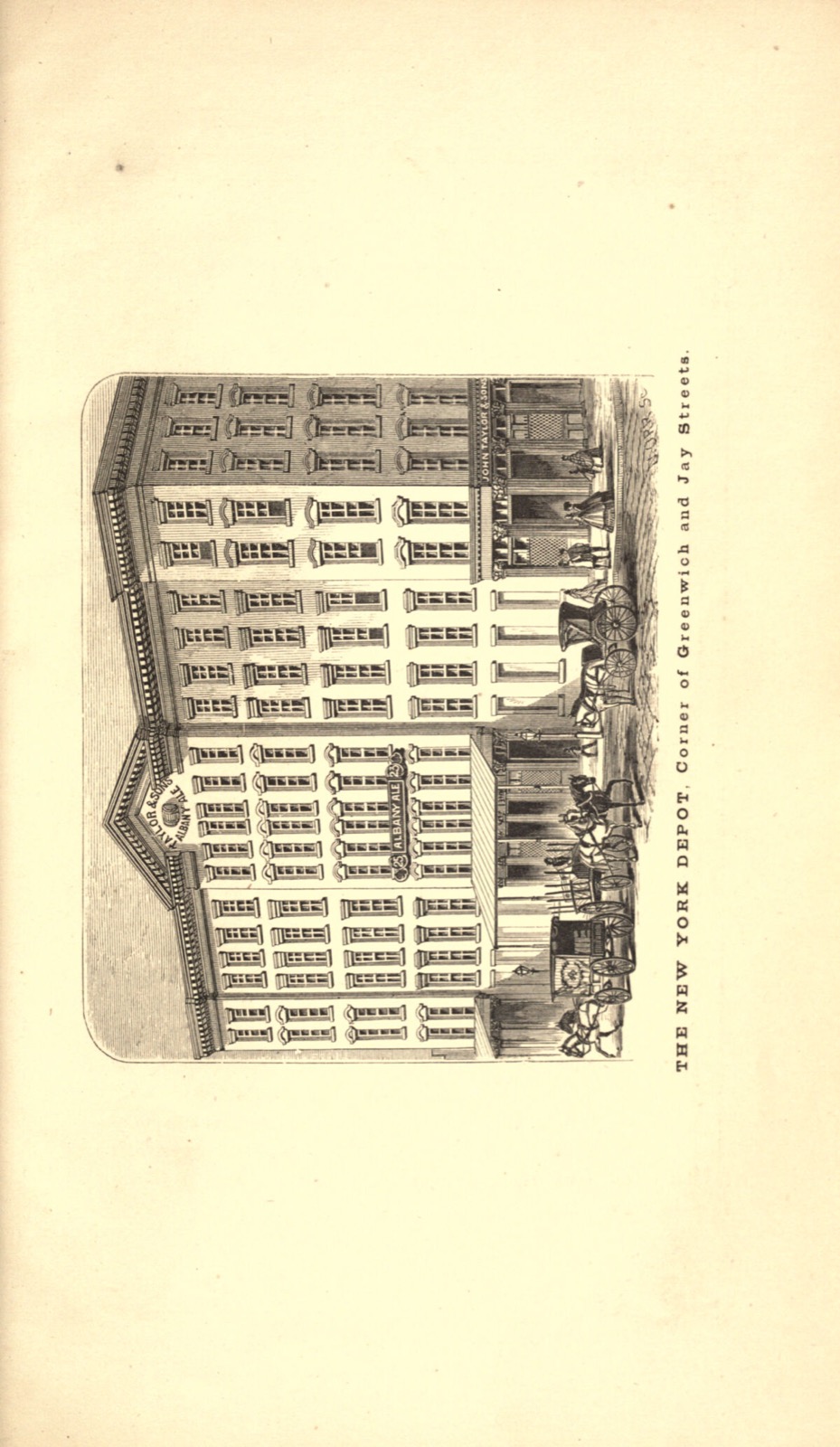
"Their mothers' milk is Taylor's ale."The humorist Saxe on Albany's healthy children, in Ale in Prose and Verse, 1866
Fathers and sons: the Amsdells
The name that lasted longest in Albany ale was Amsdell, and it belongs to two generations that are easy to mix up. Solid
William Amsdell, the father, was an English brewer. At the 1840 trial he said he had learned his trade in Essex, served an apprenticeship of four and a half years, and started as a maltster: "My father used to carry on brewing." Solid17 In 1835 he swore he had "the full charge of the brewing department of Mr John Taylor's brewery," so he was Taylor's head brewer in the early 1830s. Solid5 Later he "started a little brewery in the country," out on the Great Western Turnpike, where the directories still list him as a brewer in 1864. Solid222
His sons George I. and Theodore M. Amsdell founded Amsdell Brothers on Jay Street. The county history says it "began in 1850," and other dates run from 1851 to 1854, when George is said to have bought the "White brewhouse." Disputed2 The often-quoted 1844 date belongs to the father's country brewery, not to Jay Street. Inference By 1859 the brothers' ads gave "Brewery, 135, 137, 139 and 141 Jay St.," and from 1860 "Nos. 135, 137, 139, 141, 143 and 145." Solid25 George served as a Ninth Ward alderman around 1862–63, and Theodore later sat on the council too. Solid
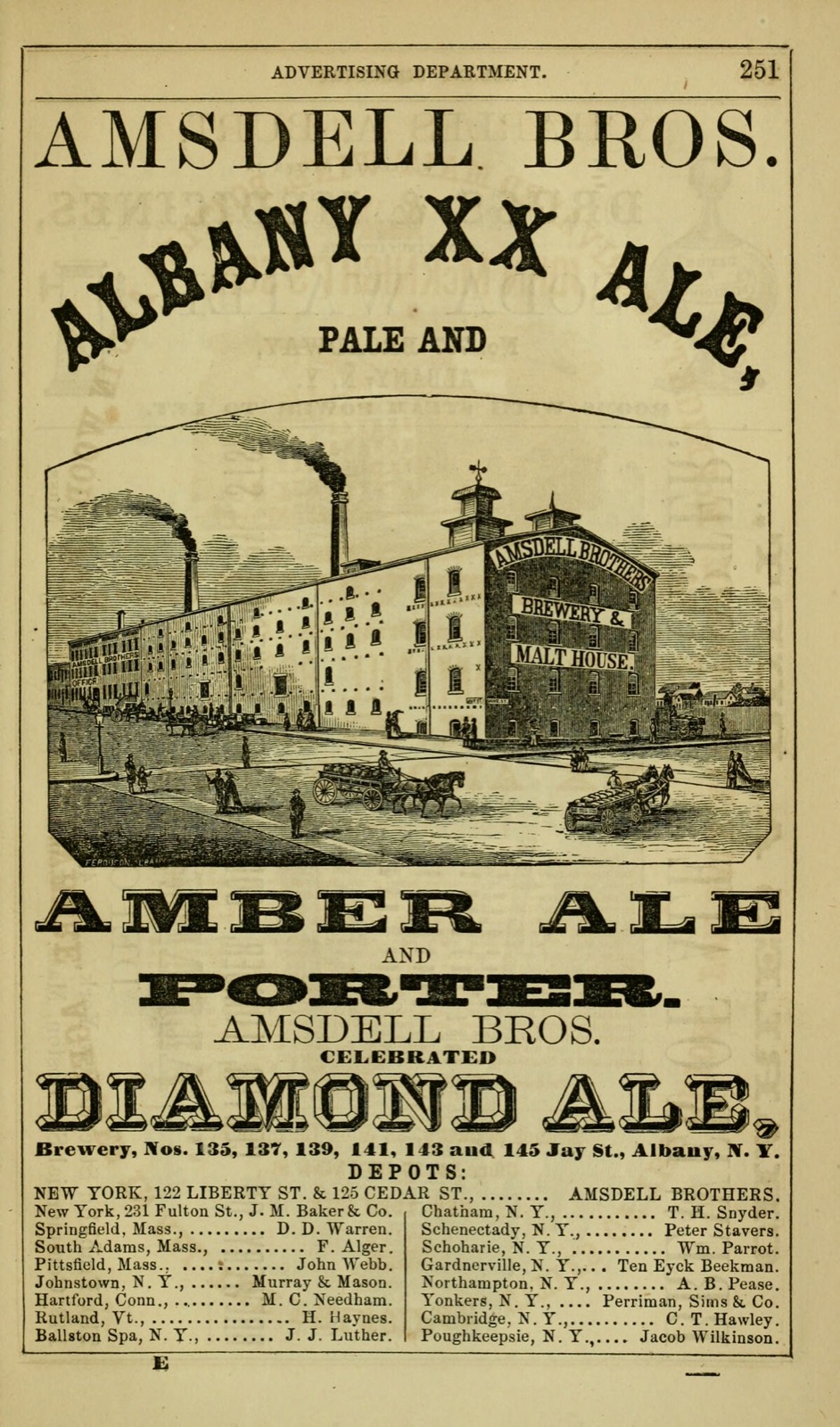
Amsdell grew into one of the city's biggest breweries. In the year to May 1877 it sold 41,282 barrels. Solid41 By the mid-1880s it covered 354 by 150 feet with six brick buildings five and six stories high, employed 150 men, and turned out 80,000 barrels of ale and 160,000 bushels of malt a year. Solid2 Amsdell would go on to be the last brewery to advertise an Albany Ale. Single source9
Corrected: whose 80,000 barrels?
Earlier versions of this research credited "~80,000 barrels of ale and 160,000 bushels of malt a year in the 1880s" to Taylor. The 1886 county history gives those figures for Amsdell Brothers, and gives no output for Taylor at all. The often-repeated "nearly 100,000 barrels in the 1870s" for Amsdell doesn't fit the contemporary numbers either: about 41,000 barrels in 1877, rising to about 80,000 by the mid-1880s. Solid2
Quinn & Nolan
On North Ferry Street, James Quinn brewed ale from the mid-1840s; one source says 1845 and another "forty years" before 1886. Approximate242 In 1866 Terence J. Quinn and Michael N. Nolan formed a partnership that lasted until Terence's death in 1878. Solid Nolan, born in County Carlow in 1833, had worked in law, managed a San Francisco street railway and worked for the brewer John McKnight. He married James Quinn's daughter. Solid4342
They were Albany's most political brewers. Terence Quinn sat on the Common Council, went to the Assembly, and was elected to Congress in 1877. He died in office in June 1878. Solid44 Nolan became mayor of Albany in 1878 and served in Congress from 1881 to 1883 at the same time. He resigned as mayor in 1883 after a court contest, The People ex rel. John Swinburne vs. Michael Nolan, found frauds in the 1882 election. Solid2
In 1877 Quinn & Nolan sold 44,571 barrels. Solid Since the lager plant didn't exist yet, that was presumably all ale. Inference41 The next year Nolan opened the Beverwyck lager brewery beside it, under a German manager, the start of the next chapter. Solid45
A city of sixteen breweries
The 1862 Albany directory is often said to list 19 breweries, and it does print 19 names under "Brewers." But three of them made root beer or spruce beer, not malt beer. The real count of ale and lager breweries in 1862 is 16. Solid46 Thirteen made ale, two made lager, and one made both. Inference
| 1862 listing | Address | What it made |
|---|---|---|
| Amsdell Brothers | Jay near Dove | Ale, porter |
| D. B. Anderson & Co. | Beaver cor. Green | "Home Brewed Ale" |
| John Artcher | Plankroad above Perry | Ale |
| Becker & Cameron | 282 Broadway | Ale |
| Boyd, Brother & Co. | Arch cor. Franklin | Ale, porter |
| U. Burt & Co. | Montgomery, Lumber, Colonie & Centre | Ale |
| James Coyle | 127 Nucella | Ale |
| A. A. Dunlop | 67 Quay | "XX Pale and Porter" |
| John F. Hedrick | 354 Bowery | Lager |
| John M. Link | West Arch near Perry | Ale (possibly lager) |
| John McKnight's Son | Hawk cor. Canal | Pale, brown, amber, XX, porter, "Malt Wine" |
| Anthony McQuade | 271 North Pearl | Ale ("Crystal Ale Depot") |
| James Quinn | 26 North Ferry | Ale |
| Schinnerer & Hinckel | Swan cor. W. Ferry | Lager |
| John Taylor & Sons | Broadway cor. Arch | Ale |
| Henry Weber | 65 Bowery | Ale and lager |
| Not counted: Patrick Dillon (root beer), Kinsella & Hennessey (root beer), John Milliman (spruce beer). | ||
Source: Albany Directory 1862, Business Directory, "Brewers," p. 161. Solid Directory counts are listings, not plants: one firm can appear twice and one-man brewers count the same as Taylor's. Inference
Look at who was there. Ten years after Albany's first lager brewer appeared in the directory in 1852, the ale houses still outnumbered the lager brewers more than four to one. Inference2
1877: the ale houses at their height
The clearest picture of the trade at the end of this era comes from a table in the Western Brewer, reprinted in One Hundred Years of Brewing (1903): the Albany brewers who sold more than 12,000 barrels in the year ending 1 May 1877. Solid41 These are sales, not capacity.
Ale houses in gold, the lager house in blue. Which brewery was behind "Alex. Gregory" and "James Walker" is our reading: Gregory later headed the Fort Orange Brewing Co. on the old Kirk site, and a Smythe & Walker ran that site until 1882. Inference
The surprise is at the top. The biggest seller wasn't Taylor's palace on Broadway but the Albany Brewing Company, the descendant of Boyd's 24-by-30-foot brewhouse of 1797, with 72,723 barrels. Solid Taylor & Son sold 53,453, Quinn & Nolan 44,571 and Amsdell 41,282. Solid Only one of the seven, Frederick Hinckel, made lager, selling 20,157 barrels. Solid41 Together the four biggest ale houses sold more than 210,000 barrels, far beyond the whole city's 80,000 of 1849. Inference
An ending that wasn't a decline
It's usual to say that Albany Ale faded after its golden age. The numbers say otherwise. In the year to May 1884 Albany brewed 263,459 barrels of ale against 94,475 of lager. Solid2 (The same page's text gives a city total of 359,203, which doesn't match its own table's 357,934.) Disputed Ale output roughly tripled between the 1840s and the 1880s. Inference
What Albany lost after the 1860s was its fame and its far-off markets, not its volume. As railroads spread west, any town could get barley and ship beer, and the canal junction stopped being an advantage. Single source8 Drinkers' tastes turned toward crisp German lager. Single source In 1878 an ale brewer and mayor, Michael Nolan, built what the city's handbook called "the model lager beer brewery of the United States" next to his ale house on North Ferry Street. Solid45 The ale houses kept brewing into the next century, but the story's center of gravity was moving, to the Germans of the South End and the Beaver Kill. Inference
Sources for this page
- Bishop, History of American Manufactures, vol. 3 (1868) archive.org
- Howell & Tenney, Bi-centennial History of the County of Albany (1886) archive.org
- New York's Great Industries (1885) archive.org
- NYS Museum: James Boyd exhibitions.nysm.nysed.gov
- NY Senate Doc. No. 88 (1835) archive.org
- Munsell, Annals of Albany vol. 8 archive.org
- Munsell, Annals of Albany vol. 10 archive.org
- Albany Institute: Albany Ale www.albanyinstitute.org
- Gravina, BeerAdvocate (2017) www.beeradvocate.com
- A Good Beer Blog abetterbeerblog427.com
- Munsell, Annals of Albany vol. 9 archive.org
- A Good Beer Blog (2019) abetterbeerblog427.com
- Newport Mercury, 30 Aug 1806 archive.org
- Ale in Prose and Verse (1866) archive.org
- The New-York Farmer, 12 Apr 1832 archive.org
- Whish, Albany Guide Book (1917) archive.org
- Trial report (1840) archive.org
- Wikipedia: List of mayors of Albany en.wikipedia.org
- Wikipedia: John Tayler en.wikipedia.org
- Brookston Beer Bulletin brookstonbeerbulletin.com
- Tavern Trove: Taylor www.taverntrove.com
- Albany Directory (1864) archive.org
- Zythophile: Pontos in America zythophile.co.uk
- Munsell, Annals of Albany vol. 4 archive.org
- Albany Directory (1862) archive.org
- Craft Beer & Brewing: Ballantine beerandbrewing.com
- Zythophile: Everything you wanted to know about X zythophile.co.uk
- WAMC (2013) www.wamc.org
- A Good Beer Blog abetterbeerblog427.com
- A Good Beer Blog: an 1834 brewing log abetterbeerblog427.com
- Pattinson, "American Ales circa 1900," BeerAdvocate www.beeradvocate.com
- Readex blog www.readex.com
- Lament of the Albany Brewers (1840), via Readex www.readex.com
- Pierpont, Airs of Palestine, and Other Poems (1840) archive.org
- Hunt's Merchants' Magazine, July 1849 archive.org
- Fisher, Progress of the United States archive.org
- Munsell, Annals of Albany vol. 3 archive.org
- Daily Pacific News, 28 Dec 1850 archive.org
- Daily Morning Chronicle (c.1859) archive.org
- North Carolina Daily Times, 30 May 1865 archive.org
- One Hundred Years of Brewing (1903), p. 612 archive.org
- One Hundred Years of Brewing (1903) archive.org
- Wikipedia: Michael N. Nolan en.wikipedia.org
- Wikipedia: Terence J. Quinn en.wikipedia.org
- Phelps, Albany Hand-book (1884) archive.org
- Albany Directory (1862), p. 161 archive.org