Lager on the Beaver Kill
German immigrants, singing societies and a ravine full of breweries: how Albany, the capital of ale, learned to brew lager, built refrigerating machines and union halls, and watched its old ale houses close one by one.
Germans on the hill
For two hundred years Albany's beer had been Dutch, then English and Scottish. In the middle of the nineteenth century a third people arrived and changed what the city drank.
The first signs are small. On the Fourth of July 1842, a city chronicle notes, "the Germans hold a celebration of their own," apart from the temperance societies' parade. Single source1 In September 1848 the exiled revolutionary Friedrich Hecker passed through with fifty companions on his way to Illinois, a sign that the wave of "Forty-Eighters" fleeing the failed German revolutions was reaching the upper Hudson. Single source Albany's first German singing society, the Liederkranz, formed in 1849 and lasted about six years. Single source2
By 1852 the community had a newspaper, the Freie Blaetter, published at 44 Beaver Street and edited by Aug. Miggael. On 16 August 1852 came the "First public procession of the Turn-Verein and Sing-Verein," the gymnastic and singing clubs at the heart of German immigrant life. Single source1 It's the earliest date found for an Albany Turnverein, and it falls in the same year that Frederick Hinckel and John Hedrick, two of the city's future lager brewers, came to Albany. Inference
These were not quiet newcomers. On 1 February 1854 "the German element" gathered in Capitol Park and burned an effigy of Bedini, the pope's envoy, the mark of a freethinking, anticlerical crowd. Single source1 An 1869 count put Albany's German-born residents at 4,744, and an 1890 estimate put German speakers at about 20,000. Single source2 Those figures come from a club history, not a census table.
The 1854 temperance riot: one source only
On 3 April 1854 German opera reached the Green Street theatre for the first time. The next day, according to the Albany Chronicles, "Opponents of temperance reform call out the governor and he is addressed by the editor of the Freie Blatter, following which a serious riot ensues." Single source1
The timing fits Governor Horatio Seymour's veto of that year's prohibition bill, and the likeliest reading is that a crowd led by the German press came to cheer the governor for it. Inference But no other account of an Albany riot that day has been found. Until the April 1854 Argus or Evening Journal is checked, treat it as a single, unconfirmed line in a chronicle compiled half a century later.
Temperance was the great political fight of the decade. New York's prohibition law took effect on 4 July 1855. Two days later William Landon, who kept the leading hotel in the capital, served two brandies and became the first Albany test case. An Albany jury acquitted him on 21 July, and the Court of Appeals struck the whole act down in March 1856. Solid3 Down the river, lager saloonkeepers charged under the same law argued that lager simply didn't intoxicate. One witness in Poughkeepsie claimed to have drunk sixty pints in twelve hours. Single source4 That was the world Albany's first lager was born into.
The first lager brewers
Lager is a different beer from ale, and a harder one to make. It ferments slowly with a bottom-fermenting yeast, and then it has to sit, or "lager," for weeks in cold cellars. Ale brewers could work in a warm brewhouse. Lager brewers needed cold, and lots of it.
The earliest Albany brewer explicitly tied to lager is C. W. Schindler. Howell and Tenney's 1886 county history, listing brewers by the year they first appeared in the directories, gives "C. W. Schindler, lager beer, 43 Division street" under 1852, beside the ale brewers Sands & Pennie and Uri Burt. Single source5 The surviving 1852 trades directory doesn't show him, though one leaf of its brewers' list is blank in the scan. Solid6 Schindler's own classified listings run from 1863, "lager," on the Bethlehem road; by 1870 he was a "lager brewery and liquor dealer" at 379 South Pearl, and in 1876 a William Schindler brewed lager at 393–403 South Pearl. Solid78 A "W. Schindler" was still representing the Albany, Troy and Schenectady brewers to the national brewers' association in the early 1900s. Single source9
Others followed. The directories tag Jacob Steinert, at Elizabeth and Van Vechten, as "(lager)" in 1858, the same year Schinnerer & Hinckel first appear. Solid A short-lived "Bamberg & Sinsheimer's brewery" at 393 Washington shows up in 1854, run by a firm that also sold laces and ribbons on Broadway. Its beer isn't named, though the partners' names suggest a German brewery. Inference10
Then there was wheat beer. Henry Weber brewed at 65 Bowery (today's Central Avenue) from 1861, and Howell and Tenney list him in 1865 as a brewer of "weiss beer." Solid115 By 1870 his "Bowery Brewery" made ale at no. 33 and lager at no. 65 Central Avenue. Solid7 George Weber brewed weiss beer at 44 Third Avenue from 1876, later running the Weber Star Bottling Works next door, and Cook & Meutsch brewed it at 129 Fourth Avenue in 1885. Solid812 Albany's German brewers made a range of beers, not just lager.
How much lager did early Albany really brew?
The historian Craig Gravina argues that Albany stayed an ale town longer than most. He finds little evidence of lager actually being brewed here before 1860. He points out that in 1857 a furniture dealer was selling refrigerators "for Lager Beer purposes," that in 1860 an acre of land was advertised as a site for a lager brewery, that an 1865 plan by lager sellers to finance their own brewery seems to have failed, and that Rochester lager was being shipped in by the mid-1860s. He suggests the early German brewers may have made a light top-fermented draft beer or weiss beer rather than true lager. Single source1314
Against that, the 1903 trade history says Hinckel's first brewery made 500 barrels of lager in its first year, and the directories mark Hinckel, Steinert, Schindler and Hedrick "(lager)" from 1858 on. Disputed The comparison with Troy is striking: by one historian's estimate Troy made only about 10% lager in 1870, against something like 80% statewide. Single source15
Frederick Hinckel's Cataract Brewery
Frederick Hinckel was born in Germany on 29 October 1832 and came to America in 1852, the first of his family to emigrate. On 22 June 1857 he married Helena Eastlay, born in Lyons, Wayne County, whose brother Frederick was a brewer in Syracuse. Solid16 His partner at the start was Johann Andreas Schinnerer. The firm's name, the Cataract Brewery, came from the waterfall on the Beaver Kill just below the site, according to the 2018 National Register nomination for Lincoln Park. Single source17 Hinckel eventually bought Schinnerer out; Schinnerer had acquired a brewery of his own in Schenectady. Single source The date of the buyout is given as 1864 by one source and 1868 by another. Disputed
Founded 1852 or 1857?
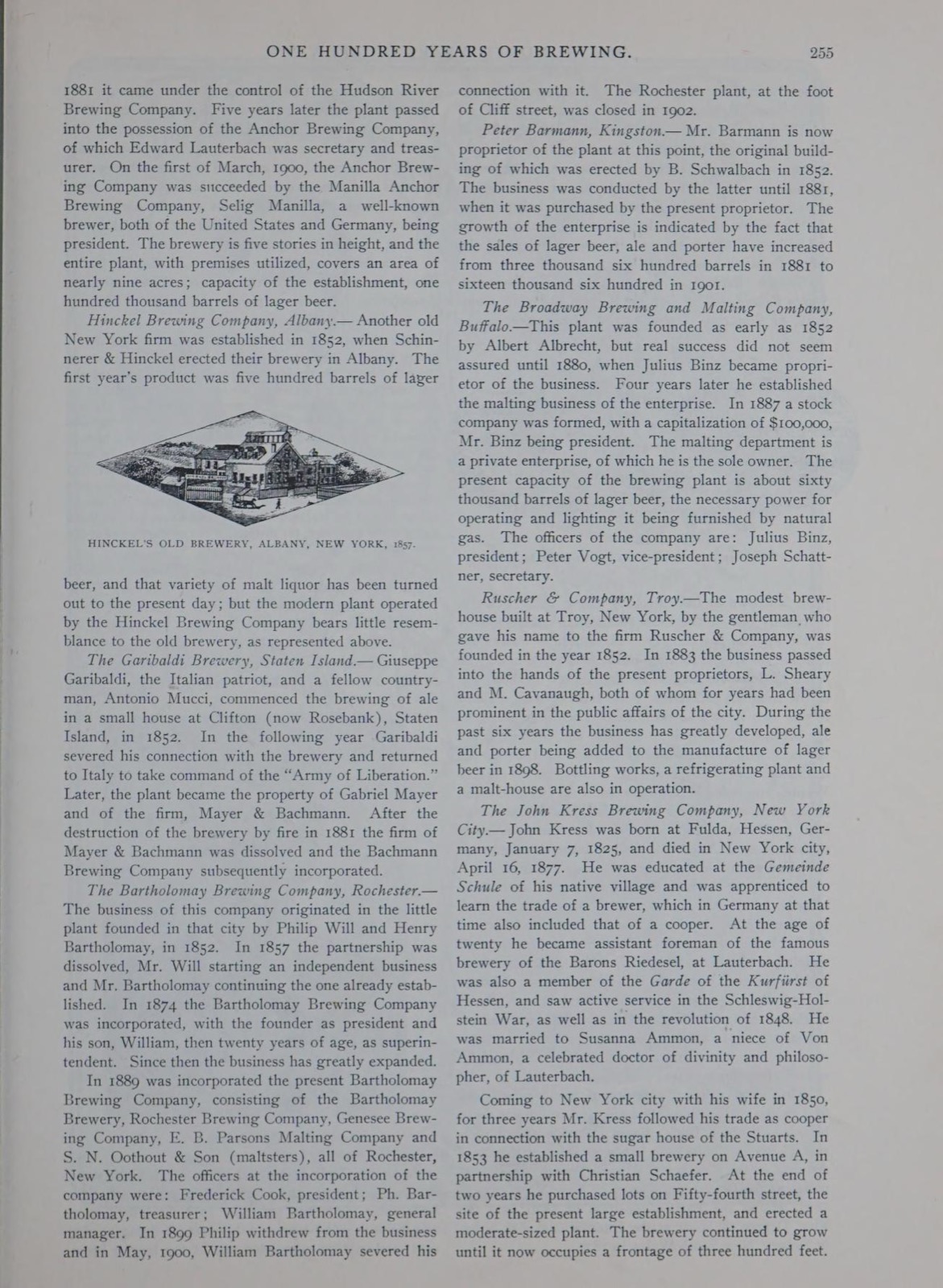
The two dates turn out to be two different claims. The 1903 trade history One Hundred Years of Brewing says Schinnerer & Hinckel built their brewery in 1852 and made 500 barrels of lager that first year. Single source9 Howell and Tenney say the Cataract Brewery was "established in 1857," and the family memoir says Hinckel "founded in a small way the business of beer brewing" in 1857. Solid516
The directories settle most of it. Schinnerer & Hinckel are absent from the 1852 and 1854 directories and present, as lager brewers at Swan Street and West Ferry, in 1858. Solid1011 So 1852 is the year Hinckel arrived in America, and 1857, the year of his marriage, is the best date for the brewery. Inference The 1903 book's own woodcut is captioned 1857.
The business grew fast. By 1869 the directory address had become Swan Street at Myrtle and Park, on the lip of the Beaver Kill ravine. Solid In the year ending 1 May 1877 Hinckel sold 20,157 barrels, the only lager brewer among the seven Albany firms that sold more than 12,000. Solid18 By 1881 "more than a hundred men were required to conduct it," and its trade extended "over the entire State of New York." Solid5
Then came the year that defines the building still standing on Park Avenue. "He died October 29, 1881," the county history says of Hinckel, "and in that year the present Hinckel Brewery was completed." Solid He died on his forty-ninth birthday. Solid16 (The same county history gives 1882 on another page; that's an error.) Solid
The brewery passed into a family arrangement. Frederick's elder brother Antone C. Hinckel, born in 1825, had worked alongside him, and in 1883 he married Helena, the widow. Solid16 In 1886 the Hinckel Brewing Company had Antone as business manager and Frederick's son Charles as treasurer; it employed about 75 workmen and made about 35,000 barrels a year. Solid5 Thomas Papen, an Albany resident since 1848, was "one of the principal stockholders" in 1888. Single source19 The 1884 Albany Hand-book's tour of Albany Rural Cemetery points out a "beautiful" monument to "Mrs. Helena Hinckel" beside the lake, almost certainly the family lot, since she was alive and remarried by then. Inference20
The brands, as recorded by collectors, included Bavarian, Export, Hinckel Ale, Sparkling Lager and a Kyffhauser Beer, named, it seems, for the mountain where legend says Emperor Barbarossa sleeps, a favorite German patriotic emblem after 1871. Single sourceInference Antone died in 1905. Solid By 1911 Frederick Jr. was keeping a hotel in Normansville and Charles worked "for an Albany brewing firm," which suggests the family no longer ran the business. Inference16 The brewery closed in 1920 and never reopened. Single source
Buttermilk Falls and the Beaver Kill
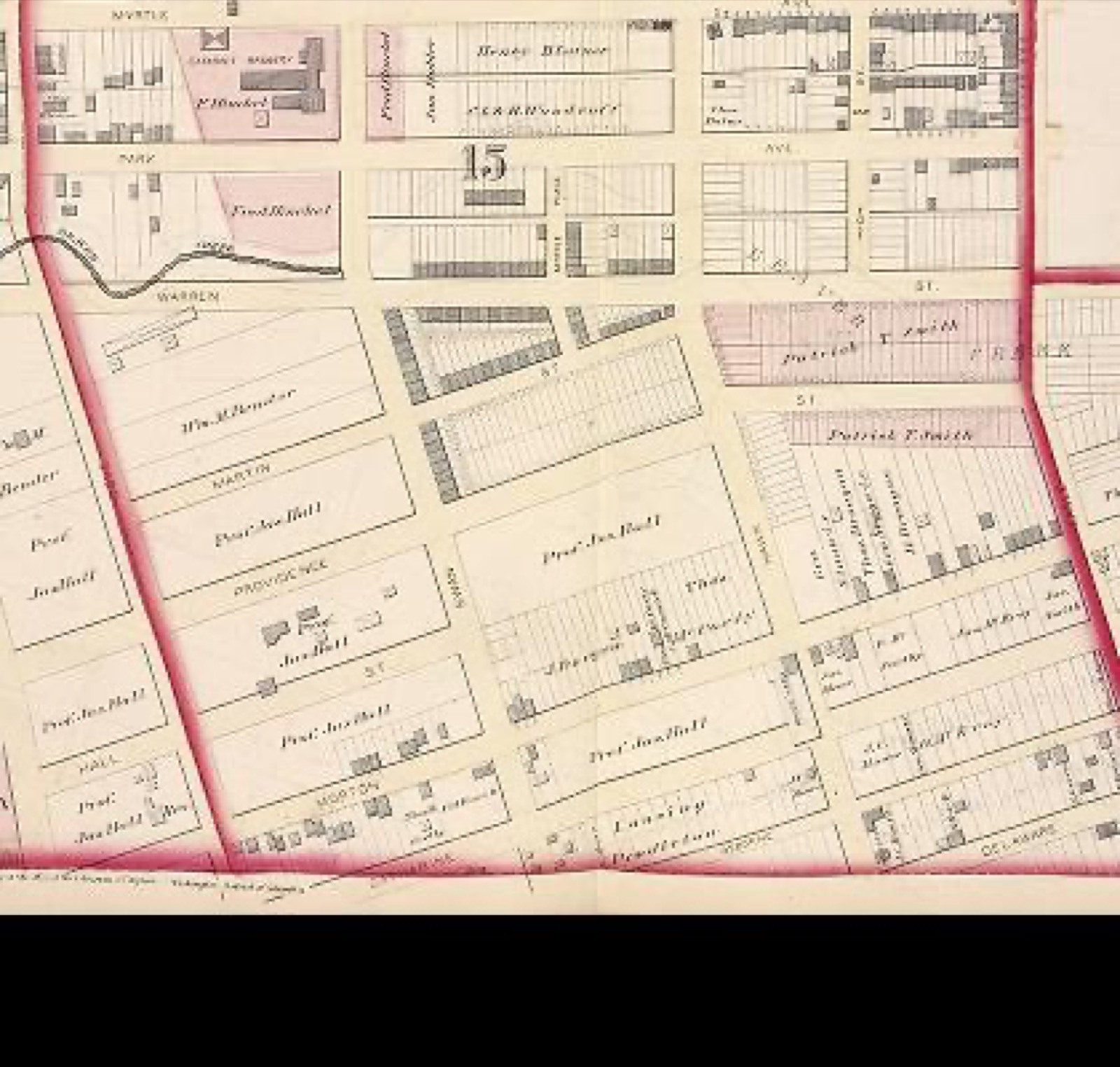
Hinckel's brewery, and Dobler's a few hundred yards away, sat above the deepest ravine in Albany. The Beaver Kill, "sometimes called Buttermilk Creek," rose in the west of the city, ran past Park Lake and the penitentiary, and reached the Hudson just below the steamboat landing. Solid521 Where it dropped into its gorge near Swan Street was a waterfall called Buttermilk Falls.
In 1884 the Albany Hand-book mourned it:
"What was naturally a romantic ravine, down which the Beaverkill plunged in foaming fury."Henry P. Phelps, The Albany Hand-book, 1884
"Civilization and the street department have destroyed the beauty of its surroundings," Phelps went on, "but something of its former state may be imagined by peering at it from the vicinity of Swan st. south of Elm." Had the park been laid out to take in the falls, "Albany would have had the most romantic and picturesque pleasure ground of any city in America." Solid20
Correction: the falls were not named for brewery waste
A popular story, repeated on Wikipedia, says Buttermilk Falls got its name from the milky-white waste the breweries poured into the stream. That story traces back to a 1993 Times Union article by Paul Grondahl. Single source22
The name is much older than the breweries. In March 1830, a 28-inch snowfall overwhelmed flocks of pigeons, "which are picked up at Buttermilk Falls in numbers." Single source1 That's more than twenty years before any lager brewery stood on the stream. The 2018 National Register nomination says the falls were named for their frothy look, and Phelps's "foaming fury" describes exactly that. Single source17 The breweries may well have fouled the creek, but they didn't name the falls. Inference
The falls were already a landmark for brewers. In 1866 the directory gave the address of one brewer, William Holden, simply as "near Buttermilk Falls." Holden was a partner in the firm that became Dobler's. Solid23
What the breweries and the city did to the stream is not in doubt. The lower creek had been enclosed in a brick-arch sewer decades earlier; the stretch of Johnson Street above it was renamed Arch Street. The section between Swan and Grand was buried between 1866 and 1876. By the 1880s the Beaver Kill carried much of the city's sewage to the river, and in 1887 the Albany Morning Express complained of drainage "from nearly the entire northwestern section of the city." Single source In 1884 the State Board of Health condemned the neighborhood of Martinville in the ravine, about ninety row houses, for nuisances dangerous to health. Single source17
The city's answer was a park. Mayor John Boyd Thacher proposed one in 1886. Beaver Park was authorized in 1890, Martinville's houses were auctioned off in 1894, a row of six fetching just $5, and most residents moved to Sheridan Hollow. Single source By 1892 the falls themselves had run dry. The park superintendent, William S. Egerton, wrote that "although the Buttermilk Falls may not be restored, for want of an adequate water supply, a ramble through the gorge formerly eroded by the stream, may, by proper treatment … be made exceedingly attractive." Solid24 Beaver Park is today's Lincoln Park.
The nomination adds one more link to the breweries: the clay-rich soil of the ravine, which fed the brickyards nearby, also helped keep the lager cool in its cellars. Single source
Darius Wood, John Dobler and the brewery on the bluff
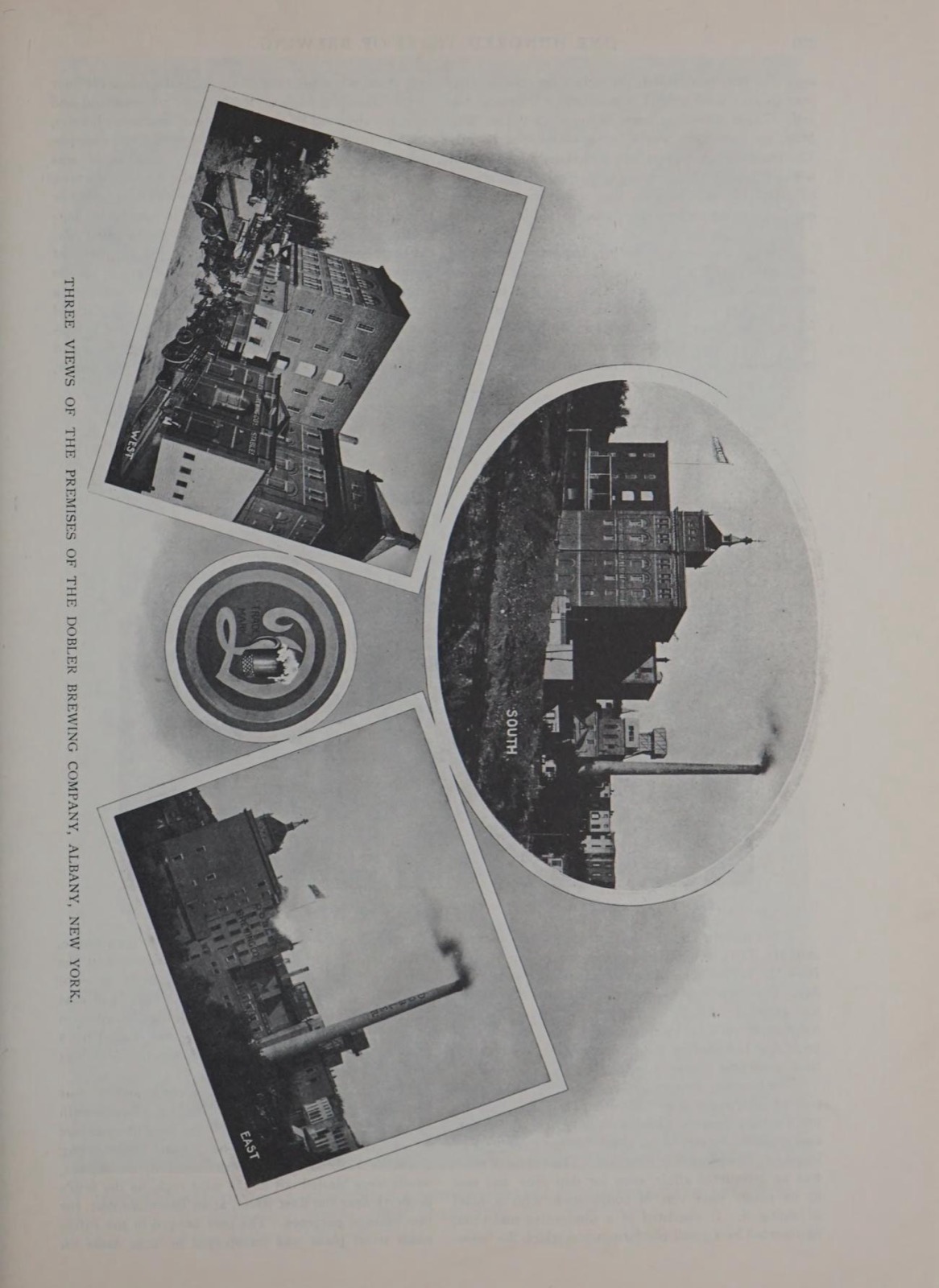
The other lager brewery on the ravine began with a railroad man. Darius S. Wood, born in Westboro, Massachusetts, in 1821, was a locomotive engineer and then superintendent of the New York Central's woodworking department. Single source5 "Early in the sixties," says the 1903 trade history, he "built a small wooden structure for the purpose of brewing beer, between Elm street, Myrtle avenue and Swan street." Single source9 The directory lists D. S. Wood & Co. on Swan Street in 1865. Solid Wood soon left to run the Malleable Iron Works and died in 1881. Single source
He sold to John Dobler. From 1866 the firm was Dobler, Leopold & Holden, and by 1876 Dobler alone. Solid7 Dobler built a new brewery in 1876 and died in 1885, and his son A. F. Dobler, German-born and called "the oldest practical brewer in this city," took over. Single source19 The 1888 account boasted of the site, "the most prominent and highest point in the city overlooking the Hudson with splendid views of the Catskills," and of its labor relations: "through his liberality Mr. Dobler has never experienced strikes." Single source That was printed in the very year Albany's brewery workers struck. Inference
Oddly, the 1886 county history says John S. Dobler ran an ale brewery at Swan and Myrtle. Disputed Every other source calls it a lager brewery.
In the early 1890s Theodore M. Amsdell, one of the Amsdell brothers of the big Jay Street ale brewery, left his brother's firm and bought into Dobler's with his son-in-law George C. Hawley. Single source25 An ale family had crossed over to lager. Amsdell was president until he died on 8 November 1903. Solid1
How big was Dobler's? It depends on whom you ask, and on whether they mean what was made or what could be made.
| Year | Figure | Measure | Source | Confidence |
|---|---|---|---|---|
| to 1885 | 12,350 bbl | John Dobler's annual sales | One Hundred Years of Brewing (1903) | Single source |
| 1888 | 15,000 bbl | sales; capacity 20,000; 35 hands | The Empire State (1888) | Single source |
| 1903 | 75,000 bbl | claimed output; capacity 150,000 | One Hundred Years of Brewing | Disputed |
| undated | 25,000 bbl | "at its height" | Wikipedia | Single source |
The 1903 figure, from a book whose entries were often paid for by the breweries, is the outlier. Inference Gravina, working from other records, says Dobler was close to bankruptcy in the 1900s. Single source2526 A family history adds a human detail: one of its forebears, a Dobler worker, was badly hurt in November 1905 in a fall down the brewery's elevator shaft. Oral history27
Hedrick and Kirchner on Central Avenue
The third great German line grew up along the old Bowery, the road out of town that became Central Avenue. John F. Hedrick came to America in 1832 and lived twenty years in Baltimore and New York. "In 1852 he settled in Albany and in 1856 commenced brewing on the present site of the Hedrick Brewing Company, on Central avenue." He built a malt house in 1868. Sales grew from 1,000 barrels in his first year to 3,000 in 1878 and 8,000 in 1901, and "about 1891" the business was incorporated as the Hedrick Brewing Company. Single source9
That clears up a long confusion. The often-repeated "founded 1852" is the year Hedrick came to Albany, and "1891" is the year he incorporated. Inference The directories add a wrinkle: Hedrick first appears as a brewer in 1861, marked "(lager)," at 354 Bowery. He may simply have brewed a few years before anyone listed him. Solid11 Renumbering moved the address up the avenue, to 422 Central in 1876 and 404–410 by 1898, without the brewery moving. Solid Hedrick stayed small. The state factory inspector counted 11 men there in 1897. Solid28 In 1903 William Hedrick was president. Single source
Nearby, Jacob Kirchner & Co. brewed lager at 9–11 Central Avenue from at least 1869; in 1870 the partners were Charles Forth and Jacob Kirchner Jr. Solid7 After Jacob's death the estate ran it at 8–10 Sherman Street, and by 1898 it was Kirchner Brothers, a small house of eight men. Solid29 Howell and Tenney call Kirchner's an ale brewery, the directories call it lager. Disputed
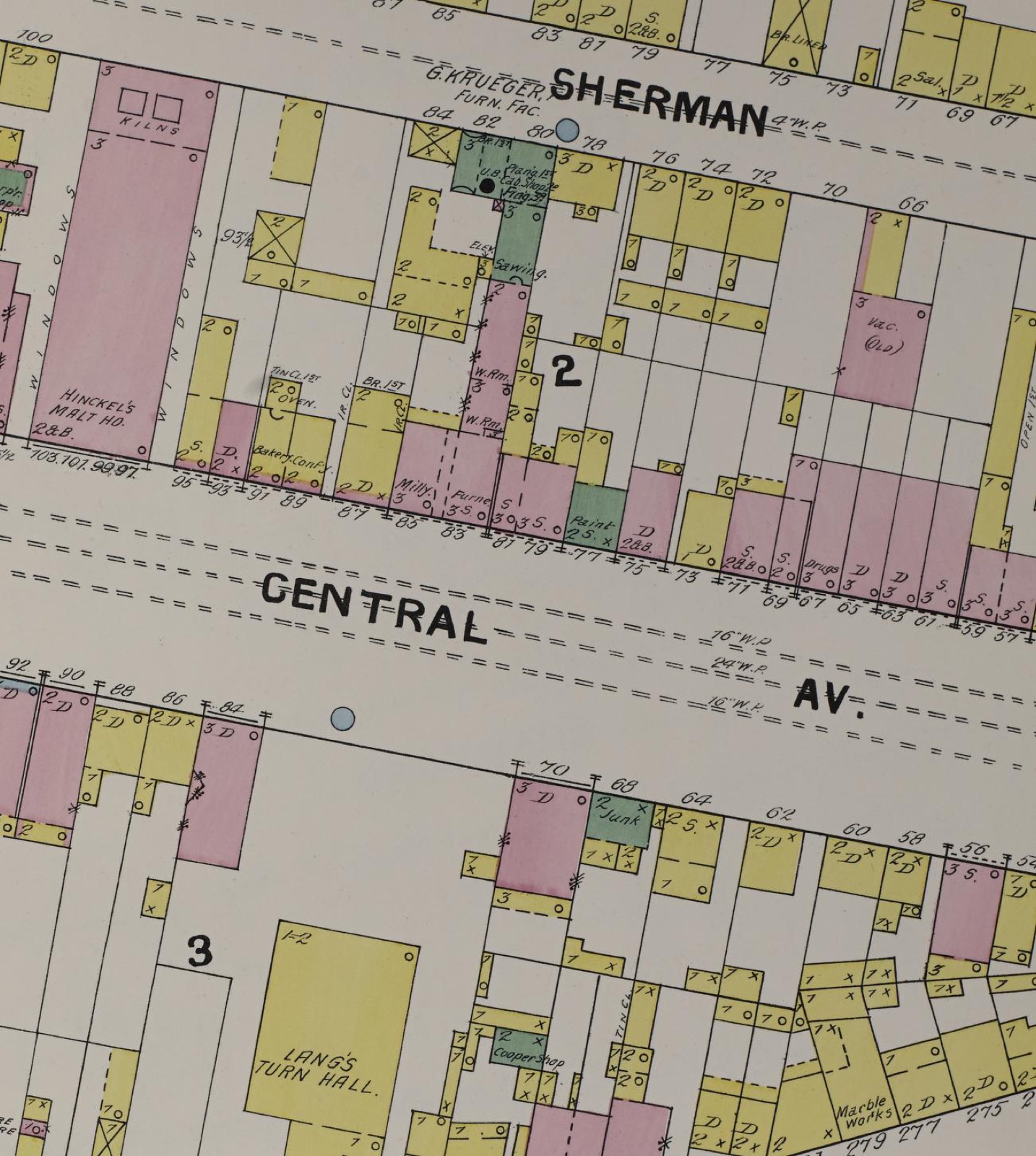
Central Avenue was the heart of German Albany's working life. The 1892 fire-insurance map shows, on one block between Central and Washington Avenues just east of Lexington, Hinckel's malt house at 97–103 Central, Kirchner's and Coleman's malt houses, a cooper's shop, and Lang's Turn Hall, the Turners' big frame hall. Solid30 Malting, barrel-making and gymnastics shared a city block.
Beverwyck: the model lager brewery
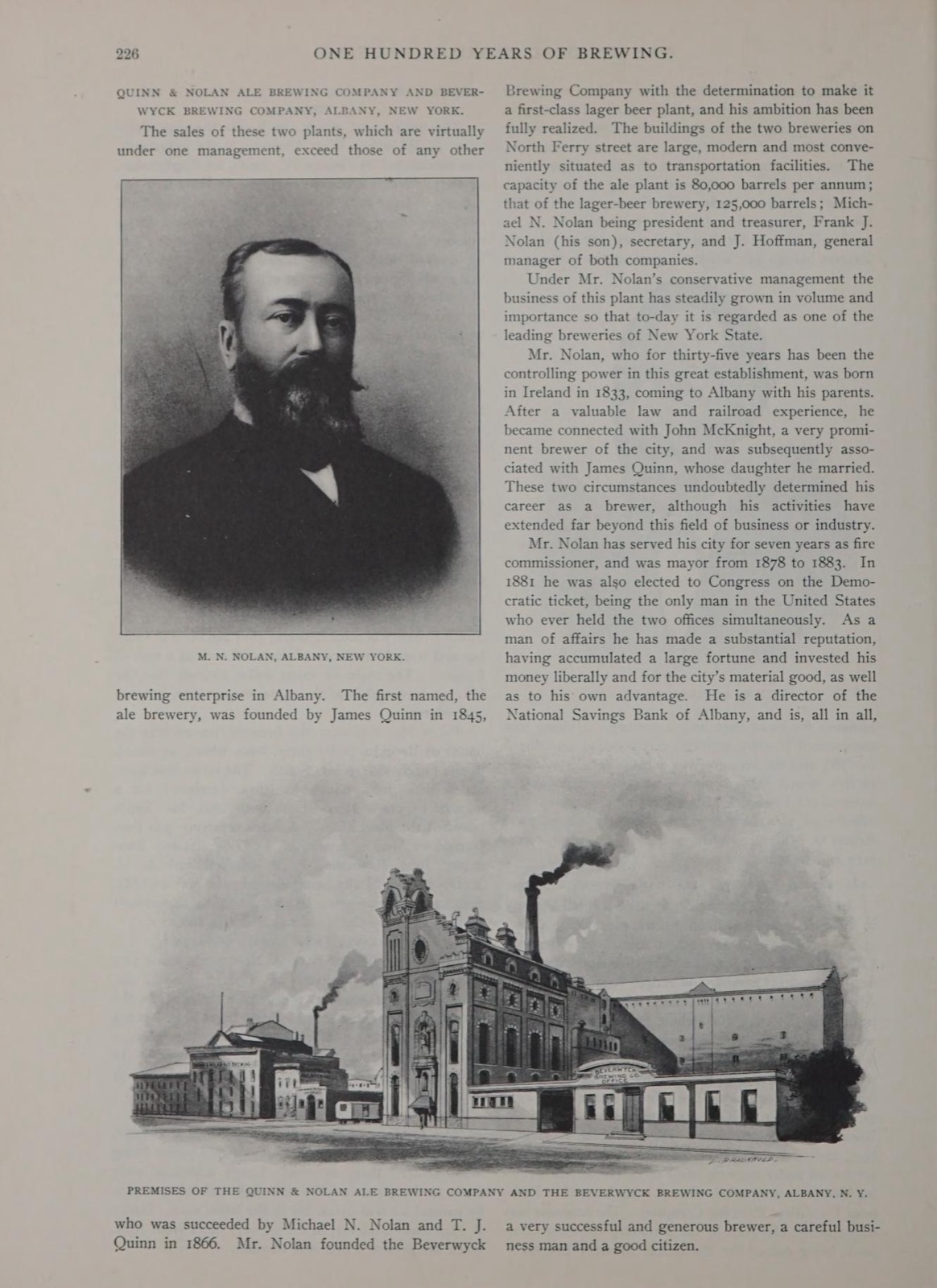
The most famous lager brewery in Albany was built by an Irish ale brewer. James Quinn started brewing ale on North Ferry Street in the 1840s. Disputed In 1866 his son Terence J. Quinn went into partnership with Michael N. Nolan, born in Ireland in 1833, who had married James Quinn's daughter. Solid95 One more founding partner of Quinn & Nolan was German: M. Schrodt, "a native of Altheim, Hesse-Darmstadt," who became general manager. Single source1920
In 1878 the firm opened the Beverwyck lager brewery beside its ale house. Phelps's Albany Hand-book of 1884 gave it a long tour, and it's worth quoting at length:
"For many years Albany had been noted for its ale, but it was not till 1878 that it became equally famous for lager."Henry P. Phelps, The Albany Hand-book, 1884
The Beverwyck, he wrote, "is unquestionably the model lager beer brewery of the United States, if not of the world," and drew "hundreds of visitors from all over the country." The ground floor, the engine and pump room, was "paved with Vermont slate, purple and green," and open to the roof "like the grand hall of some great hotel or library," with galleries "rising tier upon tier." In the center was an artesian well 230 feet deep. The pumps, "for pumping beer, air, ice-water," were "all … nickle-plated, and shining like a service of silver." Solid20
The numbers were as grand. "Two great copper kettles," each holding 180 barrels, had cost $20,000 alone. There were two 100-horsepower boilers in a separate iron building, storage for 60,000 barrels and a brewing capacity of 90,000 barrels a year. The whole plant cost $350,000. Deliveries went out behind "forty horses of the finest Kentucky, Ohio and Wayne county (N.Y.) stock." Solid The designer was Charles Stoll of Brooklyn, a Prussian-born millwright who had planned the model brewery at the 1876 Centennial and held patents on ice machines. Single source31
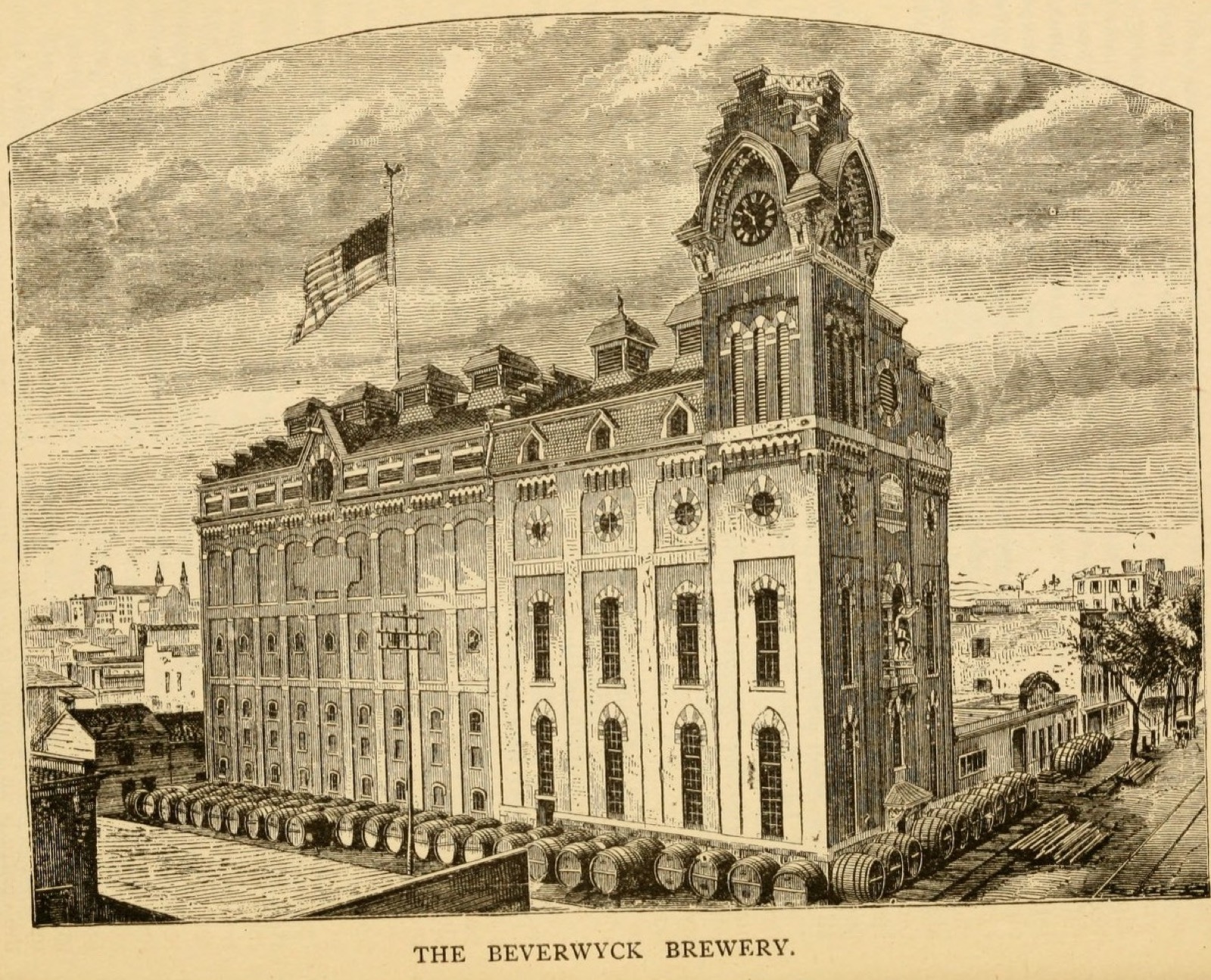
Its owner was also running the city. Nolan was mayor of Albany from 1878 to 1883, and from 1881 to 1883 he sat in Congress at the same time. Solid The 1903 trade history called him "the only man in the United States who ever held the two offices simultaneously," a boast nobody has checked. Single source9 He resigned as mayor in June 1883 after a court found frauds in the 1882 charter election. Solid5
The brewery kept growing. The output and capacity figures below are not directly comparable, and each is labeled for what it is.
| Year | Figure | Measure | Confidence |
|---|---|---|---|
| 1877 | 44,571 bbl (Quinn & Nolan, ale, before the lager plant) | sales | Solid |
| 1878 | 90,000 bbl brewing; 60,000 storage | capacity | Solid |
| c. 1886 | 60,000 bbl lager + over 50,000 ale | output | Solid |
| 1888 | 70,000 bbl; 60,000 sold "in Albany and its vicinity" | capacity / sales | Single source |
| 1897 | 100,000 bbl lager + 80,000 ale | "annual product" | Single source |
| 1903 | 125,000 bbl lager + 80,000 ale | capacity | Single source |
Sources: One Hundred Years of Brewing p. 612 and text; Phelps (1884); Howell & Tenney (1886); The Empire State (1888); Parker, Landmarks (1897). 21
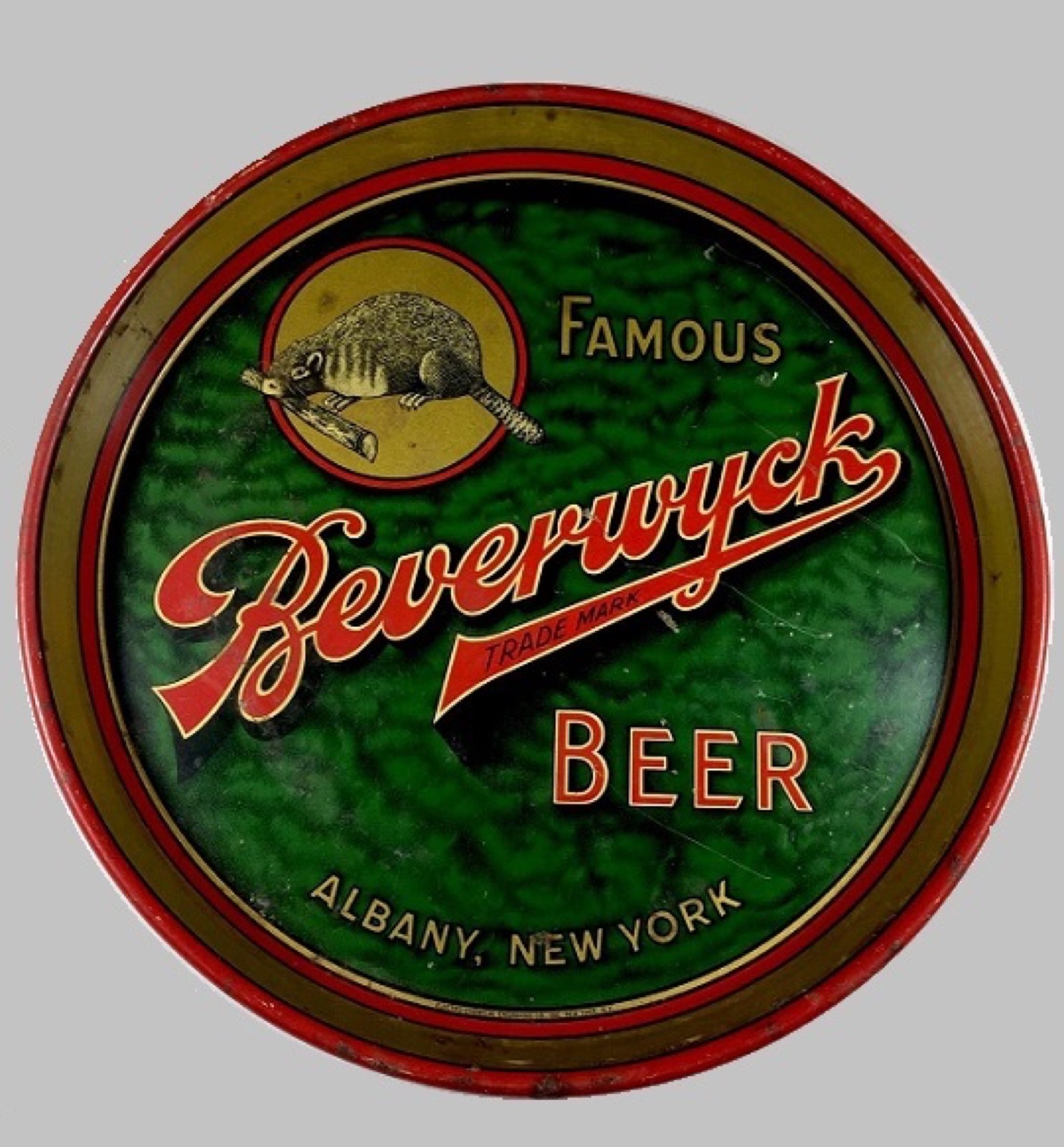
Gravina adds that the brewery's 185-foot chimney, lit with electric letters spelling BEVERWYCK LAGER, was a city landmark. Single source13 Nolan died on 31 May 1905. Solid1
The wanderings of King Gambrinus
Over the entrance Nolan set a statue of Gambrinus, the legendary king of beer. The 1884 Hand-book already noted "the heroic statue of 'Gambrinus' attracting special attention." Solid20 It was zinc, later clad in copper, and painted in many colors to match the building. It's a copy of a model sold by the foundry of J. W. Fiske, possibly cast by a Brooklyn rival that Fiske sued for copying in 1876. Single sourceDisputed32 Fiske sold the figure in two sizes, and at least a dozen went to American breweries. Single source33
The king stayed above the door for some 94 years, through Prohibition and through the Schaefer company's ownership from 1950, until Schaefer closed the Albany plant in 1972. He then went to Schaefer's new brewery in Pennsylvania's Lehigh Valley, a plant that later brewed for Stroh, Pabst and, from 2008, the Boston Beer Company. Single source32 Boston Beer's brewing chief later recalled finding him painted in about fifteen colors and having him restored. He now stands unpainted on a brick pedestal in that brewery's beer garden. Single source34
Ice, machines and the fire maps
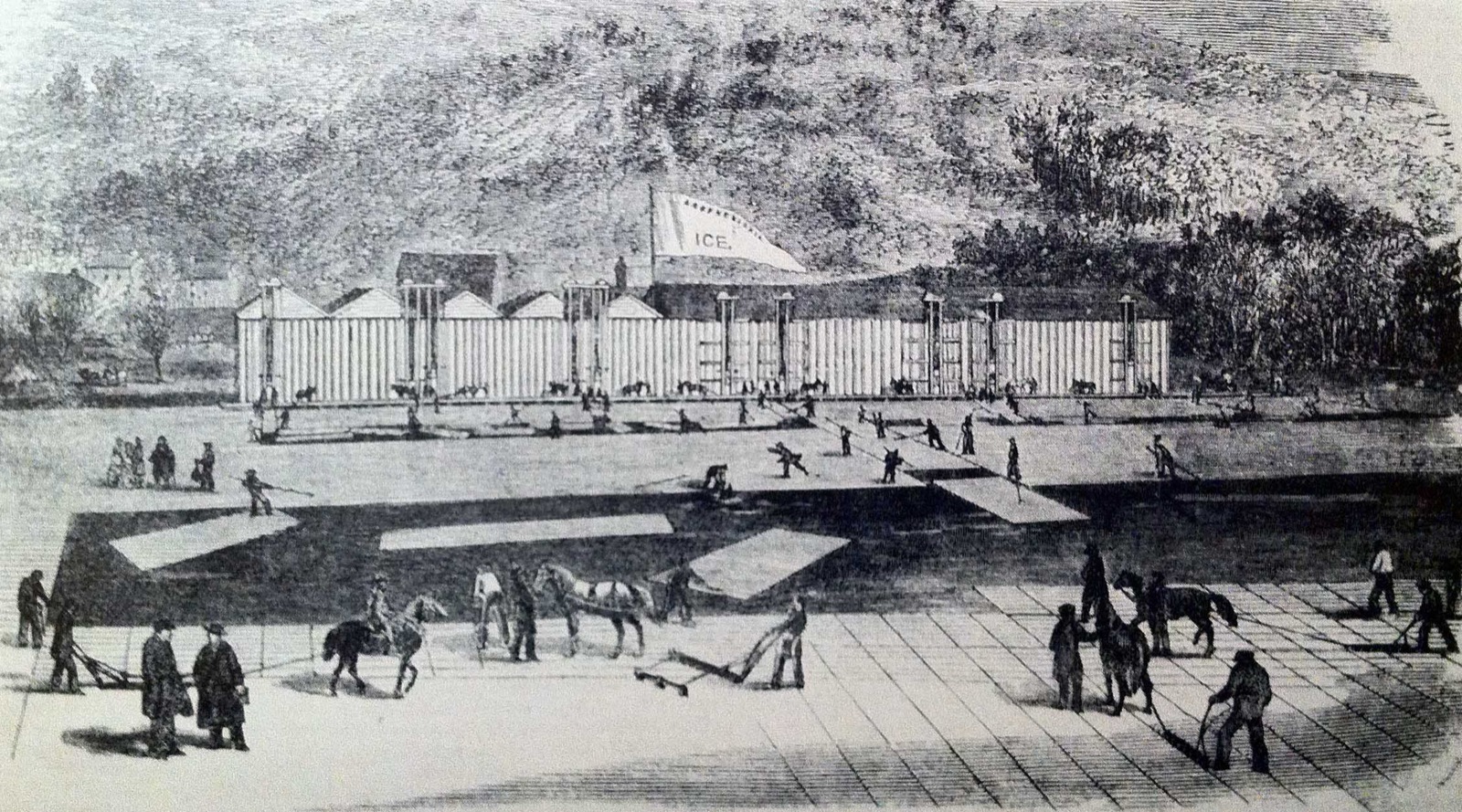
Lager needed cold, and at first the cold came from ice. In its 1880s peak the Hudson River ice industry employed some 20,000 people, with about 135 ice houses between Poughkeepsie and Albany. Single source35 Beverwyck's pumps moved "ice-water" in 1884, and in 1888 the plant had an ice house, refrigerators and a Baudelot cooler for chilling the hot wort. Solid19 No record found yet ties a particular Albany brewery to a particular ice harvester, but stored river ice is the obvious source. Inference
By the 1890s the machines had arrived. The best evidence comes from the Sanborn fire-insurance maps, drawn building by building for insurers, with every floor's use noted. The 1892 Albany atlas shows a room labeled "Refrigerating Mach." at both Hinckel's and Dobler's. Solid36 Dobler's kept a one- to two-story ice house too, linked to the plant by a bridge, with a four-story cold-storage block and an iron water tank on top. The note on cellar lighting reads: "Lights, gas. Candles in cellar." Solid37 The maps don't say who built the machines. Solid
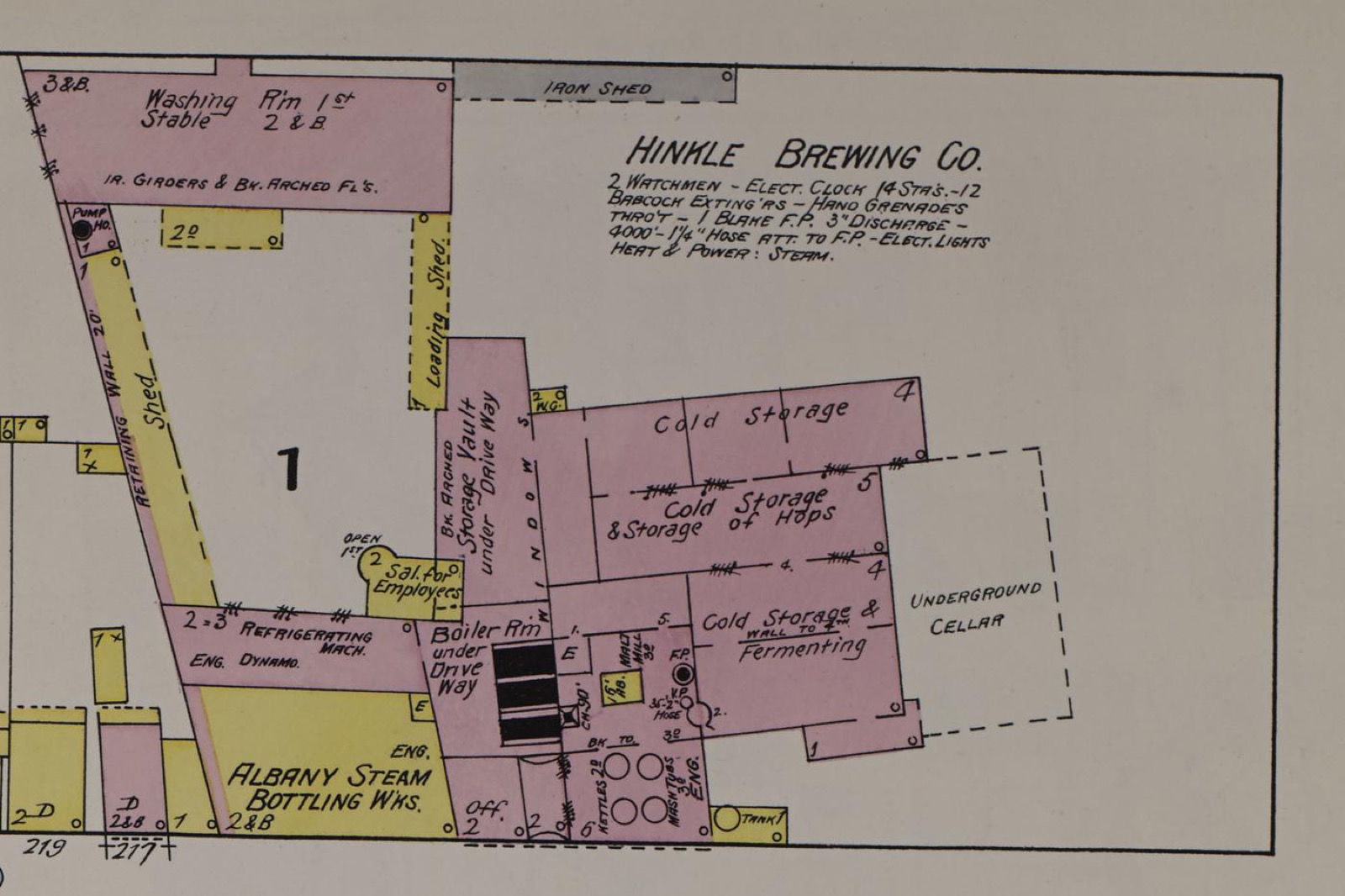
Hinckel's block, between Park Avenue, Myrtle, Dove and South Swan, is drawn in detail. On the Park Avenue side stood the brewhouse, with the kettles on the second floor, mash tubs on the third and a malt mill. Behind it rose four- and five-story blocks labeled "Cold Storage," "Cold Storage & Storage of Hops" and "Cold Storage & Fermenting," with an underground cellar beyond. There was a refrigerating-machine room with an engine and dynamo, a stable with brick-arched floors on iron girders, a pump house, and a "Saloon for Employees." The fire notes list two watchmen, an electric clock with fourteen stations, twelve Babcock extinguishers, hand grenades and electric lights. Next door on Park Avenue was the Albany Steam Bottling Works. Solid38
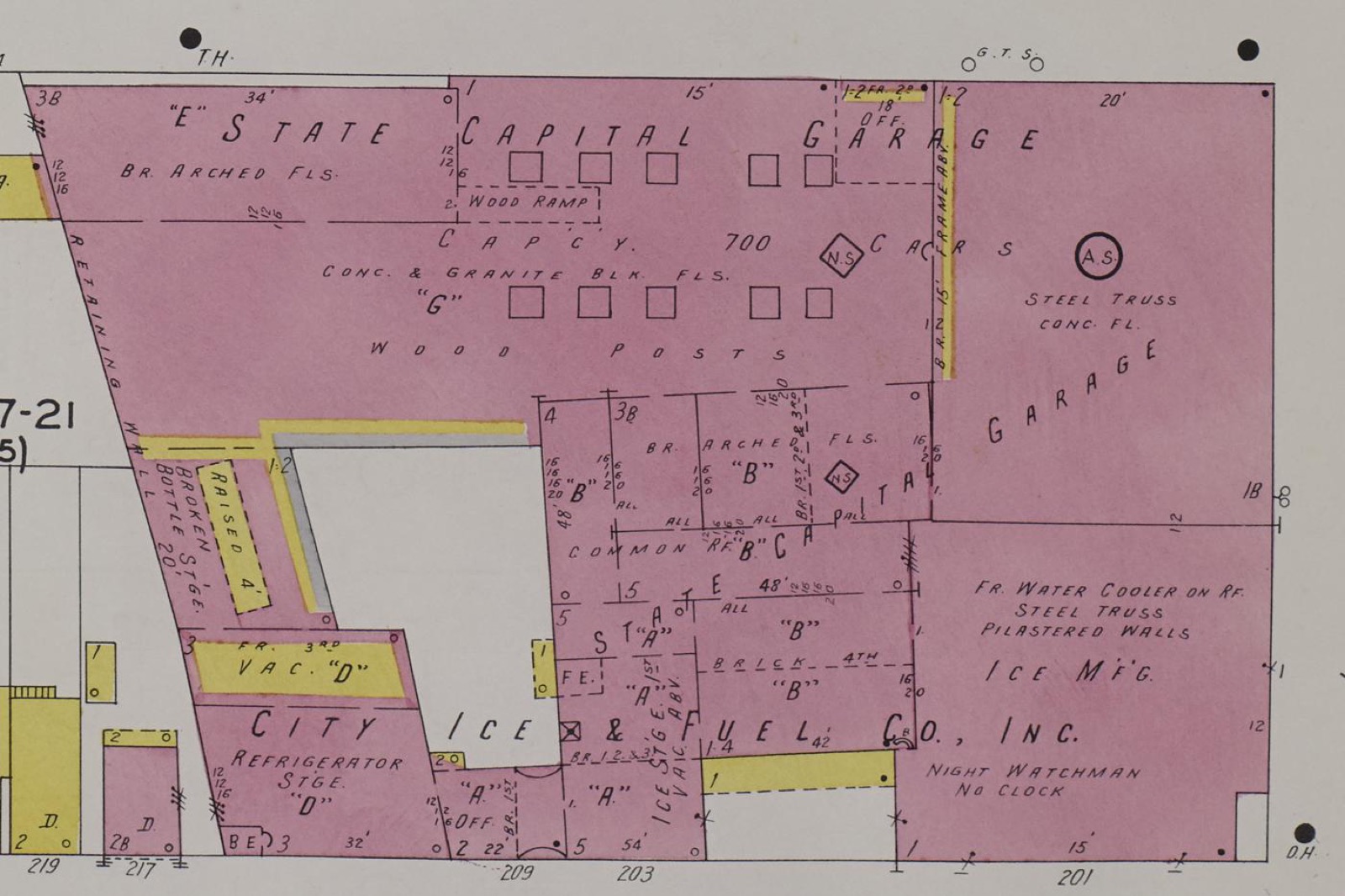
Forty-two years later the same block was drawn again. Drag the slider to compare.
 18921934
The Hinckel block on the Sanborn fire-insurance maps: left, Sanborn-Perris 1892, sheet 43; right, Sanborn 1934, vol. 1, sheet 50. Park Avenue runs along the bottom, Myrtle Avenue along the top. Public domain, Library of Congress. 39
By 1934 the stable wing and the brick-arched blocks had become the State Capital Garage, with room for 700 cars, and the Park Avenue frontage, numbered 201–209, belonged to the City Ice & Fuel Co., marked "Ice Mfg." with a water cooler on the roof and refrigerated storage. The old cold-storage blocks are still marked with brick-arched floors. Solid40 The brewery built to make cold ended up making ice for sale. When that change happened is not known. Solid
201 Park Avenue: the brewery, not the malthouse
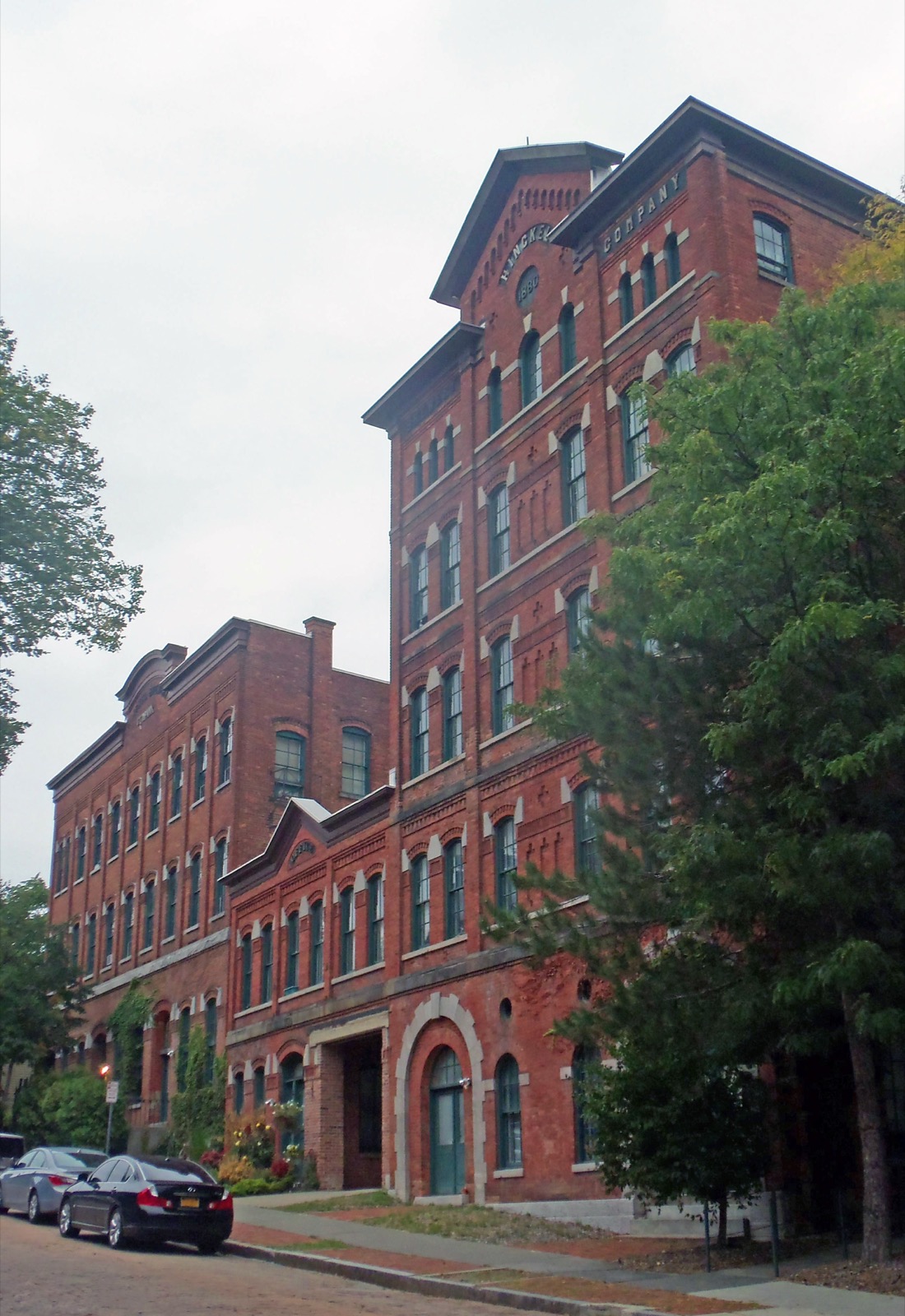
The surviving brick building at 201 Park Avenue is often called Hinckel's "malthouse." The maps say otherwise. The 1892 atlas indexes "Hinckel's Malt House" on a different sheet entirely, at 97–103 Central Avenue, about a mile away. Solid30 The Park Avenue block was the brewhouse and cold-storage plant, and the 201–209 frontage of 1934 sits on its footprint. Howell and Tenney say "the present Hinckel Brewery" was completed in 1881. Solid So the building on Park Avenue is very probably the 1881 brewhouse and cold-storage complex. Inference The "1880 malthouse" label traces to an image file name on a beer-history blog, not to any caption or record. Single source41
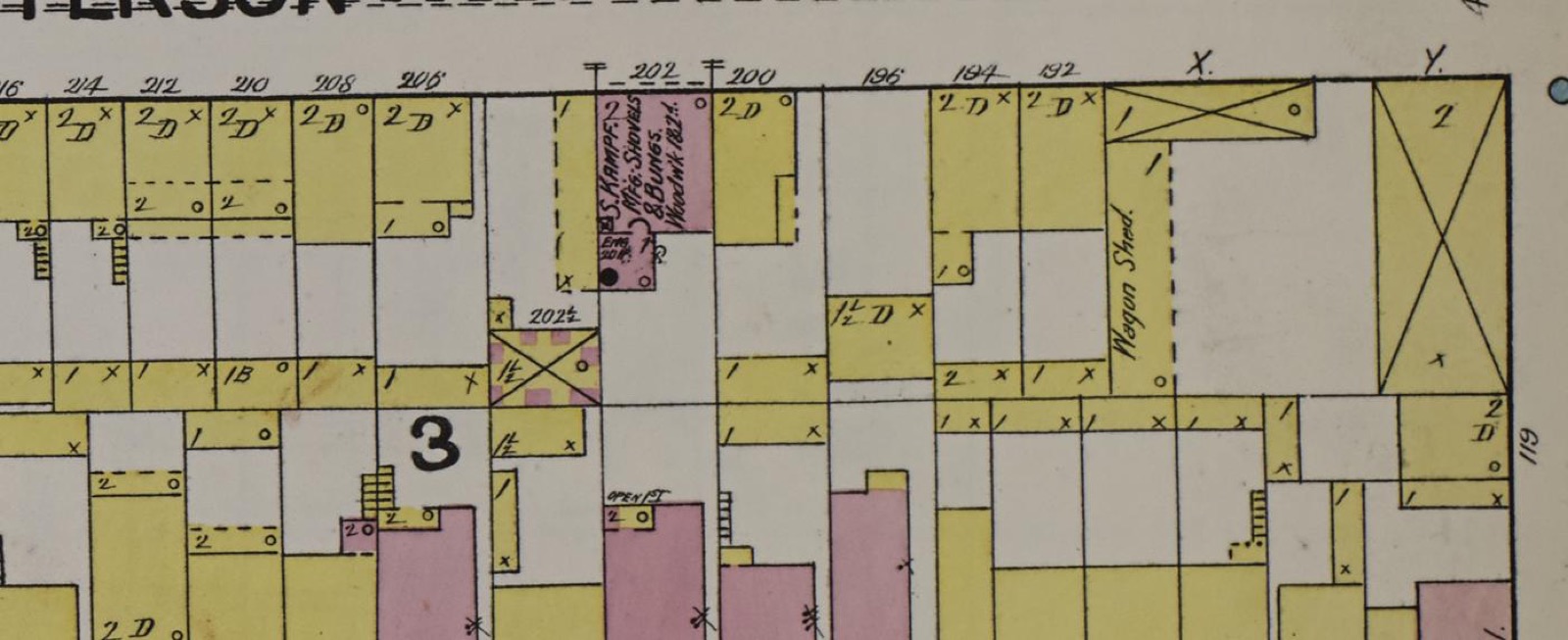
Brewing fed a whole web of smaller trades, and the fire maps catch those too. A few blocks away on the 1892 atlas, at 202 Jefferson Street near Dove, is a two-story brick shop labeled "S. KAMPF Mfg. Shovels & Bungs." Solid42 Stephen Kampf made the wooden malt shovels maltsters used to turn germinating grain, and the bungs that sealed beer barrels. His malt shovels were "commended for good workmanship" at the 1876 Centennial Exhibition. Solid43 Renumbered 186 Jefferson, it is almost certainly the same building as the old S. Kampf & Sons Bung Factory, where this website is made. Inference
The brewery workers organize
Albany's brewery workers unionized in the 1880s, and they did it along the line between ale and lager.
The ale and porter workers came first. They organized on 6 September 1886 as Local Assembly 8,546 of the Knights of Labor, the big national labor order of the day. Solid44 The lager workers formed their own union seven months later. The Lager Beer Brewers Union No. 15 was "organized April 3, 1887, at Eintracht Hall, South Pearl street, with the membership of nineteen, which gained to a membership of fifty in just two months." Its first president was Charles Moog, and dues began at 35 cents a month. Solid
On 5 May 1888 came a "Strike of Knights of Labor employees of breweries." Single source1 That one line is all that has been found. Which breweries, what the men wanted and how it ended are still unknown.
A month later, on 8 June 1888, five unions founded the Albany Central Federation of Labor, the city's first umbrella body for organized labor: the typographers, cigarmakers, bakers, bricklayers and the lager beer brewers. Their delegates were Fred Mintzer, Joseph Jahn and Frank Schumacher. Solid44 By 1892 there was a Beer Drivers Union No. 88, and a joint executive board of brewery workers. Solid In January 1897 the ale men left the fading Knights and became Local 129 of the United Brewery Workmen, about 100 members, with "every ale brewery in the City of Albany" under its jurisdiction. Solid
By 1898 the lager union had 73 members and met at Columbia Hall on Beaver Street. Its officers were all German-born. Joseph Humler lived at 228 Myrtle Avenue, next to the breweries, and William Christian Schmitt at 24 Jefferson Street. The union's own history, perhaps a little proudly, said that no "extra and particular difficulty" had arisen between Local 15 and the city's lager brewers since it began. Solid44 The owners organized too: an Albany Brewers Association formed in 1902. Single source9
Ale gives way to lager
For all the German breweries, Albany stayed an ale city for a surprisingly long time. The numbers show exactly how long.
In the year ending 1 May 1877, seven Albany brewers sold more than 12,000 barrels each. Six were ale houses: the Albany Brewing Co. (72,723), Taylor & Son (53,453), Quinn & Nolan (44,571), Amsdell Brothers (41,282), Alexander Gregory (13,973) and James Walker (13,575). The only lager brewer on the list was Fred. Hinckel, with 20,157. Solid18 Among the big houses, lager was under a tenth of sales. Inference
The Beverwyck changed that. For the year ending 30 April 1883 the city made 236,491 barrels of ale and 95,743 of lager; the next year, 263,459 of ale and 94,475 of lager, a total of 357,934. Solid5 Lager had grown to roughly a quarter of the city's beer, but ale was still growing too. These were Albany's biggest brewing years. Inference The same book's narrative gives 359,203 barrels for 1884, and the 1884 Hand-book gives 332,794 "last year" from about 20 breweries, so treat the totals as close, not exact. Disputed20
By 1916 the order had flipped: 213,544 barrels of lager and only 120,273 of ale. Solid45 The city's total output was about the same as in the 1880s. What had changed was what it brewed.
Ale and lager in Albany. 1877 counts only the seven brewers selling over 12,000 barrels (sales), so lager brewers smaller than that are missing; Approximate 1883 and 1884 are fiscal years ending 30 April (Howell & Tenney); 1916 is from Whish (1917), whose ale figure differs by four barrels from another reprint. Solid
Even the ale brewers were borrowing lager methods by then. Gravina's reading of Amsdell's brewing logs for 1900–1905 found the brewery routinely kräusening, adding fresh fermenting wort to condition its beer, a German technique. It also brewed a 4.5% pale ale called "Polar," conditioned cold for ten days to two weeks, in effect an ale made to drink like lager. Single source46
Syndicates and the end of the ale houses
The big change of the 1890s and 1900s was consolidation. Breweries stopped being family firms and became stock companies, then pieces of larger groups.
The Taylor brewery, once the pride of Albany Ale, was run by 1886 by men named Taylor who were "not relatives of the founder." Solid5 Gravina says it was caught up in a British syndicate's buying of American breweries around 1889; that remains unverified. Single source Then, on 27 September 1905, "Taylor and Amsdell Brewing companies' stockholders ratify agreement to enter Hudson River brewery syndicate." Single source1 One later account says the syndicate plan never came off, but that account hasn't been checked, so whether it happened is still an open question. Disputed Taylor's brewery closed around the same time. Single source
The same year's directory shows a new name at the old Boyd brewery on South Ferry Street, the oldest brewing line in the city: "Consumers' Albany Brewing Co." Solid47 It's very likely the "Consumers" brewery that Gravina says later belonged, with Hedrick and Amsdell, to the Knickerbocker Brewing Corporation of New York City. Inference
The Amsdell story shows how tangled it got. After George I. Amsdell died in 1906, the owners of Kirchner's bought the Jay Street brewery. It became Amsdell-Kirchner and went bankrupt, passed to a New Hampshire company, and finally to Knickerbocker, "who also owned Consumers and Hedrick Brewing Companies." Single source25 The dates in that account (a 1909 sale, a 1912 renaming) don't sit easily together. Disputed In 1916 the plant became the Citizens' brewery, which Whish listed in 1917 at Jay and Lancaster with a first brewing in 1916 and a capacity of 175,000 barrels. Solid45 It closed just before national Prohibition. Single source
Meanwhile the smaller ale houses quietly disappeared. John McKnight's brewery on Hawk Street "has not been used for years," Howell and Tenney wrote in 1886. Single source Burt, once the biggest, is last listed as a brewer in 1885. The old Kirk brewery on Upper Broadway went from the Fort Orange Brewing Co. to the Capitol Brewing Co. by 1898. Solid29 Granger's ale brewery on Fourth Avenue is said to have closed in 1893. Single source The directories tell the story in a single column:
| Year | Entries under "Brewers" | Note |
|---|---|---|
| 1862 | 19 | 16 ale and lager, 3 root or spruce beer |
| 1869 | 18 | |
| 1876 | 18 | 1 weiss beer |
| 1885 | 14 | 2 weiss beer; list probably incomplete |
| 1898 | 12 | |
| 1900 | 10 | |
| 1903 | 9 | |
| 1905 | 10 |
These are directory listings, not plants: one firm can appear under two names. Solid11
Fewer, bigger breweries made the same amount of beer. By the eve of Prohibition, Albany's brewing had settled on a handful of plants: Beverwyck on North Ferry, Dobler on the bluff, Hedrick on Central Avenue, Hinckel on Park Avenue, and the Citizens' plant in the old Amsdell buildings. Inference
German Day to the Great War
German Albany was at its most confident around the turn of the century. The Eintracht singing society, founded in 1868, won first prizes at Schenectady in 1879 and at the Troy Maennerchor festival in 1880. The Apollo Singing Society, founded in 1884 by seceders from Eintracht, had 375 members within a year, sang German songs in the Assembly Chamber of the new Capitol on Decoration Day 1885, and went to the national Saengerfest in Brooklyn that summer. Solid5 In 1886 Albany's Germans planted a memorial oak in Washington Park for the city's bicentennial. Single source A German gun club was founded in 1895 at Johann Stapf's tavern. Its outings went to Schuetzenpark, Collins Grove and "Hinkel's Farm." Single source2
The first German Day was celebrated on 19 September 1904, marking the arrival of the first Germans in America in 1683, with Mayor Gaus presiding. On 28 August 1905 came a "German Day parade of fanciful floats in morning, picnic at Dobler Park in afternoon." Single source1 Dobler Park was evidently a brewery-linked picnic ground; a German veterans' society met there too. Single source Where exactly it was hasn't yet been found.
On 24 September 1914, less than two months into the war in Europe, the Männer Quartett and the Eintracht merged at German Hall on Beaver Street to form the Albany Maennerchor. Single source2 When the United States entered the war in 1917, the mood turned. Most German clubs folded under anti-German propaganda and pressure, the Maennerchor survived "very diminished," and the club's own history marks 1918 as the end of German influence in Albany. Single source
Did the war touch the breweries directly? The record is thin. No Albany-specific account of the wartime grain limits or the 1918 wartime prohibition act has been found, and no action against an Albany brewer as an enemy alien. Solid The 1916 choice of a plain American name, "Citizens'," for the old Amsdell plant may reflect the climate, but nothing says so. Inference
What came next was not a war measure but national Prohibition. In 1920 Hinckel's closed for good. Single source Beverwyck, Dobler and Hedrick held on by making other things, and seventy years of German brewing on the Beaver Kill came to an end. Single source48 The ice plant on Park Avenue, the soda bottles on the bluff and the near-beer on Central Avenue belong to the next chapter.
Sources for this page
- Reynolds, Albany Chronicles (1906) archive.org
- History of the German-American Club (Fellehner 1995, rev. White) findingyourpast.blogspot.com
- Historical Society of the NY Courts, People v. Landon history.nycourts.gov
- Good Beer Hunting (2021) goodbeerhunting.com
- Howell & Tenney, Bi-centennial History of the County of Albany (1886) archive.org
- Munsell, Directory to the Trades in Albany (1852) archive.org
- Child, Gazetteer and Business Directory (1870–71) archive.org
- Albany Directory (1876) archive.org
- One Hundred Years of Brewing (1903) archive.org
- Albany Directory (1854) archive.org
- Albany Directory (1862), Brewers archive.org
- Albany Directory (1885; archive.org item mislabeled 1898) archive.org
- Gravina, "The Lack of Lager" (2014) web.archive.org
- Gravina, "Lack of Lager, Part II" (2014) web.archive.org
- Gravina, "The Lager Boom?" (2013), comment by Gerry Lorentz web.archive.org
- Hudson-Mohawk Genealogical and Family Memoirs www.schenectadyhistory.org
- Lincoln Park National Register nomination (2018) npgallery.nps.gov
- One Hundred Years of Brewing, p. 612 (Western Brewer table) archive.org
- The Empire State: its industries and wealth (1888) archive.org
- Phelps, The Albany Hand-book (1884) archive.org
- Parker, Landmarks of Albany County (1897) archive.org
- Wikipedia, Lincoln Park en.wikipedia.org
- Albany Directory (1866) archive.org
- Public Parks of the City of Albany (1892) archive.org
- Gravina, "The Brothers Amsdell" (2013) web.archive.org
- Wikipedia, Dobler Brewing Company en.wikipedia.org
- Dreimiller family genealogy dreimiller.com
- NY Factory Inspector, 12th Annual Report archive.org
- Albany Directory (1898; archive.org item mislabeled 1885) archive.org
- Sanborn 1892, sheet 58 (detail) tile.loc.gov
- Wikipedia, Charles Stoll & Son en.wikipedia.org
- Gravina, "The King Has Left the Building" (2014) web.archive.org
- Restore the King restoretheking.com
- Wikipedia, King Gambrinus (sculpture) en.wikipedia.org
- Scenic Hudson www.scenichudson.org
- Sanborn-Perris, Insurance Maps of Albany (1892), Library of Congress www.loc.gov
- Sanborn 1892, sheet 31 (Dobler detail) tile.loc.gov
- Sanborn 1892, sheet 43 (Hinckel detail) tile.loc.gov
- Sanborn, Insurance Maps of Albany vol. 1 (1934), Library of Congress www.loc.gov
- Sanborn 1934, sheet 50 (detail) tile.loc.gov
- Brookston Beer Bulletin brookstonbeerbulletin.com
- Sanborn 1892, sheet 45 (detail) tile.loc.gov
- Centennial Reports and Awards, Group III (1878) archive.org
- Illustrated History of the Central Federation of Labor (1898) archive.org
- Whish, Albany Guide Book (1917) archive.org
- Gravina, "Ich Werde Eine Albany Ale" (2013) web.archive.org
- Albany Directory (1905) archive.org
- OldBreweries.com, Beverwyck www.oldbreweries.com