Dry Years
How a city that brewed a third of a million barrels a year went dry: temperance and wartime suspicion of all things German, the breweries that shut and the three that hung on with soda and cereal beverage, a federal agent killed on Madison Avenue, Legs Diamond's last night on Dove Street, and the spring beer came back.
A lager town at full strength
On the eve of Prohibition, Albany was still a serious beer city. In 1916 its breweries turned out 333,822 barrels, about as much as in the record years of the 1880s. Solid1 But the mix had flipped. In 1884 nearly three barrels in four were ale. By 1916 lager made up 213,544 barrels and ale only 120,273. Solid (Another source copies the ale figure as 120,277; one of the two has a typo.) Approximate
The industry was also shrinking into fewer hands. Taylor, the great Albany Ale house, had closed in 1905. Solid2 Amsdell, the last brewery to advertise "Albany Ale," passed through bankruptcy and several owners and became Amsdell-Kirchner in 1912 and Citizens' Brewing Corp. in 1916. Single source3 Craig Gravina writes that by the end it belonged to a New York City firm, the Knickerbocker Brewing Corporation, which also owned Hedrick on Central Avenue. Only one source says so, and its dates overlap awkwardly. Single source4
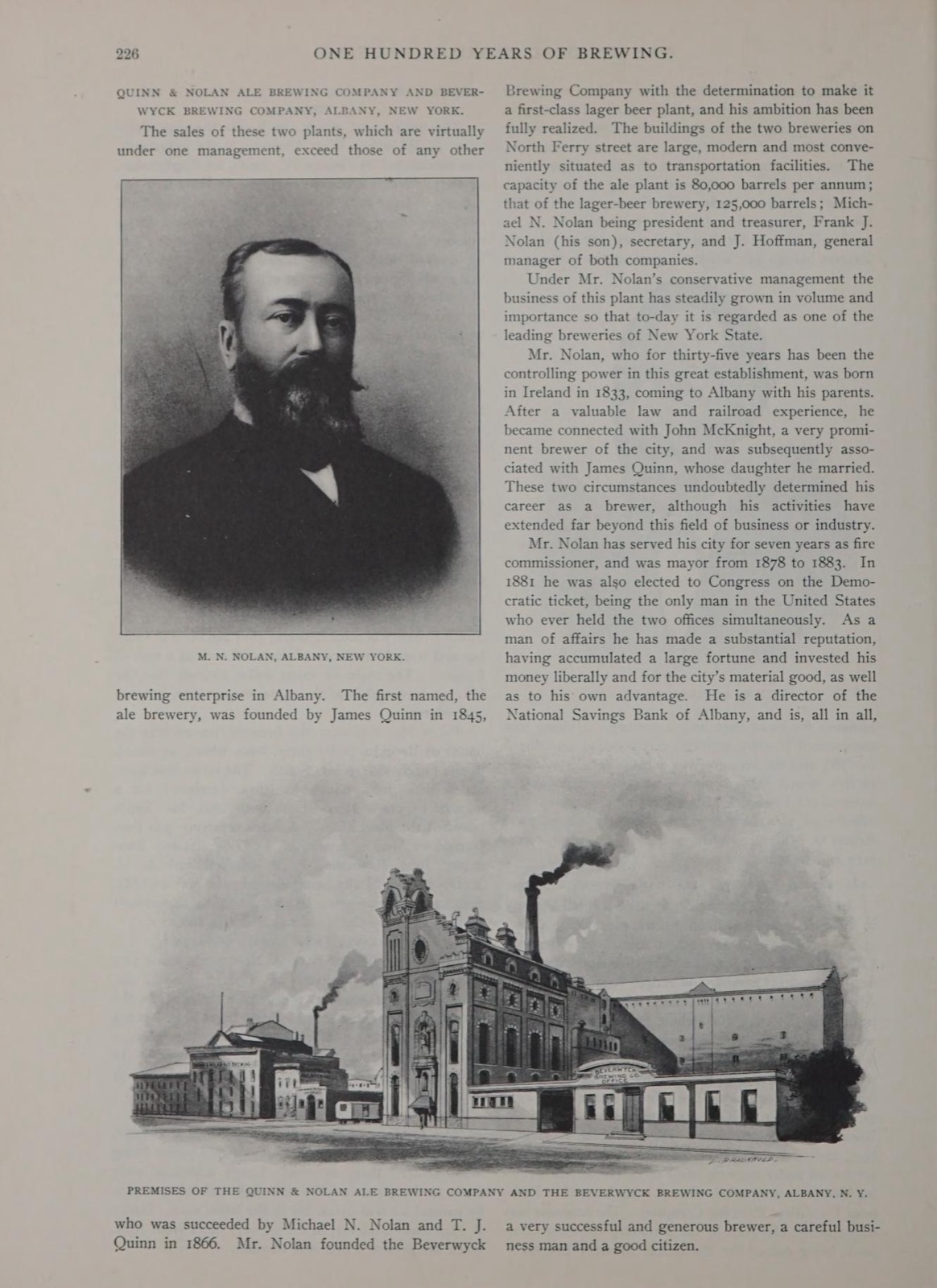
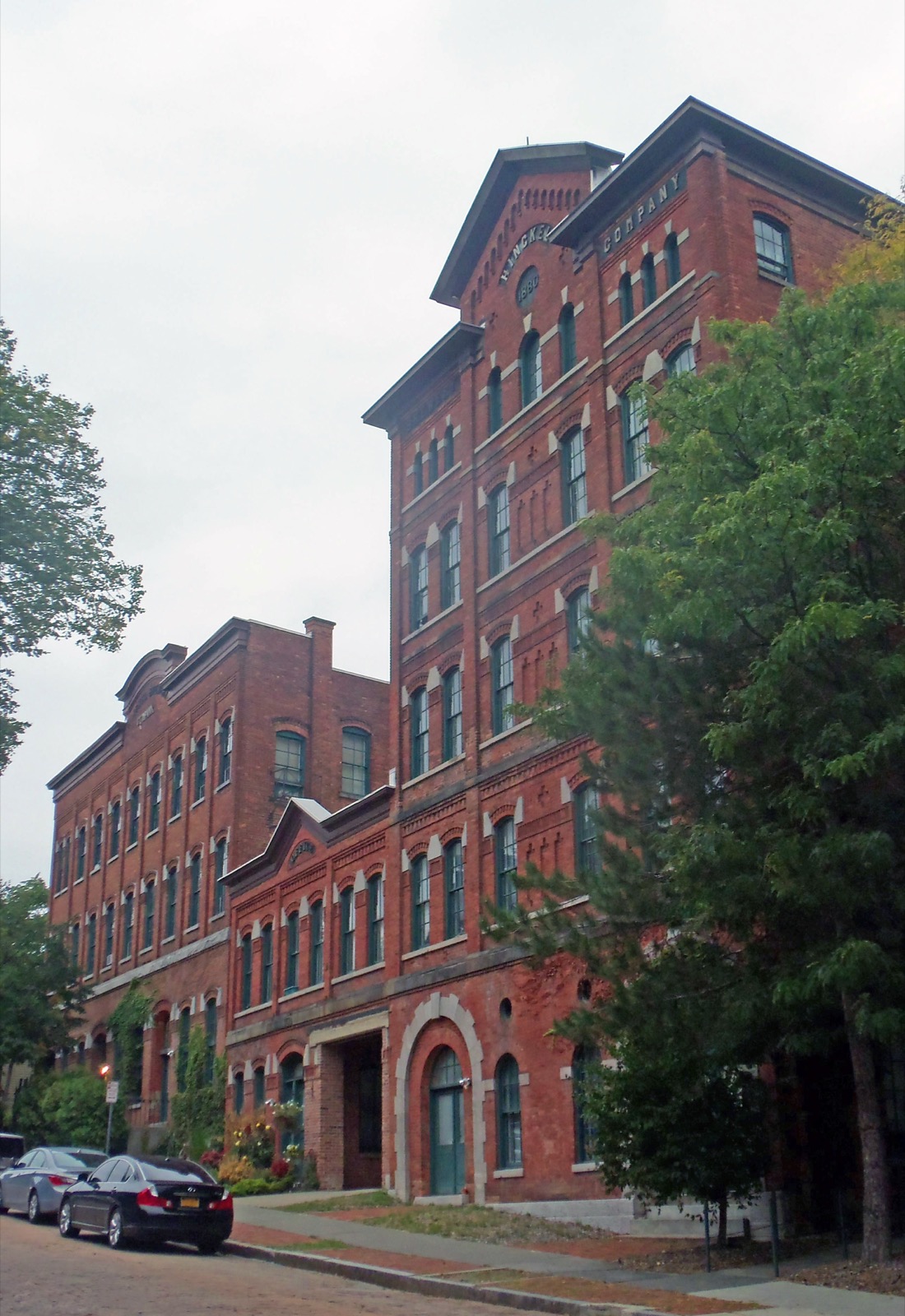
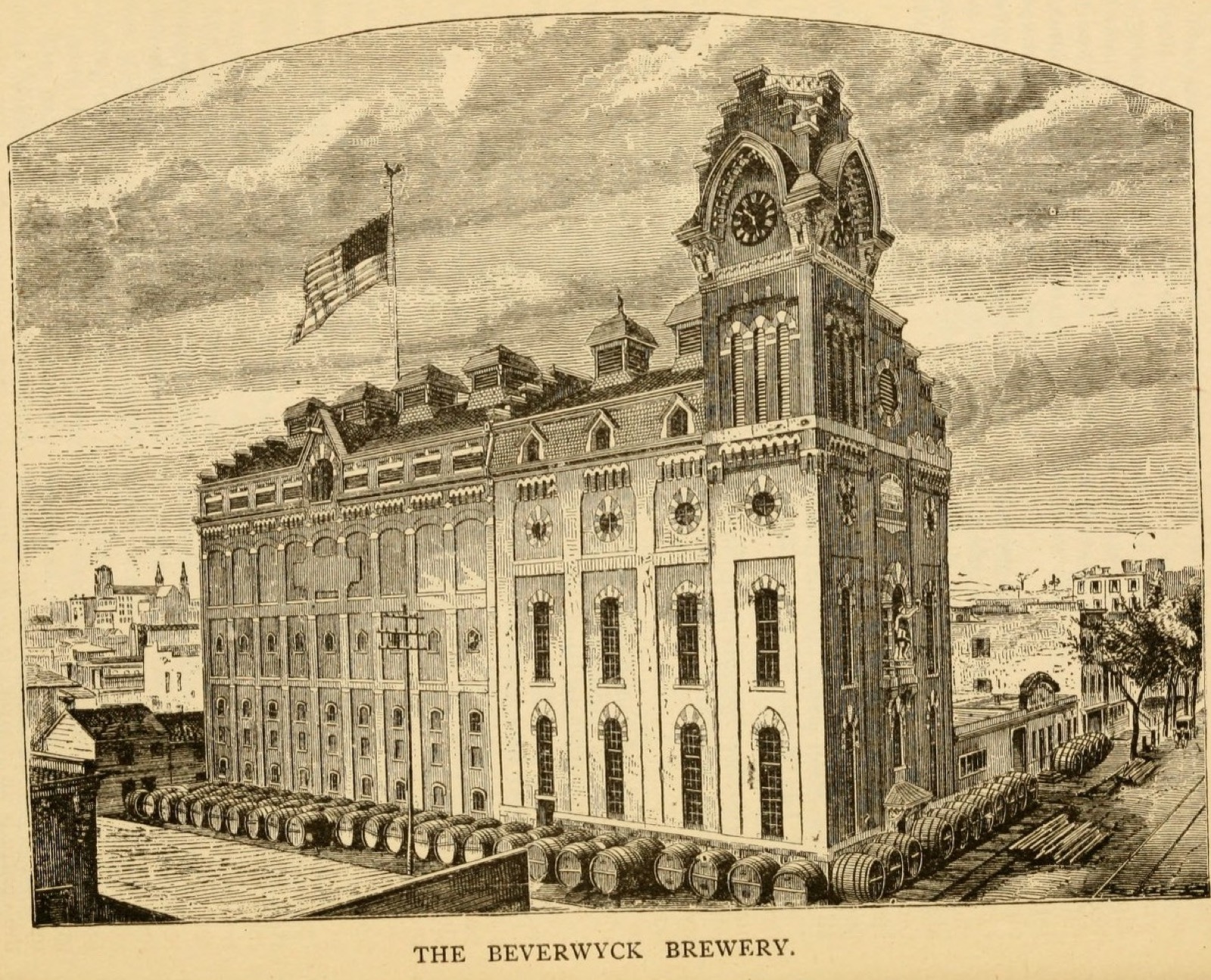
The big names left standing were lager houses: Michael Nolan's Beverwyck on North Ferry Street, with the old Quinn & Nolan ale brewery across the road; Hinckel's Cataract Brewery and Dobler, facing each other near Park Avenue and Swan Street; and Hedrick on Central Avenue. Solid5 All of them had spent forty years building cold cellars, ice houses and refrigerating machines to make lager. In the 1920s that cold would decide who survived. Inference
The long temperance campaign
Albany had argued about drink for most of a century before the country went dry. On 2 April 1829 a meeting "of citizens friendly to temperance" at the Capitol founded the New York State Temperance Society, with Reuben H. Walworth as president and the Albany merchant Edward C. Delavan among its founders. Solid67 When the British traveler J. S. Buckingham visited in 1838, he credited the general temperance of Albany's people to the society, "of which this has for many years past been the head-quarters." Solid6 The capital of the brewing trade was also the capital of the movement against it. Inference
In 1835 Delavan accused Albany maltsters of steeping barley in a pond full of dead animals. The brewers sued for libel, and in April 1840 they lost. Solid8 When New York passed its first prohibition law in 1855, Delavan's hotel, the Delavan House, was "brilliantly illuminated" to celebrate. Single source9 The law took effect on 4 July 1855, and two days later the keeper of the capital's leading hotel, William Landon, served two brandies to test it. An Albany jury acquitted him on 21 July, and the state's highest court struck the whole act down in March 1856. Solid10
Albany's Germans had been on the wet side from the start. In April 1854, days after Governor Seymour vetoed an earlier prohibition bill, opponents of temperance reform "call out the governor and he is addressed by the editor of the Freie Blatter," the German newspaper, "following which a serious riot ensues." Single source9 By the early 1900s that community was confident and public. Albany held its first German Day in September 1904, and the next year's parade ended with a picnic at Dobler Park, presumably a beer garden connected to the brewery, though no one has yet pinned down where it was. Single sourceInference
Did Albany County vote dry?
Before national Prohibition, New York let towns vote on whether to license liquor sales. A search-engine summary of an Altamont Enterprise history column says that in November 1915 six of seven Albany County towns that voted went wet and only Coeymans went dry. We could not open the article itself, so treat this as unverified. Nothing found suggests the City of Albany ever voted itself dry. Single source
The war on German Albany
Then came the First World War. Lager was a German drink, made mostly by German-born brewers and drunk in German halls, and once America entered the war all of that became suspect. In Albany, according to a history of the city's German-American club, most of the German societies "folded after succumbing to the intense anti-German propaganda and consequent actions." The Maennerchor, formed in September 1914 by merging two singing societies, came out "very diminished," and the club's own history says 1918 marked the end of German influence in Albany. Single source11
The brewery workers were in the middle of it. The Lager Beer Brewers Union No. 15, founded in 1887 at Eintracht Hall on South Pearl Street, was run by German-born officers, and in 1888 it was one of the five founding unions of Albany's Central Federation of Labor. Solid12 What happened to those men between 1917 and 1920 hasn't been traced.
The timing of one renaming is suggestive. In 1916 the Amsdell-Kirchner brewery dropped its German-sounding second name and became "Citizens'." It may have been a nod to the mood of the moment, but no document says so. Inference
Still missing
We have not found any Albany-specific record of the wartime brewing limits that came before national Prohibition, such as the 1917 grain restrictions or the 1918 War-Time Prohibition Act. Nor have we found any action against an Albany brewer as an "enemy alien." Some accounts end Amsdell's brewing in 1919 rather than 1920; wartime limits might explain that, but it's unconfirmed. Single source
Albany votes wet, New York votes dry
The decision to ratify national Prohibition was made in Albany's own Capitol, and Albany's legislators voted against it. On 23 January 1919, after a five-hour debate, the Assembly ratified the Eighteenth Amendment 81 to 66. The Republicans had made it a party caucus measure, and eleven of them broke ranks, among them Assemblymen Malone and Welsh of Albany. Solid1314
The Senate followed on 29 January, 27 to 24, "at the end of a nine hour session," making New York the 44th state to ratify. Senator Henry M. Sage of Albany was one of two Republicans who "bolted the caucus" and voted no. Solid15 Two days earlier, on a procedural vote, Sage had said he was "as much opposed to this Federal amendment as any man in this room," but believed "that no opposition could now be effective." Solid16 Governor Al Smith had wanted a referendum instead; The Sun's headline read "SMITH CALLS DRY ACTION DESPOTIC." Solid17
The winners came to town to celebrate. On 25 February 1919 the Anti-Saloon League held its state convention in Albany, where its superintendent, William H. Anderson, charged that German brewers "who were pro-German during the world war are now inciting to riot and rebellion and are willing to jeopardize the American nation in order to save beer." Solid18 The anti-German feeling of the war and the case against beer had become a single argument. Inference
"…willing to jeopardize the American nation in order to save beer."Anti-Saloon League convention, Albany, 25 Feb. 1919
1920: the taps shut
National Prohibition began in 1920. For Albany's breweries it ended any lawful trade in beer. The city's total went from about a third of a million barrels a year to none, with near-beer and soft drinks the only legal products. Solid5
Several old names closed for good:
- Hinckel's Cataract Brewery, Albany's first big German lager brewery, beside the Beaver Kill's falls, closed in 1920 and never brewed again. Solid1920 (One collector's page says it reopened after Repeal, but a caption on the same page says it didn't, and the other sources end it in 1920.) Disputed Its brewmaster of about twenty years, Ernst Uhlmann, died in April 1922 at 56. Single source
- Citizens' Brewing Corp., the last of Amsdell's ale brewery on Jay Street, closed in 1920. Single source3 With it went the last firm that had sold beer as "Albany Ale." Inference
- Quinn & Nolan, the ale brewery across North Ferry Street from Beverwyck, is listed through 1920. Its name turns up again in 1934, but it isn't clear it ever brewed again. Single source21
Three survived: Beverwyck, Dobler and Hedrick. All three were lager breweries. Solid522
How the survivors survived
Each of the three found a different legal product, and what we know about each comes from a single kind of source: collectors' registers and encyclopedia summaries, not company records.
- Beverwyck carried on as "Beverwyck Co. Inc." from 1920 to 1932 and held a license to make non-alcoholic drinks. Single source235 One brewery roster adds near beer and ginger ale, but we haven't confirmed exactly what it made. Single source
- Dobler, on the Swan, Elm and Myrtle block, switched to soda. Its refrigeration, built for lager, made the change possible. Single source22 A student local-history site adds that the cooling plant was turned to chilling food as well as soda, but that site has obvious errors elsewhere. Single source24
- Hedrick, on Central Avenue, sold "Hedro Cereal Beverage," the only product listed for it from 1920 to 1933. Single source25 Not everything coming out of Central Avenue was so innocent: in January 1921 federal agents sealed the plant for making real beer (see below). Solid A "cereal beverage" was legal near-beer: brewed like beer, with the alcohol kept under the federal limit or taken out. Inference
The pattern is hard to miss. The survivors were the plants with the most cold: refrigerating machines, insulated cellars and bottling lines. Those were exactly what soda, near-beer and cold storage needed. Ale breweries, built to ferment warm, had fewer ways to earn a living and most were gone before 1920 anyway. Nobody at the time wrote down that reasoning, so this is our reading of the evidence, not a documented fact. Inference
Pick a year to see what Albany's main breweries were doing before, during and after the dry years.
| Brewery | Where | Status |
|---|
Statuses come from the sources cited above. Quinn & Nolan's 1934 entry is a name in a listing, not proof of brewing. "De Luxe Brewery" is known only from one 1925 news item; where it was is unknown.
Ice, cars and bungs: what the empty plants became
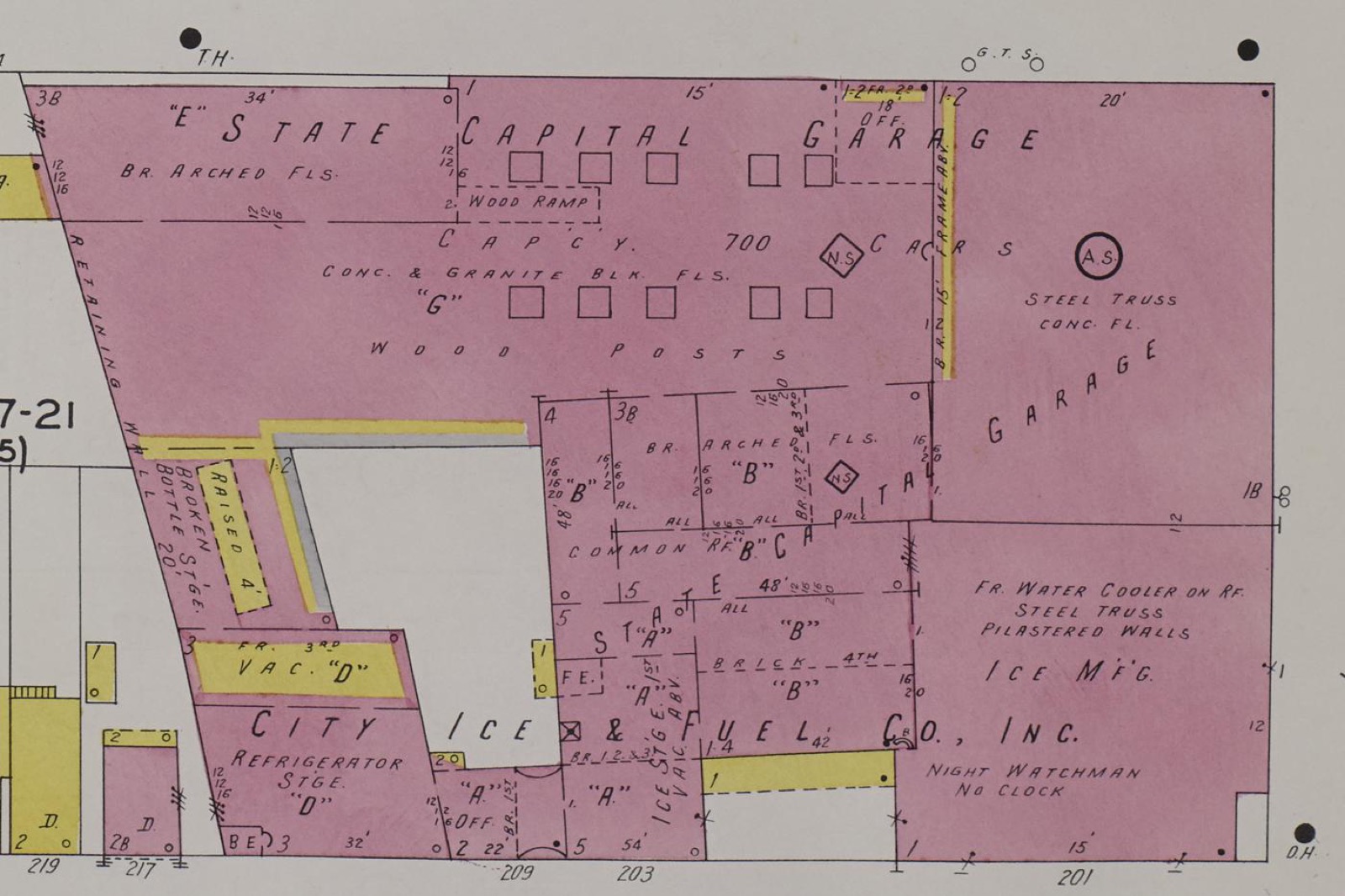
A closed brewery was still a large, solid, well-insulated building, and Albany found uses for them. By 1934 the old Hinckel brewhouse and cold-storage block at 201–209 Park Avenue held the City Ice & Fuel Co., labeled "Ice Mfg." on the fire-insurance map, and the State Capital Garage, with room for about 700 cars. Solid26 A building made to keep lager cold went on making ice. When that conversion happened between 1920 and 1934 is unknown. Single source
The trades that served the breweries had to adapt too. Stephen Kampf's shop at 186 Jefferson Street, which made malt shovels and wooden bungs for beer casks, was still listed in the 1923 city directory as a "bung and shovel mfr." Single source27 The 1934 map still shows a "Wood Bung Factory" for S. Kempf & Son. Solid26 There's an irony in that. Since the Civil War, the federal beer tax had been collected with a stamp "placed over the bunghole in such a manner that it has to be destroyed when the barrel is opened," as the brewery workers' historian Hermann Schlüter described it in 1910. Solid28 Every lawful keg's bung had doubled as a tax receipt; in the 1920s there were none. Inference Who was buying bungs in a dry decade, whether vinegar and cider makers, the near-beer breweries or someone less legal, is an open question. Inference
Speakeasies and the Canadian pipeline
Albany did not stop drinking. Much of what we know about its speakeasies comes from the novelist William Kennedy, who researched the period for his Albany books. The summary below is from a 2017 WMHT local-history article about his research, so it is secondhand. Single source29
- Named spots: Swifty Mead's, Big Charlie's in the South End, Mullen's, O'Malley's, and the Rain-Bo Room at the Kenmore Hotel on North Pearl Street. Single source
- The depot: Canadian liquor came into the city through a central distribution point, a garage near Lodge and Howard streets. Single source
- The result: Albany reportedly had more drunk-driving arrests than anywhere else in New York except New York City. Single source
Albany sat on the road from Montreal to Manhattan, so Canadian liquor passing through it makes geographic sense. Inference But we have not yet found police records, court cases or newspaper reports confirming the Lodge and Howard depot. Until then it is Kennedy's account, relayed by WMHT.
The breweries raided
The legal near-beer plants were not always making near-beer. In January 1921, a year into Prohibition, an Albany dispatch reported: "Federal agents have seized the Hedrick brewing plant in this city for alleged making of beer containing more than one-half of 1 per cent. alcohol. No arrests were made but the plant was sealed up and operations will be suspended until the case is disposed of." Solid30 How the case ended, and when Hedrick reopened, hasn't been found. Single source
Four years later, an Associated Press roundup reported that "the De Luxe Brewery in Albany, N. Y., was raided last night and $10,000 worth of beer seized." Single source31 No "De Luxe Brewery" appears in any Albany brewery list. It may have been a Prohibition-era name for one of the old plants, or an outlaw brewery somewhere else in the city; a 1920s city directory should tell. Inference
No raid has turned up at Beverwyck or Dobler. The Museum of Political Corruption calls Hedrick "originally a bootlegging operation" without giving evidence; the 1921 seizure is the nearest thing to support for it so far. Single source32
A death on Madison Avenue
Enforcement in Albany could be deadly. On 13 July 1928, federal Prohibition agent Irving Washburn died after being shot during a raid on a drink parlor on Madison Avenue. Single source33 The people charged were reportedly acquitted. Single source
That is nearly all we can say. The Officer Down Memorial Page lists him, but its full text did not load for our research, and the details above come from search excerpts of that page and of the federal ATF's memorial listing. We don't yet know the address, the names of the accused, or whether the shooter was ever identified. Single source
Legs Diamond comes to Albany
The most famous bootlegger in the upper Hudson was Jack "Legs" Diamond, whose beer and liquor business ran through the Catskills. In 1930 he and two of his men kidnapped a truck driver, Grover Parks, in Cairo, Greene County, over a load of hard cider, and beat and tortured him. Solid34
In April 1931 Diamond was shot three times at the Aratoga Inn, near Cairo; the New York Times reported it on 27 April. A local man drove him to an Albany hospital, where he reportedly told the surgeon that the bullet that could kill him hadn't been made yet. SolidSingle source On 1 May 1931 State Police seized more than $5,000 of beer and alcohol at Cairo and the Aratoga Inn, and that August he was convicted of bootlegging and sentenced to four years. Solid34
Albany was where he went for care and for a good time, and where his story ended.
Dove Street, 18 December 1931
The last night
On 17 December 1931 a jury in Troy acquitted Diamond. He celebrated in Albany. From about 1 a.m. he was at the Rain-Bo Room of the Kenmore Hotel on North Pearl Street, with Marion "Kiki" Roberts. Solid34 At about 4:30 a.m. he went back, drunk, to a rooming house at 67 Dove Street. About an hour later two men came in. One held him down; the other shot him three times in the back of the head. He was 34. Solid
The rowhouse still stands. It contributes to the Center Square/Hudson–Park Historic District, though that district's Wikipedia article misdates the killing to 12 December. Solid35 It later belonged to William Kennedy himself. Single source29 From the old Hinckel and Dobler breweries it's a walk of a few blocks. Approximate
Who killed Legs Diamond? The O'Connell claim, unproven
Officially, the murder is unsolved. Solid34
The best-known theory is William Kennedy's. In a 1974 interview, Dan O'Connell, the boss of Albany's political machine, told Kennedy that he had warned Diamond he would not be allowed to do business in Albany, and that police Sergeant William Fitzpatrick, who had been in the room with Diamond, had finished him off. Kennedy published this in O Albany! (1983). Single source Fitzpatrick later became Albany's chief of police, a promotion that is said to have been his reward. Single source In 1945 he was shot dead in his office by a detective, John McElveney. Solid The Times Union's Paul Grondahl also suspects O'Connell. Single source36
Other theories name Dutch Schultz, or partners he had double-crossed. Single source
What this rests on: one old man's remark to a novelist, more than forty years after the event, reported secondhand. No police file, court record or confession supports it. It may be true; it may be a boss enjoying his own legend. It belongs here as a claim, not a fact. Disputed
Whoever pulled the trigger, the story points ahead to the next chapter. If O'Connell meant what he told Kennedy, the machine did not want an outsider selling beer in its city, and within two years beer would be legal again and the machine would have a brewery of its own. Inference
Beer is back: 7 April 1933
Repeal came in two steps. On 22 March 1933 the federal government signed into law the Cullen–Harrison Act, which allowed beer of up to 3.2% alcohol by weight from 7 April 1933 in states that passed their own enabling laws. Solid37 In New York, Governor Herbert Lehman had already asked the Legislature on 4 January to prepare the machinery for licensing beer, according to a search summary of a Brooklyn Eagle report we could not read in full. Single source
What we haven't found
No Albany account of that night has been found yet. TIME reported that summer that Hedrick's legal operation began on 7 April, and in December 1932 Dobler's manager, H. J. McKeon, had told the United Press the brewers had made no distribution plans yet. Single source3839 Beyond that we don't know whether crowds gathered on North Ferry Street, which Albany brewery shipped first, or what the papers said. The Knickerbocker Press, Times-Union and Evening News for March and April 1933 should answer it, but the newspaper archives were blocked during our research. If you know of a photograph or an account, we'd like to hear from you.
What we do know is who came back:
- Beverwyck reopened in 1933 as Beverwyck Breweries Inc., now making ale and porter alongside lager, under the slogan "Beverwyck, Best Beer Brewed." Single source235
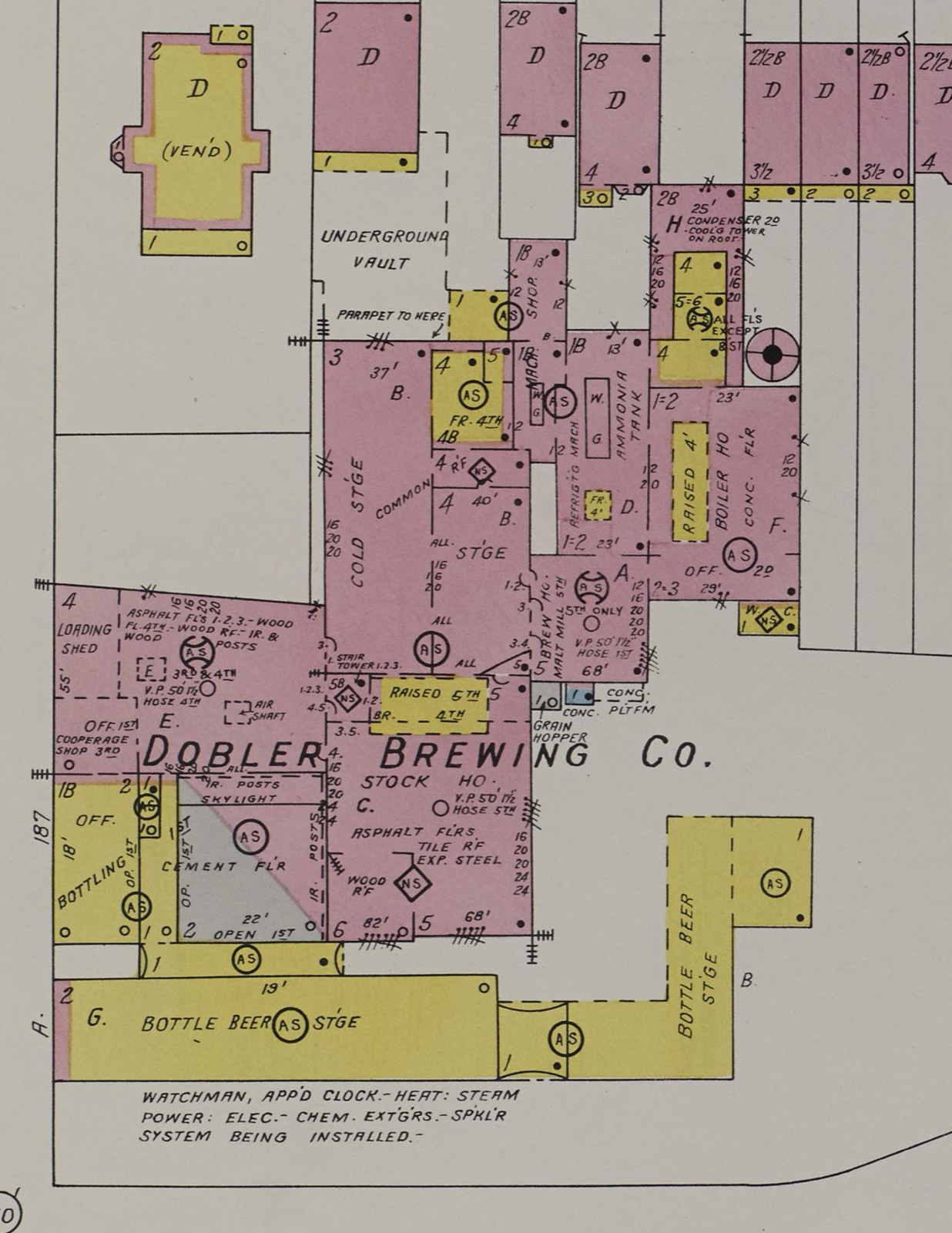
- Dobler resumed brewing, and by 1934 its plant at 187 South Swan Street had ammonia refrigeration, bottling, bottled-beer storage and its own cooperage, with a sprinkler system being installed. Solid26
- Hedrick reopened in 1933 as Hedrick Brewing Co., Inc. Single source25 John Oliver, whose father distributed Hedrick's, writes that from December 1933 his "Uncle Joe Kennah," a favorite of Dan O'Connell, had the right to sell Hedrick's to bars and restaurants in Albany County. Oral history40
By then Hedrick was the machine's brewery. In July 1933 the boss's 24-year-old nephew, John J. "Butch" O'Connell Jr., was kidnapped, and his captors demanded $250,000. Reporting the case, TIME said Butch had run beer distribution for the Hedrick brewery, which his uncles Dan and Ed O'Connell partly owned, and that Hedrick's legal beer had helped put Albany's beer runners out of business, a possible motive. Single source38 So the O'Connells held a stake in Hedrick by July 1933, within about three months of legal beer. Exactly when and how they bought in, and which brother held the shares, is still not established. Single source
Hinckel, Amsdell, Taylor and the Quinn & Nolan ale brewery stayed shut. Albany came out of the dry years with three breweries, all lager houses, and the city that had once sent "Albany Ale" around the world no longer had anyone brewing under that name. Solid
The machine's beer, the brewery that wouldn't fall down, and the long road to Albany's last closing are the story of the next chapter.
Sources for this page
- Whish, Albany Guide Book (1917), p. 39 archive.org
- Tavern Trove: Taylor Brewing & Malting www.taverntrove.com
- Brookston Beer Bulletin: George I. Amsdell brookstonbeerbulletin.com
- Gravina, "The Brothers Amsdell," drinkdrank (2013) web.archive.org
- Wikipedia: Beverwyck Brewery en.wikipedia.org
- Munsell, Annals of Albany vol. 9 archive.org
- NYS Museum: Edward C. Delavan exhibitions.nysm.nysed.gov
- Report of the trial, Taylor v. Delavan (1840) archive.org
- Reynolds, Albany Chronicles (1906) archive.org
- Historical Society of the New York Courts: People v. Landon history.nycourts.gov
- Finding Your Past: Brief history of the German-American Club findingyourpast.blogspot.com
- Illustrated History of the Central Federation of Labor (1898) archive.org
- New-York Tribune, 24 Jan. 1919 www.loc.gov
- The Sun, 24 Jan. 1919 www.loc.gov
- The Sun, 30 Jan. 1919 www.loc.gov
- New-York Tribune, 28 Jan. 1919 www.loc.gov
- The Sun, 31 Jan. 1919 www.loc.gov
- The Sun, 26 Feb. 1919 www.loc.gov
- Tavern Trove: Schinnerer & Hinckel www.taverntrove.com
- trayman.net: Hinckel trayman.net
- Tavern Trove: Quinn & Nolan www.taverntrove.com
- Wikipedia: Dobler Brewing Company en.wikipedia.org
- OldBreweries: Beverwyck www.oldbreweries.com
- Albany Walks for Health (archived) web.archive.org
- Tavern Trove: Hedrick www.taverntrove.com
- Sanborn, Insurance Maps of Albany, vol. 1 (1934) www.loc.gov
- Albany Directory (1923), seen as search snippets archive.org
- Schlüter, The Brewing Industry and the Brewery Workers' Movement in America (1910) archive.org
- WMHT, "Albany's underbelly during Prohibition" (2017) www.wmht.org
- Evening World, 14 Jan. 1921 www.loc.gov
- Evening Star (Washington), 19 May 1925 www.loc.gov
- Museum of Political Corruption museumofpoliticalcorruption.org
- Officer Down Memorial Page: Irving Washburn www.odmp.org
- Wikipedia: Legs Diamond (citing the NYT, Grondahl and Kennedy) en.wikipedia.org
- Wikipedia: Center Square/Hudson–Park Historic District en.wikipedia.org
- Wikipedia: Daniel P. O'Connell en.wikipedia.org
- Wikipedia: Cullen–Harrison Act en.wikipedia.org
- TIME, 24 July 1933 time.com
- Indianapolis Times, 6 Dec. 1932 www.loc.gov
- John Oliver, "Still the Best," louchelife (Substack, 2023) louchelife.substack.com